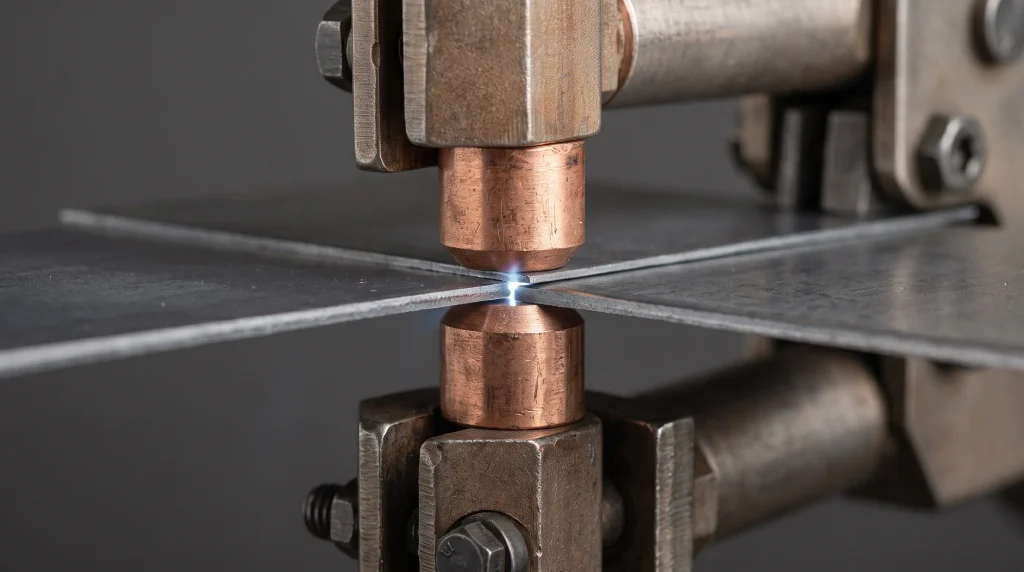
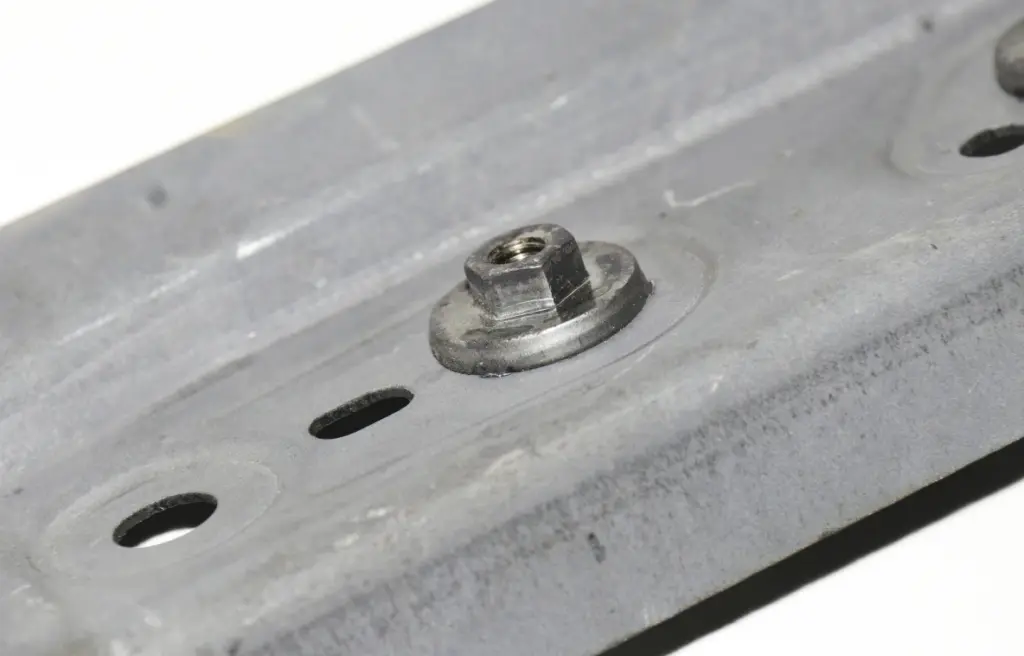
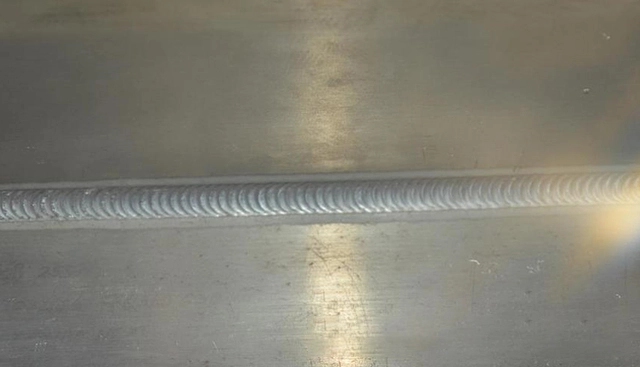
Aluminium doesn’t weld like steel — and if your production line is still running steel-tuned parameters on aluminium parts, you already know the symptoms: expulsion, inconsistent nugget size, surface pitting, or welds that look fine and fail anyway. Aluminium spot welding is a different discipline, and the machine you choose has more influence over your outcome than almost any other variable in the process.
This guide walks through why aluminium behaves the way it does under resistance welding, the defects that show up when the process isn’t dialed in, and what separates a machine that struggles with aluminium from one that’s actually built for it. If you’re an OEM engineer or production decision-maker evaluating equipment, this should give you a clear, practical framework — not a sales pitch dressed up as advice.

Why Aluminium Spot Welding Is Harder Than It Looks
Steel is forgiving. Aluminium is not. Two properties explain most of the difficulty aluminium spot welding.
The Oxide Layer Problem
Aluminium forms a thin, hard aluminium oxide layer almost instantly on exposure to air. This layer is highly resistant electrically and inconsistent in thickness across a sheet — which means the very first thing your weld current encounters is an unpredictable barrier. Break through it unevenly, and you get inconsistent nugget formation before the “real” weld has even started.
High Conductivity Means Fast, Unforgiving Cycles
Aluminium conducts both heat and electricity far more readily than steel. That sounds like an advantage, but in practice it means the weld window — the range between “not enough heat” and “too much heat, causing expulsion” — is much narrower and closes much faster. A welding machine with slow current rise or imprecise control simply doesn’t have the response time aluminium demands.
Put together, these two properties mean aluminium spot welding isn’t just “spot welding with different settings.” It requires equipment engineered for fast, precise, repeatable current delivery.
Common Aluminium Spot Welding Defects (and What Causes Them)
Most quality issues on lines of aluminium spot welding trace back to one of a few root causes:
- Metal expulsion — usually caused by excessive current or force applied too slowly, often the result of AC power supplies with a sinusoidal current curve that overshoots before it can correct.
- Inconsistent nugget size — typically linked to oxide layer variation combined with electrode force that isn’t reacting fast enough to surface conditions.
- Electrode sticking and pickup — aluminium’s low melting point relative to copper electrodes means poor cooling or excessive dwell time causes material transfer onto the electrode face, degrading every subsequent weld.
- Surface marking — often a force or electrode geometry issue rather than a current issue, but still traced back to inadequate control precision.
None of these are “aluminium being difficult for no reason” — they’re predictable outcomes of a process running outside its narrow tolerance window. The fix is almost always tighter control of current, force, and timing, not more welding experience alone.

MFDC vs AC: Which Machine Type Actually Works for Aluminium
This is the decision point most OEM teams eventually reach, and it’s worth being direct about it.
AC spot welders operate at mains frequency with a sinusoidal current waveform. They’re proven, cost-effective, and perfectly capable on steel and many standard materials. On aluminium, that sinusoidal curve becomes a liability — the current rises and falls in a shape that’s hard to match to aluminium’s narrow weld window, which is why AC-welded aluminium often shows more variation in nugget quality.
MFDC (Medium Frequency Direct Current) welders operate at 1,000–4,000 Hz and output a stable, near-flat DC current. That translates directly into faster, more controllable current rise and a heat input that can be shaped precisely to aluminium’s requirements. This is why MFDC has become the practical standard for aluminium resistance spot welding in automotive, aerospace-adjacent, and appliance production — not because it’s newer, but because its current profile actually matches what aluminium needs.
For OEM lines running mixed materials — some steel, some aluminium — MFDC also removes the need to compromise settings between the two, since its control resolution comfortably covers both.
What to Look for in an Aluminium Spot Welding Machine
If you’re specifying or replacing equipment, these four factors matter more than headline KVA numbers.
Current Control and Rise Time
Ask specifically about current rise time and control resolution, not just maximum output. A machine that reaches high current slowly will produce inconsistent aluminium welds regardless of its power rating.
Electrode Force and Follow-Up
Aluminium welding depends on electrode force responding in real time as the material softens. Servo-driven force control with fast follow-up response outperforms static pneumatic force on aluminium applications.
Cooling and Duty Cycle
Because aluminium’s weld window is narrow and cycles run fast, sustained production puts real thermal load on electrodes and transformers. Forced water-cooled circulation isn’t optional at OEM production volumes — it’s what keeps weld quality stable across a full shift rather than just the first hour.
Process Monitoring
For safety-relevant or structural aluminium joints — automotive body panels, battery enclosures, structural brackets — being able to capture current, force, and weld data per cycle matters for traceability and quality assurance, not just troubleshooting.

Where Aluminium Spot Welding Is Used in OEM Production
Aluminium’s weight advantage keeps expanding its role across manufacturing:
- Automotive — body panels, battery enclosures, and structural components where weight reduction directly supports efficiency and range targets.
- Appliance manufacturing — aluminium housings and panels where finish quality matters alongside joint strength.
- Electrical and electronics — busbars and enclosures where conductivity and weight both factor into material choice.
- Industrial equipment — lightweight structural assemblies where aluminium replaces steel without sacrificing strength.
Each of these applications shares the same underlying requirement: a welding process that’s controllable enough to be repeatable at volume.
How Heron-Welder Supports Aluminium Spot Welding Lines
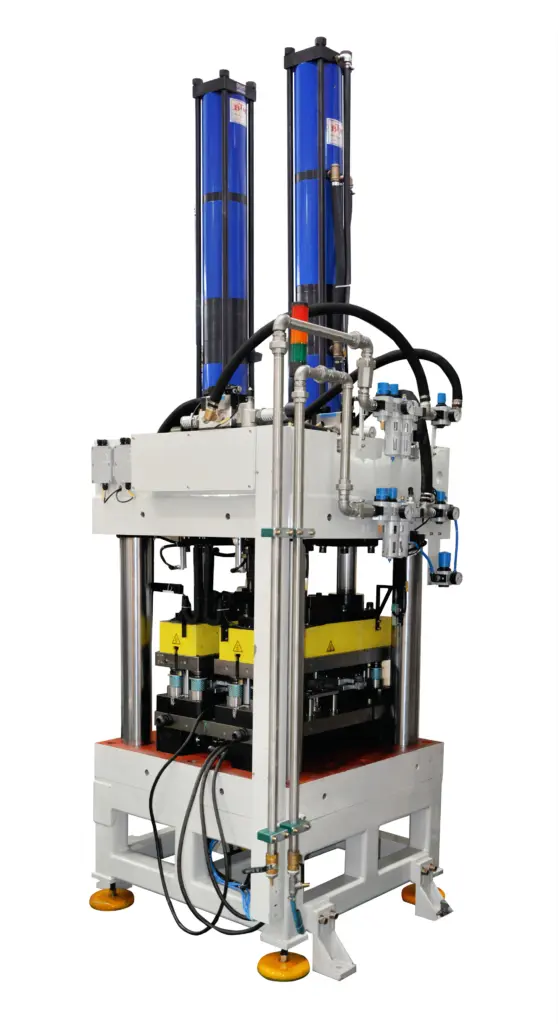
Heron-Welder designs MFDC and AC resistance welding equipment for OEM production across automotive, appliance, electrical, and industrial sectors, with control systems built around the current precision that aluminium spot welding requires. Heron’s MFDC platforms are engineered with fast current rise, real-time force control, and forced water-cooling for sustained high-duty-cycle operation — the specific combination that addresses the defect causes outlined above, rather than treating aluminium as an afterthought on a steel-oriented machine.
For teams weighing MFDC against AC, or trying to solve a specific defect pattern on an existing line, Heron’s engineering team works directly with production data — current, force, and cycle information — to recommend a configuration suited to your actual material mix and volume, rather than a one-size-fits-all machine spec.
FAQs
Q1. Why does aluminium spot welding need different settings than steel?
Aluminium has higher electrical and thermal conductivity than steel, plus a resistive oxide layer on its surface. Both properties narrow the usable weld window and require faster, more precise current control than typical steel settings provide.
Q2. Can AC spot welders be used for aluminium at all?
Yes, on some standard-gauge applications AC machines can produce acceptable aluminium welds. However, most OEM lines producing aluminium components at volume find MFDC delivers more consistent nugget quality due to its stable DC output and faster current control.
Q3. What causes expulsion in aluminium spot welding?
Expulsion is typically caused by current levels or rise rates that exceed aluminium’s narrow weld window, often combined with electrode force that isn’t responding quickly enough to the material as it softens.
Q4. How often do electrodes need maintenance on aluminium welding lines?
Aluminium tends to cause faster electrode wear and pickup than steel due to its lower melting point relative to copper. Maintenance intervals should be set based on observed nugget consistency rather than a fixed schedule, and adequate cooling significantly extends electrode life.
Q5. Is MFDC worth the higher upfront cost compared to AC for aluminium spot welding?
For production lines where aluminium volume and quality requirements are significant, MFDC’s improved consistency, reduced rework, and lower energy consumption at equivalent output typically offset the higher initial investment over the equipment’s service life.
Q6. What industries use aluminium spot welding most heavily?
Automotive (body panels, battery enclosures), appliance manufacturing, electrical/electronics (busbars, enclosures), and industrial equipment are the primary sectors, driven largely by aluminium’s weight-to-strength advantages.
Final Thoughts — Getting Aluminium Welds Right the First Time
Aluminium spot welding rewards precision and punishes guesswork. The defects that frustrate production teams — expulsion, inconsistent nuggets, electrode pickup — aren’t random; they’re the predictable result of equipment that isn’t matched to aluminium’s narrow, fast-moving weld window. Getting it right comes down to current control, responsive electrode force, real cooling capacity, and the ability to monitor what’s actually happening at the weld.
If your team is scaling aluminium production or troubleshooting an existing line, it’s worth reviewing your current setup against these fundamentals before assuming the problem is operator error. Request your aluminium welding assessment from Heron-Welder’s engineering team and get a configuration recommendation based on your actual production requirements.