Best Industrial Welding Machine for Factory Production is not just a keyword; it reflects a real decision that affects product quality, production stability, and long-term manufacturing efficiency. In high-volume industrial environments, welding machines must deliver consistent weld strength, precise current control, repeatable performance, and reliable uptime.
Engineers focus on welding stability, process accuracy, and integration with automated systems, while purchasing teams evaluate lifecycle cost, supplier capability, maintenance support, and long-term return on investment. Choosing the wrong system results in production downtime, increased defects, and higher operational costs. Choosing the right system supports quality consistency, faster production cycles, safer operations, and measurable cost efficiency.
That is why modern factories in automotive, appliance manufacturing, metal fabrication, compressors, and electronics increasingly rely on resistance welding machines, MFDC systems, and intelligent automated welding solutions to maintain competitive manufacturing performance.
Best Industrial Welding Machine for Factory Production: What Engineers and Purchasing Teams Need to Know
Factory production environments demand welding machines that deliver consistent product quality, stable welding current, process repeatability, integration capability, and long-term reliability. The best industrial welding machines for factory production are typically resistance welding systems, including spot welding, projection welding, MFDC welding, capacitor discharge welding, and automated welding systems, because they support high-volume manufacturing, stable heat control, lower operating cost, and reduced maintenance compared to many fusion welding processes.
Engineers should primarily evaluate:
-
welding stability
-
material compatibility
-
production speed
-
automation readiness
-
quality monitoring capability
Purchasing teams should evaluate:
-
lifecycle cost instead of only equipment price
-
after-sales support and spare supply
-
energy efficiency
-
manufacturer experience and system integration ability
Modern factories in automotive, appliance manufacturing, electronics, compressor production, and metal fabrication rely heavily on resistance welding solutions to achieve higher productivity, cost efficiency, and quality stability.
Why Choosing the Right Industrial Welding Machine Matters
Selecting the best industrial welding machine for factory production is not simply a procurement decision; it is a strategic manufacturing decision. Welding quality directly affects:
-
product structural integrity
-
production line uptime
-
defect rate
-
energy consumption
-
long-term maintenance burden
Factories today operate under pressure to deliver consistent quality, comply with industry standards, and maintain competitive production costs. A poorly selected welding machine can lead to unstable welds, frequent downtime, slow production cycles, and higher repair costs. A well-matched industrial welding system supports higher throughput, stable performance, and predictable production planning.
Understanding Industrial Welding Machines for Factory Production
Not every welding machine is suitable for factory-scale production. Industrial factories require machines designed for:
-
continuous operation
-
high duty cycle
-
repeatable process control
-
integration with semi-automation or automation systems
-
stable heat and current consistency
Industrial welding equipment is engineered differently from workshop or DIY welding tools. These machines emphasize:
-
stronger mechanical structure
-
robust transformers / MFDC inverters
-
advanced control systems
-
long lifecycle reliability
-
production monitoring capability
This is why terms like best industrial welding machine for factory production, and heavy-duty welding equipment are important LSI elements when planning SEO content and technical positioning.

Types of Welding Machines Used in Modern Factories
Different industries require different welding technologies. The most commonly used welding machines in factories include:
Resistance Spot Welding Machines
Widely used in:
-
automotive sheet metal
-
appliance panels
-
metal enclosures
They offer:
-
fast joining capability
-
dependable strength for sheet metal
-
stable process control
Projection Welding Machines
Used when:
-
nuts, bolts, fasteners, and components are joined
-
thicker weld spots are required
-
high positioning accuracy matters
Their biggest benefit is the ability to produce consistent, repeatable weld nuggets in high-volume applications.
MFDC Welding Machines (Medium Frequency Direct Current)
MFDC welding machines are preferred for many modern manufacturing plants because they:
-
offer excellent current control
-
reduce heat distortion
-
support faster welding cycles
-
improve electrical efficiency
They are used in:
-
automotive part assembly
-
electrical component manufacturing
-
compressor manufacturing
-
structural metal joining
Capacitor Discharge Welding Machines
These are suitable for:
-
thin metals
-
precision parts
-
electrical contact welding
They deliver a very short, controlled high-energy weld, minimizing heat impact.
Automated Welding Systems for Factories
Many factories now integrate welding into:
-
robotic systems
-
automated production cells
-
conveyor production lines
Automation:
-
increases output
-
decreases human variability
-
supports intelligent quality control
For high-production enterprises, automation-ready welding machines are becoming the standard expectation rather than an optional upgrade.
Why Resistance Welding Is the Best Choice for High-Volume Factory Production
Resistance welding remains one of the most trusted best industrial welding machine for factory production for practical reasons:
Stable Welding Quality
Heat is generated internally by electrical resistance. With advanced controllers, weld consistency remains stable across thousands or millions of cycles.
High Productivity
Cycle times are short. Operators or automated systems can weld components rapidly without extensive post-processing.
Energy Efficiency
Compared to some fusion welding processes, resistance welding:
-
requires no filler
-
minimizes waste
-
reduces overall energy usage in continuous production environments
Lower Maintenance Complexity
Well-designed resistance welders require routine mechanical maintenance but do not require consumable filler wire or shielding gas typically associated with other processes.
Safety and Workplace Efficiency
The controlled heat and localized weld area reduce risk and environmental stress.
For industries like automotive, appliances, electronics, and metal product manufacturing, resistance welding has proven to be reliable, predictable, and scalable.
Key Features Engineers Should Look for
Engineers must ensure the welding machine supports technical and production requirements. Key evaluation points include:
Welding Stability & Current Control
An industrial welding machine must deliver:
-
consistent current
-
predictable heat input
-
repeatable weld quality
Advanced control systems such as MFDC controllers improve precision.
Material Compatibility
Engineers should ensure the machine supports:
-
steel
-
stainless steel
-
coated steel
-
aluminum (where applicable)
Different materials react differently to heat and current; the system must support correct parameter tuning.
Automation Integration Capability
Modern factories depend on future expansion. Welding machines should allow connection to:
-
PLC systems
-
robots
-
intelligent manufacturing execution platforms
This future-proofs the production process.
Quality Monitoring & Data Recording
In many industries, traceability is essential. Machines equipped with:
-
data recording
-
quality monitoring
-
real-time parameter display
support better process control, quality audits, and defect prevention.
Mechanical and Structural Strength
Machines must withstand:
-
continuous production load
-
pressure requirements
-
vibration and stress
This prevents misalignment and performance drift.
What Purchasing Teams Should Evaluate
Procurement is responsible for long-term value, not only equipment price. Important considerations include:
Total Cost of Ownership
This includes:
-
purchase price
-
installation cost
-
operation cost
-
energy consumption
-
maintenance expense
-
spare part availability
A machine with a slightly higher upfront price may deliver significantly better lifecycle economics.
After-Sales Support & Spare Parts Availability
Factories cannot afford long downtime. Good suppliers provide:
-
fast technical support
-
training
-
readily available spare components
-
long-term service capability
Customization Capability
Every factory has different fixture requirements, cycle expectations, and product structures. A capable supplier offers engineering customization rather than only standard machines.
Proven Industry Experience
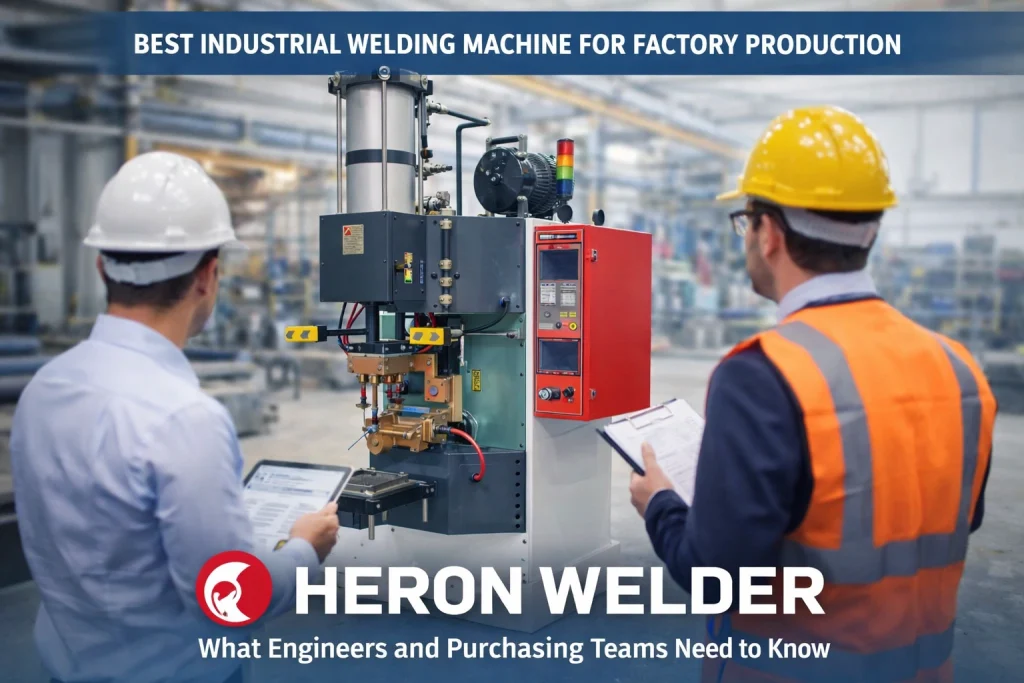
A supplier with industrial references demonstrates system knowledge, technology maturity, and implementation reliability. When relevant, this is where a brand like Heron Welder fits naturally—particularly in resistance welding, MFDC systems, and automated welding integration.
Applications Where the best industrial welding machine for factory production Deliver Results
Automotive Manufacturing
Used for:
-
body structures
-
brackets
-
chassis components
-
seat structures
Resistance welding supports high-speed body assembly and structural joining.
Home Appliance Manufacturing
Used for:
-
washing machine drums
-
refrigerator components
-
air conditioner frames
-
microwave enclosures
Factories depend on stable welding quality to maintain product reliability.
Compressor & Motor Manufacturing
Precise welding helps ensure reliability in:
-
HVAC compressors
-
motor housings
-
mechanical support parts
Electronics & Electrical Component Manufacturing
Applied in:
-
terminals
-
contact welding
-
component assembly
High precision and controlled heat are essential.
Metal Fabrication & General Manufacturing
Factories producing:
-
furniture hardware
-
sheet metal products
-
structural assemblies
benefit from fast welding cycles and predictable performance.
Productivity, Cost Efficiency & ROI
Factories evaluate welding systems not only for technical capability but also impact on:
Production Efficiency
Faster welding cycles increase throughput.
Defect Reduction
Stable current reduces rework and rejects.
Energy Consumption
Efficient systems lower costs in long-term operation.
Maintenance Downtime
Reliable machines reduce unexpected stoppages.
When these elements combine, a suitable industrial welding machine provides a strong ROI through efficiency, quality stability, and lifecycle durability.
Automation & Intelligent Welding Systems
Modern factories are adopting automation and Industry 4.0 strategies. Welding machines now integrate:
-
programmable logic control
-
real-time monitoring
-
automatic parameter adjustment
-
smart detection
Automation improves:
-
production stability
-
labor efficiency
-
traceability
-
consistency
This is where professional industrial welding solution providers stand out — delivering not only machines but complete welding systems.
Why Leading Manufacturers Prefer Professional Welding Equipment Suppliers
Factories partnering with professional industrial welding suppliers benefit from:
-
engineering consultation
-
process design support
-
application matching
-
system integration guidance
-
reliable production lifecycle partnerships
A knowledgeable supplier understands factory requirements, production goals, and technical constraints rather than merely selling a machine. When appropriate and contextually suitable, a brand like Heron Welder fits naturally into such discussions as a global welding solution provider with experience in resistance welding equipment, MFDC welding systems, and automated welding applications.
FAQs About Best Industrial Welding Machine for Factory Production
1. What is the best industrial welding machine for factory production?
The best welding machine depends on production volume, material type, and application. For most factories, resistance welding machines (spot, projection, MFDC) offer the best balance of speed, stability, cost efficiency, and automation capability.
2. Why is resistance welding preferred in high-volume manufacturing?
Resistance welding delivers fast cycle times, strong structural joints, stable heat input, and lower operating costs, making it ideal for automotive, appliance, compressor, and metal fabrication industries.
3. What industries use industrial resistance welding machines?
They are widely used in:
-
automotive manufacturing
-
home appliance production
-
electronics and electrical components
-
compressor and motor manufacturing
-
metal fabrication and industrial assembly
4. What factors should engineers consider when selecting a welding machine?
Engineers should evaluate welding stability, current control, material compatibility, automation readiness, heat management, structural strength, and quality monitoring capability.
5. What should purchasing teams look for when buying an industrial welding machine?
Focus on total cost of ownership, not just price. Evaluate:
-
machine reliability
-
spare parts availability
-
after-sales support
-
energy efficiency
-
customization capability
-
supplier industry experience
6. Is MFDC welding better than traditional AC resistance welding?
In many factory environments, yes. MFDC welding provides more precise heat control, faster welding cycles, reduced distortion, and improved electrical efficiency, making it suitable for modern automated production lines.
7. Can industrial welding machines integrate with automation systems?
Yes. Many advanced welding systems integrate with:
-
robotic arms
-
PLC systems
-
smart factory networks
-
automated production lines
This supports Industry 4.0 and intelligent manufacturing.
8. How does the right welding machine improve factory productivity?
The right welding machine:
-
increases production speed
-
reduces defects and rework
-
minimizes downtime
-
lowers energy consumption
-
improves process consistency
Together, these benefits deliver strong ROI.
9. Are industrial welding machines suitable for continuous 24/7 production?
Well-designed industrial welding machines are built for high duty cycle, continuous operation, and long-term reliability. This is why selecting a professional industrial supplier is important.
10. Why choose a professional welding equipment manufacturer instead of a generic supplier?
Professional suppliers provide:
-
application engineering support
-
customization options
-
reliable technical service
-
proven industrial solutions
This ensures better performance, stable production, and long-term value.
Summary
The best industrial welding machine for factory production is one that delivers:
-
stable welding quality
-
repeatable results
-
integration capability
-
lifecycle reliability
-
operational efficiency
Engineers should focus on technical precision, process capability, and production performance. Purchasing teams should focus on lifecycle value, supplier capability, after-sales support, and long-term partnership strength.
Factories that invest in the right welding technology gain measurable advantages in productivity, product quality, and manufacturing competitiveness. Choosing carefully, based on informed engineering and commercial evaluation, ensures welding systems support sustainable industrial success.