Building an electric vehicle body is not just a manufacturing challenge — it is a materials science problem that plays out on the production line every single shift. Modern NEV body structures combine aluminum alloys, high-strength steels, ultra-high-strength steels, hot-stamping steel, and die-cast aluminum-magnesium components in the same subassembly. Each material combination demands a different joining approach.
No single joining technology solves every EV body joining challenge. The most capable NEV manufacturers deploy a combination of EV body joining solutions — selecting the right process for each joint based on material, access, surface requirements, and production speed. This guide covers the three core EV body joining solutions used in NEV BIW production, how they compare, and how Heron Intelligent Equipment’s portfolio addresses the full spectrum from a single supplier.
Why EV Body Joining Is More Complex Than Traditional Automotive Welding

ICE vehicle body manufacturing operated for decades on a straightforward model — resistance spot welding on predominantly mild steel structures. That model no longer works for the material architectures that define modern electric vehicle bodies. Heron-Welder brings advanced EV body joining solutions for professional manufacturers.
The Multi-Material Challenge in NEV Body Structures
EV and NEV bodies are driven by two competing demands: weight reduction to extend battery range, and structural integrity to meet crash standards. The engineering response has been multi-material design — aluminum alloys where mass savings are achievable, ultra-high-strength and hot-stamping steels where crash performance is critical, and die-cast aluminum-magnesium alloys for complex structural nodes. Click here.
The EV body joining challenge is that dissimilar materials cannot be reliably joined by conventional thermal welding. Aluminum and steel have different thermal expansion coefficients and melting points. Joining them with heat creates galvanic corrosion risk, heat-affected zone weakening, and intermetallic compounds that compromise joint strength. Cold mechanical joining processes are required for these material combinations — which is why multiple EV body joining solutions are now standard on advanced NEV production lines.
Why Conventional Welding Alone Falls Short
Traditional resistance spot welding faces real limitations on advanced EV body materials. Hot-stamping steel is prone to cracking under thermal stress at weld locations. Die-cast aluminum-magnesium alloys are difficult to spot weld without surface defects. Many EV body joining points are also in recessed or constrained locations where electrode placement is physically impossible. These limitations drive the multi-technology approach that defines modern EV body joining solutions.
The Three Core EV Body Joining Technologies
Self-Pierce Riveting (SPR) — Cold Joining for Dissimilar Materials
Self-pierce riveting joins materials without heat, pre-drilling, or surface preparation. A semi-tubular rivet is driven through the upper layers and into the bottom sheet, where a die causes the tail to flare and lock into a mechanical interlock. No heat-affected zones, no fumes, strong corrosion-resistant joints in a single fast cycle. SPR is a foundational EV body joining solution for dissimilar material stacks — aluminum to steel, coated metals, and multi-layer composite assemblies — fully compatible with robotic BIW production cells.
Flush Self-Pierce Riveting (FSPR) — The Advanced Standard for NEV Production
FSPR is an advanced evolution of standard SPR, pioneered and patented by Heron. Where standard SPR leaves a raised button protrusion on the underside of the joint, FSPR produces a joint flush with the workpiece surface on both sides — a critical distinction for EV body joining on hot-stamping steel and die-cast aluminum-magnesium alloys, where the raised button creates stress concentration and cracking risk.
FSPR also uses a universal mold concept — one mold design handles multiple material types, reducing mold change frequency on high-mix NEV production lines. For manufacturers running multiple body variants with varying material specifications, this modularity translates directly into less downtime and lower tooling costs, making FSPR one of the most operationally efficient EV body joining solutions available today.
MFDC Resistance Spot Welding — Precision Joining for Steel and Aluminum
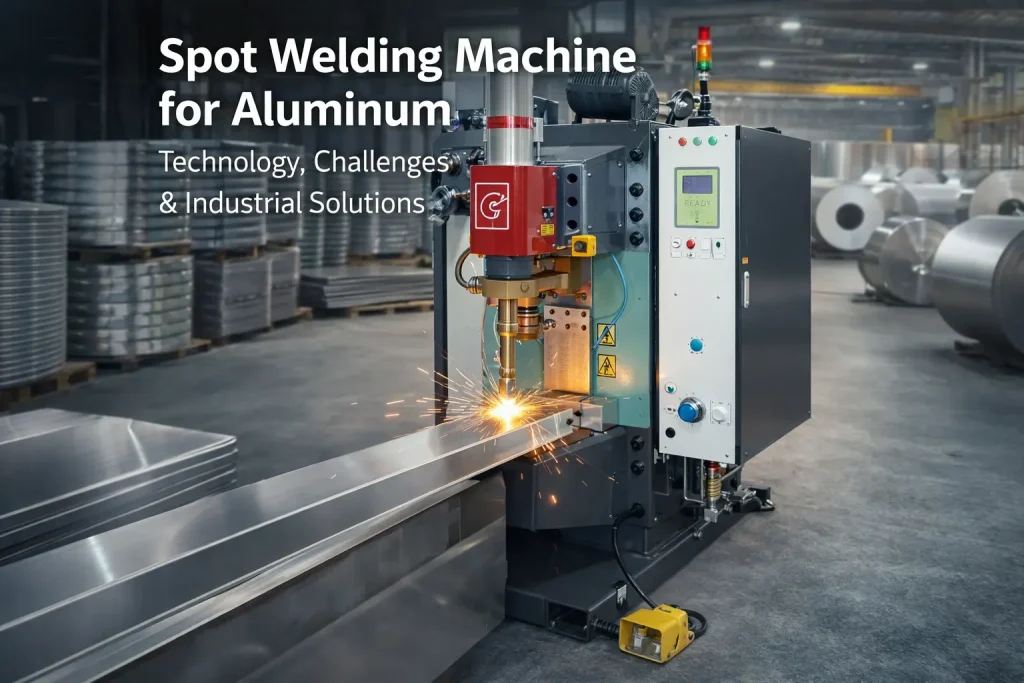
MFDC (Medium Frequency Direct Current) resistance spot welding remains an essential EV body joining solution for the steel-dominant structural areas of the body — floor assemblies, pillar reinforcements, roof structures, and closure panels where resistance welding is both technically appropriate and operationally efficient.
Operating at 1,000–4,000 Hz, MFDC delivers stable DC output with fast current rise times. For modern body steels — AHSS, UHSS, and hot-stamping grades — this precision matters: tighter current control produces consistent nugget geometry, minimal spatter, and smaller heat-affected zones than AC systems. For EV aluminum body components, including battery trays and door inners on aluminum-intensive NEV platforms, MFDC spot welding with aluminum-optimized electrode designs delivers the high current levels and precise timing aluminum’s thermal conductivity demands.

SPR vs FSPR vs Spot Welding: Which Solution Do You Need?
| Criteria | SPR | FSPR | MFDC Spot Welding |
|---|---|---|---|
| Joining principle | Cold mechanical | Cold mechanical (flush) | Resistance thermal |
| Heat generated | None | None | Yes — controlled |
| Dissimilar material joining | Yes | Yes — superior | Limited |
| Surface finish | Raised button | Flush both sides | Surface indentation |
| Hot-stamping steel | Limited | Excellent | Limited |
| Die-cast Al-Mg | Limited | Excellent | Limited |
| Universal mold | No | Yes | N/A |
| Best for | Multi-material stacks | High-mix NEV BIW, AHSS, die-cast | Steel BIW structures, aluminum panels |
For most NEV production lines the answer is a structured combination: MFDC handles steel-dominant structural areas; FSPR covers dissimilar material joints, die-cast nodes, and constrained locations. Together, they form a complete set of EV body joining solutions addressing every joint with the technically appropriate process.
Heron’s Complete EV Body Joining Solutions Portfolio
Heron Intelligent Equipment is the only joining equipment manufacturer offering both proprietary FSPR riveting technology and MFDC resistance spot welding solutions engineered for EV and NEV body-in-white production. This dual-technology capability is the foundation of Heron’s EV body joining solutions offering — and why leading NEV OEMs and Tier-1 suppliers choose Heron as a single-source joining technology partner.
FSPR Riveting Machines and Guns — Heron’s FSPR machines and guns deliver flush self-pierce riveting in standalone workstation and robotic cell configurations. The universal mold concept reduces change frequency; miniaturized gun designs reach constrained joining locations in complex NEV body architectures that standard riveting equipment cannot access.
MFDC Spot Welders and Robotic Welding Guns — Available from 110 KVA to 880 KVA, Heron’s MFDC spot welders cover every BIW joining requirement from standard panel assemblies to demanding structural connections. Over 300 robotic gun models bring the transformer directly to the robot arm, eliminating cable losses and sustaining the high cycle rates automated BIW production demands.
Robotic Working Cells — Heron’s S, M, and L Series robotic working cells integrate FSPR and MFDC equipment with robot platforms and fixture systems into fully engineered EV body joining production cells, supporting multi-station, multi-point layouts for high-volume NEV and mixed-model body lines.
Real-Time Quality Monitoring — Heron’s monitoring system integrates with both FSPR and MFDC equipment, capturing process data for every joining cycle, implementing closed-loop corrections in real time, and maintaining full production traceability without post-production sampling.
Contact Heron’s engineering team to discuss your body structure, material stack, and production requirements for your EV body joining solutions.

Frequently Asked Questions
Q1. What are EV body joining solutions and why do they differ from ICE vehicle joining?
EV body joining solutions are the joining technologies used to assemble electric vehicle body-in-white structures. They differ from ICE joining because modern EV bodies use multi-material architectures — aluminum, AHSS, and die-cast alloys — that cannot be reliably joined by conventional spot welding alone. Cold joining processes like FSPR are required for dissimilar material stacks where thermal joining would cause corrosion or cracking.
Q2. What is the difference between SPR and FSPR in EV body joining?
Standard SPR leaves a raised button protrusion on the joint underside. Heron’s FSPR produces a flush joint on both sides — eliminating the stress concentration and cracking risk that the raised button creates on hot-stamping steel and die-cast aluminum-magnesium alloys common in NEV body structures. FSPR also uses a universal mold design that reduces changeover time on high-mix production lines.
Q3. Why do advanced NEV lines use multiple joining technologies?
No single joining technology covers the full material matrix of a modern NEV body. MFDC spot welding handles steel-dominant structural areas efficiently. FSPR covers dissimilar material joints, die-cast nodes, and constrained locations where spot welding cannot perform. Using both EV body joining solutions — matched to each joint’s specific requirements — produces better joint quality, higher efficiency, and lower tooling cost than forcing a single technology across all applications.
Q4. Does Heron supply both FSPR and MFDC solutions for EV body production?
Yes. Heron is the only joining equipment manufacturer offering both proprietary FSPR riveting technology and MFDC spot welding solutions engineered for NEV body-in-white production — covering the full spectrum of EV body joining solutions from one supplier with unified process engineering, automation integration, and real-time quality monitoring.
Conclusion
Electric vehicle body manufacturing has moved beyond single-technology joining. Multi-material NEV body structures demand a combination of EV body joining solutions — cold mechanical riveting for dissimilar material stacks, precision resistance spot welding for structural steel and aluminum assemblies — each matched to the specific requirements of the joint it serves.
Heron Intelligent Equipment offers the complete portfolio: proprietary FSPR riveting, MFDC spot welding machines and robotic guns, robotic working cell integration, and real-time quality monitoring across both joining processes.
Ready to specify EV body joining solutions for your NEV production line? Explore Heron’s FSPR and MFDC product range or contact Heron’s engineering team to request a tailored joining technology consultation — and get a complete solution built around your body structure, materials, and production requirements.