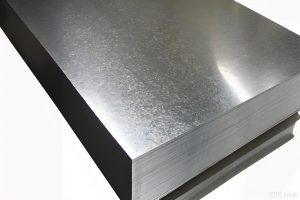
Galvanized steel welding machines play a critical role in achieving stable joint quality when welding galvanized steels and galvanized nuts. This article analyzes the key welding defects in galvanized steel welding and explains how proper galvanized steels welding machine enables consistent appearance, mechanical strength, and long-term corrosion resistance.
Galvanized steel is widely used in automotive body structures, appliance housings, and low-voltage electrical enclosures due to its strength and corrosion protection. In automotive manufacturing, hot-dip galvanized nuts are commonly joined by projection welding, making galvanized steel welding machine performance a key factor in production reliability.
However, manufacturers often encounter quality issues when conventional resistance spot welding or projection welding machines are used instead of a customized galvanized steel welding machine. Typical problems include poor surface appearance, reduced joint strength, and premature corrosion failure.
In high-volume manufacturing, galvanized steel welding machines must operate under tight cycle times, strict cosmetic standards, and long-term durability requirements. Based on Heron’s experience in automotive body-in-white lines, appliance enclosure production, and electrical cabinet manufacturing, welding defects in galvanized materials are rarely isolated—they typically result from excessive or poorly controlled heat input, insufficient energy control, or unstable electrode force during projection welding.
1. Process Challenges in Galvanized Steel Welding
The challenges of welding galvanized steel result from zinc’s material properties. Zinc melts at approximately 419.5 °C, far below steel (~1500 °C). Under welding heat, zinc vaporizes rapidly and reacts with iron at the faying interface, interfering with stable weld nugget formation. This behavior places high demands on a galvanized steel welding machine, particularly its ability to precisely control peak current, current rise time, and total heat input.
1.1 Surface Defects: Zinc Build-Up and Edge Accumulation
After welding, zinc often accumulates around weld nugget edges. Once painted, the surface is raised and poor flatness, particularly along component edges. Additional grinding is often required, increasing labor cost and risking damage to the remaining zinc coating.
1.2 Internal Defects: Porosity and Cracking
Cross-sectional inspection often reveals fine pores in the weld nugget. Under load, these pores become crack initiation points. Cracking in the heat-affected zone further reduces joint strength and prevents components from meeting structural requirements.
1.3 Corrosion Protection Failure: Zinc Burn-Off
Excessive heat input damages the zinc coating around the weld area, often producing white zinc oxide residue. This significantly reduces salt spray resistance and may cause premature localized corrosion.
1.4 Hidden Costs: Toxic Fumes and Electrode Wear
Conventional processes such as brazing produce zinc oxide fumes, posing health risks, including metal fume fever. In addition, unstable welding conditions accelerate electrode wear, increasing consumable costs and maintenance frequency.
2. Precision Solution: Medium-Voltage Capacitor Discharge Galvanized Steel Welding Machine
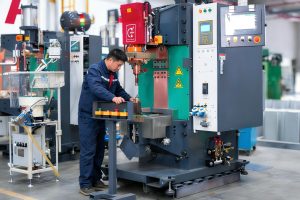
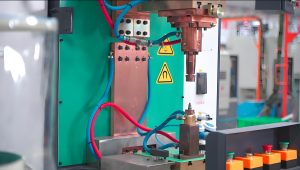
Heron addresses these challenges using medium-voltage capacitor discharge (CDW) galvanized steel welding machine, designed for precise current and voltage control. The galvanized steel welding machine stores energy in capacitors and releases it in a short, controlled pulse, delivering high peak current while keeping low total heat input, which is essential for preserving the zinc coating and ensuring weld integrity in galvanized steel welding.
Reduced Porosity and Cracking
Ultra-short welding time concentrates energy precisely at the projection area. Compared to conventional resistance welding, galvanized steel welding machine effectively reduces porosity, deformation, and cracking.
3ms High-Current Discharge
High current output within 3 ms, enables consistent weld nugget formation while minimizing zinc burn-off, reduces post-weld grinding and meets quality requirements for automotive safety components and galvanized appliance parts.
Reduced Maintenance and Consumable Wear
The metal film capacitor provide more than ten times the service life of electrolytic capacitors, with no electrolyte degradation and minimal capacitance decay. Electrode lifespan doubles compared to traditional projection welding, reducing replacement frequency.
Green, Energy-Saving, and Low-Consumption
By replacing arc welding and brazing processes, the galvanized steel welding machine eliminates harmful fumes and lowers environmental impact. Reduced water and power consumption can cut power grid upgrade costs by up to 40%, supporting cost control in high-volume manufacturing.
3. End-to-End Quality Assurance: Process Monitoring and Factory’s Self-Developed Capabilities
Certain defects in galvanized steel welding—such as micro-cracks or insufficient zinc retention—are hard to detect visually. Heron addresses this through real-time process monitoring integrated into each galvanized steel welding machine.
Intelligent Welding Monitoring System
Key parameters, including welding current, voltage, electrode force, weld collapse, and dynamic resistance, are continuously monitored and displayed as process curves. This data-driven approach reduces destructive testing, improves production continuity, and supports traceability, process repeatability, and continuous improvement in automotive and appliance manufacturing.
100% Self-Developed Core Components
All critical components—including resistance welding transformers, controllers, and welding heads—are designed and manufactured in Heron’s 54,000 m² facility. This improves system compatibility and reduces failure rates by about 40% compared with mixed-supplier systems, while simplifying maintenance and spare parts management.
4. Proven Applications and Cost-Reduction Value Across Industries
Heron’s galvanized steel welding machines are deployed in mass-production across the automotive and home appliance industries, where process stability, uptime, and long-term cost control are essential.
In automotive nut welding applications, the galvanized steel welding machine achieve up to 85% energy conversion efficiency—approximately 50% lower energy consumption than conventional welding machines—while doubling electrode life and reducing annual consumable costs by up to 30%.
For manufacturers, the core requirements of galvanized steel welding including consistent surface appearance, reliable joint strength, durable corrosion protection, high productivity, and low operating cost.
With 35 years of joining technology expertise, Heron delivers not just a welding system, but a galvanized steel welding machine solution optimized for the full production lifecycle.
From an engineering perspective, effective galvanized steel welding is not achieved through higher power, but through controlled energy delivery—where the galvanized steel welding machine functions as a process-critical system rather than a simple power source.