Stainless steel, with its corrosion resistance and high strength, is widely used in home appliances, low-voltage electrical components, and automotive parts. However, welding stainless steel remains a process-intensive challenge.
Compared to carbon steel, stainless steel has a 30% higher thermal expansion coefficient, making it more prone to distortion. Its low thermal conductivity causes heat to concentrate easily, increasing the risk of burn-through. At high temperatures, chromium carbide precipitation can also reduce corrosion resistance.
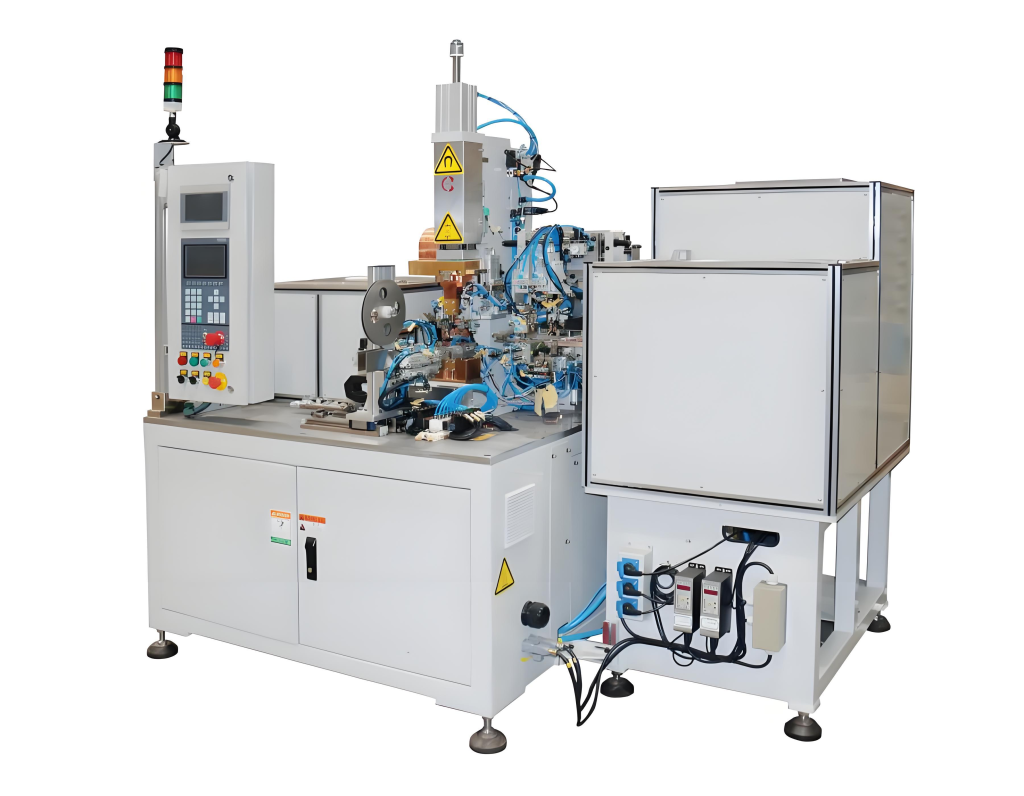
With over 30 years of experience in metal joining, Heron provides a stable and efficient stainless steel welding solution using two core technologies: MFDC (Medium Frequency Direct Current) welding and CD (Medium-Voltage Capacitor Discharge) projection welding, combined with full-process intelligent monitoring.

I. Precision Breakthrough: Two Core Technologies for Stainless Steel Welding
To address the three core challenges of stainless steel welding—thermal sensitivity, distortion, and temperature control—Heron provides solutions at the process level.
1. Medium Frequency DC Welding: Precise Heat Control for Medium–Thickness Stainless Steels
For medium-thickness austenitic stainless steels (304/316) and duplex stainless steels (2205), uncontrolled heat input is the primary risk. Heron’s MFDC technology combines millisecond-level current control with three-phase power input to maintain heat input within a safe range:

Fast current rise, high accuracy
Welding current reaches the set value within milliseconds, with constant current accuracy of ±2%. This minimizes excessive heat input and reduces the risk of intergranular corrosion. In one home appliance application welding 3 mm 304 stainless steel water inlet/outlet ports, salt spray resistance improved from 200 hours to 480 hours, effectively doubling corrosion resistance.
Reduced electrical losses, compact footprint
Compared with traditional AC welding machines, reactive power loss is reduced by 40%, and overall equipment size by 50%, making the system well-suited for dense welding layouts such as stainless steel frames in low-voltage electrical cabinets.
When paired with a diamond-rail guided pneumatic cylinder, welding force remains stable between 10,000-24,000N, significantly reducing spatter in dissimilar material welding, such as hot-formed steel to stainless steel.
Material Compatibility
Single-layer welding from 2mm to 6mm, and double-layer stacked plates up to 4mm+4mm can be handled reliably.
2. Medium-Voltage Capacitor Discharge Welding: A Distortion Solution for Thin Stainless Steels
For ferritic stainless steel (430) and thin-walled austenitic stainless steel, thermal distortion is the primary concern. Heron’s medium-voltage capacitor discharge projection welding uses instantaneous high current and ultra-short welding time to achieve rapid heating and cooling.
Welding completed within 30ms
A peak short-circuit current of up to 1000KA rapidly forms the weld nugget, limiting the heat-affected zone to ≤0.5mm .
Independent from grid fluctuations
Once charged, the system is fully isolated from the power grid, delivering output repeatability of ±1%. Even with ±10% voltage fluctuation in the plant, applications such as stainless steel nut projection welding in automotive production achieve 100% thread integrity, avoiding weak or missed welds caused by an unstable power supply.
Safer and energy saving
Operating at medium voltage (<1000 V), the system is safer than traditional high-voltage capacitor welders. The transformer does not require water cooling, reducing cooling water consumption by 50%, which aligns well with cost-control requirements in large-scale appliance manufacturing.
II. Intelligent Process Monitoring: Eliminating Hidden Welding Risks

Hidden defects in stainless steel welding, such as intergranular corrosion or micro-cracking, are often difficult to detect visually. Heron addresses this through real-time monitoring and data traceability.
HRC650 intelligent welding monitoring
The standard welding quality monitoring system collects five key parameters in real time, including current, voltage, and electrode force, and visualizes the entire welding process in real-time curves to prevent batches of weak or missing welds.
Modular maintenance design
Standardized consumables, such as electrodes and capacitors, reduce replacement time from 40 minutes to 15 minutes. Welding programs can be updated via USB, allowing rapid parameter changes for different stainless steel grades, adapting to multi-variety, low-volume production.
III. Proven Applications Across Industries
Heron’s stainless steel welding solutions are deployed by over 30 Fortune Global 500 companies, covering a wide range of industrial applications:
Home appliance industry
Medium-voltage capacitor discharge projection welding enables spatter-free welding in water heater production, increasing daily output per line by 30%.
Low-voltage electrical industry
Customers use MFDC welders for stainless steel circuit breaker frames, achieving clean weld appearance without post-weld grinding and reducing labor costs by 40%.
Automotive Industry
In stainless steel exhaust flange welding, our MFDC multi-stage current control prevents high-temperature oxidation and significantly improves sealing test pass rates.
IV. Sustainability and Lifecycle Cost Reduction
Beyond quality and productivity, Heron’s solutions deliver measurable cost and energy benefits across the equipment lifecycle.
Up to 50% energy savings
Medium-voltage capacitor discharge projection welding achieves an energy conversion efficiency of 85%, saving over 120,000 kWh per machine per year compared to conventional welding machines.
Extended consumable lifespan
Shorter welding times reduce electrode wear, extending the lifespan of CuCrZr electrodes and lowering annual consumable costs by 30%.
No auxiliary materials required
No welding wire or shielding gas is required, avoiding material waste caused by welding spatter and reducing annual consumable expenses.
For manufacturers, the core requirements of stainless steel welding are corrosion resistance, visual quality, high efficiency, and cost control. Backed by three decades of expertise, Heron delivers an integrated solution that combines technology, equipment, and service. From precision welding of thin stainless steel panels to high-strength joining of medium-thickness structural components, we provide application-specific solutions that meet demanding industrial standards.