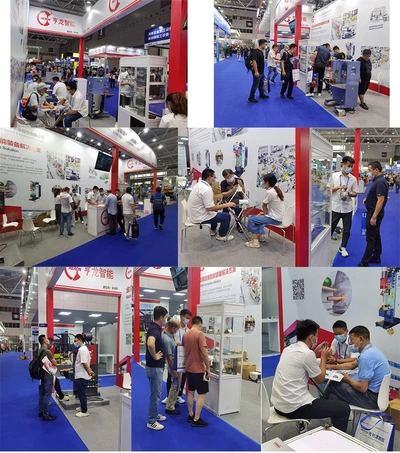
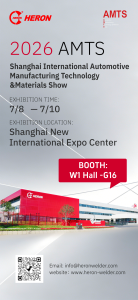
The AMTS Shanghai International Automotive Manufacturing Technology & Material Show is one of Asia’s leading events for automotive engineering and manufacturing innovation. From July 8 to July 10, global manufacturers and industry experts will gather in Shanghai to explore the latest technologies shaping the future of automotive production.
Heron welcomes you to visit Hall W1, Booth G16 (W1-G16) at the Shanghai New International Expo Centre, where we will present advanced solutions for automotive lightweight metal joining applications.
Addressing Key Challenges in Body-in-White Joining
Modern body-in-white joining processes are under growing pressure from the increasing use of lightweight materials, shorter production cycle times, and more stringent requirements for traceability and consistent quality.
With over 30 years of expertise in resistance welding, clinching, and riveting, Heron focuses on delivering solutions defined by stability, efficiency, and reliability—engineered to perform consistently in high-volume production.
1. Medium Frequency DC (MFDC) Spot and Projection Welder
Designed for joining difficult-to-weld materials such as aluminum alloys, galvanized steels, and high-strength steels. With rapid current response and precise heat control, the welder effectively minimizes spatter while ensuring stable weld quality. It is well-suited for lightweight automotive body structures requiring high consistency in mass production.
2. Medium-Voltage Capacitor Discharge Projection Welder
Optimized for nut and stud projection welding in applications such as bumper reinforcements, A/B pillars, and structural channels. Its ultra-short discharge time and precise energy control reduce thermal impact on the base material, helping to prevent overheating, lower rework rates, and improve overall production efficiency.
3. C-Type/X-Type Robot Welding Guns with Control Systems
Featuring a lightweight, high-rigidity gun body integrated with Heron’s self-developed and manufactured controller, the system enables precise closed-loop control of welding parameters. It is well-suited for complex geometries such as curved surfaces and deep cavity structures, delivering stable weld quality, extended electrode life, and seamless integration with automated production lines, including cycle time alignment and traceability requirements.
4. Flush Self-Piercing Riveting (FSPR) System
Flush Self-Pierce Riveting (FSPR) is breakthrough lightweight joining technology independently developed by Heron. It utilizes an 8-ton servo-driven actuator to drive a specially designed rivet through the upper sheet without pre-drilling, while the die forms a mechanical interlock through controlled material displacement.
FSPR system supports a maximum joint thickness of 9.1 mm and is compatible with hot-stamped steels (≤1800 MPa), aluminum alloys, cast aluminum, carbon fiber materials, and other multi-material combinations.
5. From Standalone Equipment to Fully Automated Production Line Engineering
Heron goes beyond supplying equipment—we provide end-to-end engineering support across the entire project lifecycle, from process evaluation and equipment selection to full production line integration.
Visitors are welcome to bring part drawings or production data to our booth. Our engineering team will conduct on-site evaluations and propose tailored joining solutions based on specific application requirements.

Heron Addressing Real Production Challenges
Modern automotive joining processes are facing three key challenges: the increasing use of lightweight materials, the need for shorter production cycle time with consistent weld quality, and the growing demand for flexible, data-traceable manufacturing systems.
While many solutions perform well in laboratory conditions, mass production often exposes practical issues such as excessive spatter, unstable weld quality, short electrode life, and inefficient changeovers—ultimately driving up total manufacturing costs.
With deep expertise in metal joining and resistance welding equipment, Heron continues to develop its technologies around four core principles: stable weld formation, controlled spatter, optimized energy and maintenance costs, and full compatibility with robotic automation systems.