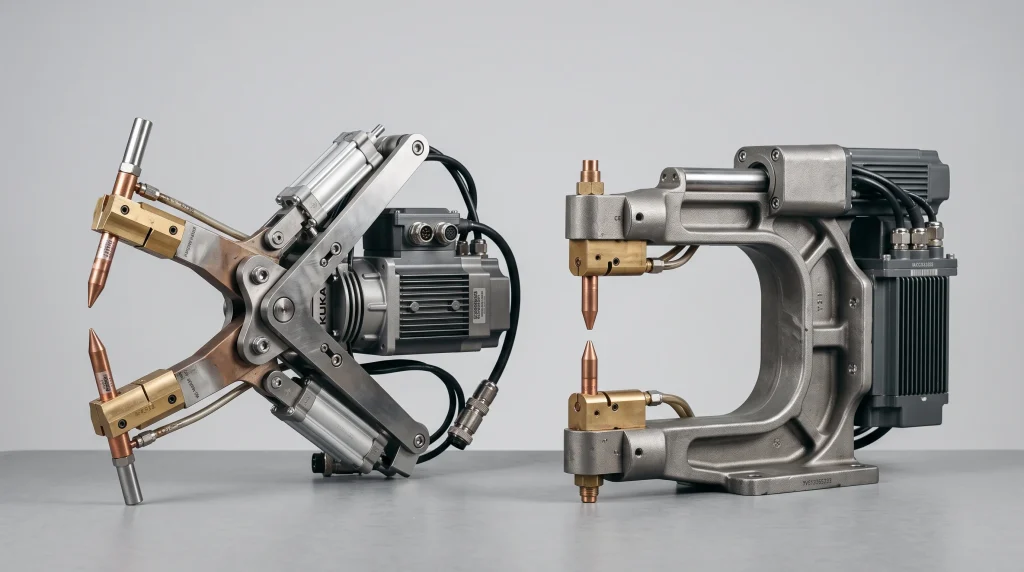
Ask ten engineers how does a spot welder work and most will start with “electricity and pressure,” which is true but incomplete. The real answer involves a precise sequence of mechanical and electrical events happening in a fraction of a second, and getting any one of them wrong is usually why a weld fails inspection later.
Spot welding is the most widely used form of resistance welding in manufacturing today. It joins two or more metal sheets by passing current through electrodes pressed against the surfaces, generating enough localized heat to melt and fuse the metal at that single point. Understanding how does a spot welder work in practical terms, not just theory, matters if you’re specifying equipment, troubleshooting weld quality, or trying to figure out why your current setup produces inconsistent nuggets.
The Short Answer: Current, Pressure and Heat in One Cycle

At its core, how does a spot welder work comes down to three variables acting together: mechanical force, electrical current, and time. A spot welder clamps two metal surfaces between a pair of electrodes, applies mechanical force to hold them tight against each other, then passes a high electrical current through that contact point for a controlled duration. Resistance at the interface between the two sheets converts electrical energy into heat, and that heat is what melts a small pool of metal, the weld nugget, which solidifies into a joint once current stops and the electrodes continue holding pressure.
This is different from arc welding or gas welding, since spot welding needs no filler material and no open flame. The heat comes entirely from electrical resistance at the joint, which is also why spot welding is considered a comparatively safer and more cost-effective way to join thin sheet metal at high volume.
What Is a Spot Welder Used For in Real Production
What is a spot welder used for varies by industry, but the common thread is joining large components or thin sheet stamping parts where speed and repeatability matter more than joint aesthetics. Automotive body assembly relies on spot welding extensively for structural panels, door skins, and body-in-white components, often with hundreds of spot welds on a single vehicle body.
Beyond automotive, understanding what is a spot welder used for helps explain why the process shows up in home appliance manufacturing (washing machine drums, oven housings, refrigerator panels), electrical enclosure fabrication, HVAC and compressor shell assembly, and general sheet metal fabrication across hardware and consumer goods. Any application joining overlapping thin metal sheets in high volume is a reasonable candidate for spot welding rather than a slower, filler-based process.
Breaking Down the Spot Welding Cycle Step by Step
The full cycle happens in well under a second on most production equipment, but it’s built from four distinct phases. This sequence is really the detailed version of how does a spot welder work, and skipping or shortcutting any one of these phases is where weld defects usually originate.
Squeeze
The electrodes close on the material stack before any current flows. This squeeze phase establishes consistent contact pressure across the joint area, since inconsistent initial contact leads directly to inconsistent resistance and, downstream, inconsistent heat generation. Rushing this phase is one of the most common causes of weld splash and undersized nuggets on production floors.
Weld
Current flows through the electrodes and into the material stack for a set duration, typically measured in cycles of the local power frequency rather than in seconds. Resistance at the sheet-to-sheet interface, which is naturally higher than resistance within the bulk metal, generates concentrated heat right at the joint. This is the phase that actually forms the molten nugget, and it’s controlled by current magnitude, duration, and the pressure being held simultaneously by the electrodes.
Hold and Off
Once current stops, the electrodes continue holding force on the joint while the molten nugget cools and solidifies under pressure. This hold phase is what gives the weld its mechanical strength and grain structure, and cutting it short before the metal has solidified produces a weaker joint even if the weld looked fine during the current phase. After hold, the electrodes retract in the off phase, and the material stack advances or is repositioned for the next weld.

Why Current and Force Have to Move Together, Not Separately
A frequent misunderstanding of how does a spot welder work is treating current and electrode force as independent settings. They aren’t. Force determines the contact resistance at the interface, and current determines how much heat that resistance generates. Increase current without adjusting force appropriately, and you risk expulsion, molten metal spitting out from between the sheets, which weakens the joint and creates surface damage. Increase force without adjusting current, and you can suppress resistance to the point where the weld never reaches the temperature needed to fuse the metal.
This is why modern resistance welding equipment, including Heron’s MFDC and AC spot welders, controls both variables together through a programmed weld schedule rather than leaving an operator to manage them independently. Medium frequency DC technology in particular allows tighter, more responsive control over current delivery across the weld phase than older single-phase AC equipment, which is part of why MFDC has become the default specification for automotive-grade spot welding over the last decade.
Where Spot Welding Fits Against Projection, Seam and Butt Welding
Spot welding is one of several resistance welding methods, and knowing where it fits helps clarify what a spot welder is used for compared to its neighbors. Projection welding uses raised features on the metal to concentrate current at specific points, useful for welding nuts and studs onto stamped panels, and tends to produce more consistent results across multiple simultaneous welds. Seam welding replaces the stationary electrode rods with motor-driven wheels, producing a continuous, gas or liquid-tight weld line rather than isolated points, which is why it’s used for fuel tanks, radiators, and steel drums. Butt welding joins two pieces end to end along the same plane rather than overlapping them, suited to different joint geometries entirely.
Spot welding remains the default choice specifically because most sheet metal assembly involves overlapping thin material where individual point welds, applied in enough quantity, deliver sufficient joint strength without the added complexity of projections or continuous seams.
Specifying a Spot Welder for Your Line
Once the mechanics of how does a spot welder work are clear, the practical question becomes which configuration actually fits your production volume and material. Heron has built resistance welding equipment for over 30 years, with MFDC spot welders, AC spot and press welders, and capacitor discharge welders covering a wide range of current capacity and duty cycle requirements. The right choice depends on material type and thickness, required cycle time, and whether the line runs manual, semi-automatic, or fully robotic welding stations.
Getting this wrong usually shows up months later as inconsistent nugget size or premature electrode wear, not as an obvious failure on day one. That’s why Heron’s engineering team reviews part drawings and production targets directly with customers before recommending a welder configuration, rather than starting from a standard catalog spec and hoping it fits. Customers across automotive, motor manufacturing, compressor production, electrical and electronics, home appliances, and hardware manufacturing have specified equipment this way.
If your team is evaluating resistance welding for a new line or replacing aging equipment, request a spot welder quote and include your material stack, target cycle time, and expected production volume. You’ll get a configuration recommendation matched to your actual application, not a generic price sheet.

FAQ
Q1. How does a spot welder work compared to arc welding?
A spot welder generates heat through electrical resistance at the contact point between two clamped metal sheets, with no filler material and no open flame. Arc welding creates an electric arc between an electrode and the workpiece, generally with filler material added, and is typically used for thicker material or non-overlapping joints rather than thin sheet stacks.
Q2. What is a spot welder used for besides automotive manufacturing?
Spot welders are widely used in home appliance manufacturing, electrical enclosure fabrication, HVAC and compressor shell assembly, and general sheet metal fabrication wherever thin overlapping metal sheets need to be joined at volume.
Q3. Why do some spot welds fail even though the current and time settings look correct?
Weld failures often trace back to the squeeze or hold phases rather than the weld phase itself. Inconsistent initial electrode contact pressure or a hold time that’s cut short before the nugget solidifies can produce a weak or inconsistent joint even when current and weld duration are set correctly.
Q4. What’s the difference between AC and MFDC spot welders?
AC spot welders use single-phase alternating current, which is simpler and generally lower cost. MFDC (medium frequency direct current) welders convert and control current more precisely, giving tighter control over the weld cycle and generally better consistency, which is why MFDC has become the standard for automotive-grade production.
Q5. Can a spot welder join materials other than steel?
Yes, though the settings change significantly. Aluminum alloys, for example, generally require higher current and shorter weld times than steel due to their different electrical and thermal conductivity, and equipment needs to be specified accordingly rather than assumed to work identically across material types.
Q6. How do I know if spot welding is the right process for my application?
Spot welding suits overlapping thin sheet metal joints where high volume and repeatability matter more than continuous seal integrity. If your application needs a gas or liquid-tight joint, seam welding is usually more appropriate, and if you’re joining fasteners like nuts or studs, projection welding tends to perform better.
Understanding how does a spot welder work, and knowing what a spot welder is used for on your specific line, is the starting point for specifying equipment that actually performs on your production floor. Heron Welder’s engineering team is available to review your material stack and production targets and recommend a resistance welding configuration built around your application, not a generic model pulled off a shelf.