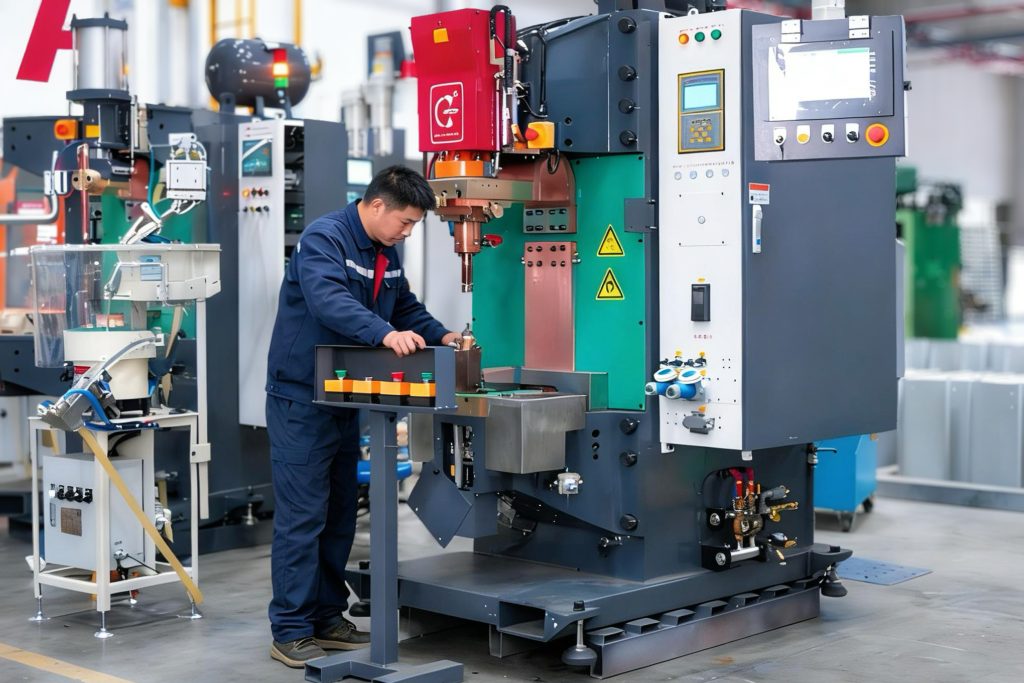
In the automotive parts, low-voltage electrical, and home appliance industries, resistance welding is a critical metal joining process. Selecting the right welding machine can substantially enhance production efficiency and minimize defect rates, whereas an improper choice may lead to rework, operational downtime, and increased costs. To ensure optimal equipment selection, manufacturers must carefully evaluate four critical factors: welding performance compatibility, core system specifications, long-term cost management, and specific application adaptation.
Factor 1: Material Weldability and Equipment Capability Matching
Equipment selection starts with evaluating material weldability. The choice between spot welders, projection welders, seam welders, or robotic welding guns depends mainly on the compatibility between the equipment’s output characteristics and the material’s physical properties—the core criterion for resistance welding machine selection. When selecting a welding machine, four key material properties should be prioritized.
1. Electrical and Thermal Conductivity
Materials such as copper and aluminum possess low resistance and high thermal conductivity, leading to rapid heat dissipation during welding. Consequently, these materials require high-current, high-power welding equipment to ensure proper nugget formation and penetration. In contrast, carbon steel has higher resistance and lower thermal conductivity, allowing effective welding with relatively lower power requirements. If your production line welds aluminum alloys, using an underpowered welding machine will cause incomplete fusion and unstable joint strength.
2. High-Temperature Strength
Materials such as hot-formed steel and high-strength steel retain high yield strength at high temperatures (around 0.5–0.7 Tm), increasing the risk of spatter and solidification shrinkage defects during spot welding. To ensure weld quality, the equipment must provide high electrode pressure along with post-weld forging control. Heron’s medium-voltage capacitor discharge welder delivers instant high electrode force, effectively reducing spatter and enabling stable welding of hot-formed steel with strengths up to 1,800 MPa.

3. Plastic Temperature Range
Materials with a narrow plastic temperature range require greater process stability. Aluminum alloys have a limited plastic temperature range and are highly sensitive to welding current and time variations. Thus, welding machines must provide precise current and time control, along with superior electrode follow-up capability to compensate for dynamic sheet movement and prevent misalignment. In contrast, carbon steel has a wider plastic temperature range and greater tolerance to parameter variations, allowing more flexibility in equipment selection.
4. Thermal Cycling Sensitivity
Materials such as high-strength steels are prone to cold cracking, while alloys containing fusible impurity phases are prone to hot cracking under improper thermal cycling. These materials require welding machines with advanced heat input management. Heron’s multi-segment current ramping technology dynamically adjusts heat input during the welding cycle, reducing thermal stress concentration and effectively preventing crack-related defects.
Factor 2: Focus on Core Configurations and Avoid “Parameter Overstatement”
The welding machine’s core configuration directly determines process stability and long-term consistency. When evaluating equipment, three critical systems must be carefully assessed:
1. Power System
Prioritize medium-frequency DC (MFDC) or capacitor discharge power systems. Heron’s MFDC welders offer ±2% current control accuracy, meeting mass production demands. Heron’s capacitor discharge welders provide extremely fast current rise times, effectively limiting heat input and preventing thermal deformation during high-strength steel welding. Avoid traditional AC power supplies, as grid fluctuations compromise weld quality and repeatability.
2. Electrode System
Evaluate material selection and water-cooling design. Chromium-zirconium-copper (CuCrZr) electrodes, combined with internal circulating water cooling ensuring optimal conductivity, strength, and longevity. High-quality electrodes endure thousands of welds without degradation, whereas inferior electrodes deform after only dozens of welds, causing unstable weld quality. Additionally, the electrodes should support rapid replacement mechanisms to minimize downtime.
3. Control system
Select a control system with real-time parameter visualization and fault alarms. Real-time current and voltage waveform displays can flag weak welds early. Support for USB flash drive program upgrades enables flexible process optimization, reducing dependence on manufacturer on-site debugging.

Factor 3: Evaluate Total Cost of Ownership—Not Just the Purchase Price
Many companies prioritize low upfront costs without considering the total cost of ownership (TCO) over resistance welding machine’s lifecycle. A comprehensive evaluation should include long-term operational expenses, not just the initial price.
Effective procurement decisions should account for three critical cost drivers:
1. Service Life of Wear Components
Wear components such as capacitors and electrodes significantly impact long-term operating costs. Heron’s medium-voltage capacitor discharge welders use custom-designed capacitors with low ESR and ESL, delivering a service life exceeding 8,000 operating hours, reducing replacement costs by approximately 30% compared to standard alternatives. In contrast, lower-grade capacitors often degrade after about 1,000 hours, increasing maintenance and downtime.
2. Energy Consumption and Operating Inputs
Capacitor discharge welding systems achieve up to 85% energy conversion efficiency, offering roughly 50% energy savings over conventional welding machines. Additionally, our capacitor discharge systems eliminate consumables like welding wire or shielding gas, cutting annual costs.
3. After-Sales Support and Service Capability
Reliable after-sales support is essential for long-term cost control. Manufacturers with global service teams minimize downtime with quick response. Heron’s 24/7 global service centers ensure prompt repairs and spare parts availability. In contrast, smaller suppliers often lack infrastructure, leading to prolonged downtime.
Factor 4: Verify Scenario Adaptability — Practical Welding Trials Outweigh Sales Claims
The final step in selecting welding machine involves confirming its adaptability to actual production conditions, rather than relying solely on supplier presentations or technical specifications.
To validate equipment effectively, focus on two critical actions:
1. Samples Trial Welding
Conduct on-site welding tests using actual production parts, such as automotive A/B/C pillar nuts or low-voltage electrical contacts, to directly evaluate weld strength, thread integrity, and process stability. This method prevents scenarios where equipment performs well in generic demonstrations but fails to meet specific application demands.

2. Reference Proven Industry Applications
Prioritize equipment with demonstrated success in leading enterprises. For automotive industry, favor solutions adopted by Tier 1 suppliers such as Cosma and Lingyun. For home appliances, consider systems approved by manufacturers such as Whirlpool and Midea. As a long-standing global supplier to major automotive and home appliance manufacturers, Heron’s equipment has undergone extensive validation in large-scale production, ensuring superior cross-scenario compatibility and process reliability.
When selecting a welding machine—whether spot welders or projection welders—precision is key. The selection must align with material properties, process requirements, and total cost objectives. Focusing solely on parameters or low costs often leads to inefficient investments and production instability. By evaluating equipment across these four critical factors and verifying performance through real-world trial welding, manufacturers can achieve consistent weld quality, reduced operating costs, and enhanced production efficiency. Heron provides customized welding machines and automated production lines for diverse industries, helping manufacturers optimize efficiency and accelerate intelligent manufacturing upgrades.