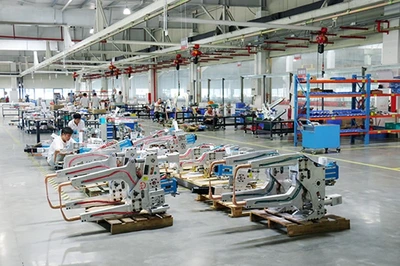
In large-scale manufacturing, fractional gains in cycle time and energy efficiency separate industry leaders from struggling operations. Plant directors and procurement managers in the automotive, HVAC, low-voltage electrical, and appliance sectors face continuous pressure to cut operational costs while maintaining flawless joint integrity. At the heart of many high-volume assembly lines sits a critical but often under-optimized component: the industrial point welder.
Whether you are upgrading an existing assembly setup or designing a fully automated robotic line from scratch, selecting the right point welder technology dictates your factory’s output capacity, total cost of ownership (TCO), and reject rates. This comprehensive guide breaks down the technical variables necessary to scale your factory production utilizing advanced resistance welding infrastructure.
The Evolution of the Industrial Point Welder in Modern Manufacturing

Traditional resistance point welding relied heavily on standard Alternating Current (AC) transformers. While reliable for basic sheet metal fabrication in previous decades, legacy AC systems struggle to keep pace with the strict quality and speed requirements of modern high-volume manufacturing lines. For more details, visit here.
Shifting from Traditional AC to Medium Frequency Direct Current (MFDC)
For plants looking to scale, upgrading to Medium Frequency Direct Current (MFDC) systems represents a massive step forward. MFDC power supplies transform standard 50/60Hz AC power to a much higher frequency (typically 1,000Hz or greater) before converting it to DC.
The physical and financial benefits are immediate:
-
Precision Heat Control: Millisecond-level adjustments allow for highly accurate heat placement, virtually eliminating thermal distortion in delicate or thin-gauge components.
-
Energy Savings: MFDC technology draws balanced power across three phases instead of one, dramatically lowering the peak power demand and slashing factory electricity bills.
-
Lighter Equipment: Because transformers operating at higher frequencies can be physically smaller, they are much easier to integrate into high-speed robotic arms.
The Power of Capacitor Discharge (CD) Systems for Precision Jobs
When your production line requires rapid energy bursts with minimal thermal impact on the surrounding material, Capacitor Discharge (CD) systems provide an excellent solution. A CD point welder stores energy in large capacitor banks before releasing it in a fraction of a millisecond. This makes CD technology uniquely suited for low-voltage electrical components, projection welding of fasteners, and joining heat-sensitive or pre-painted metals without damaging surface finishes.
Key Factors to Consider When Scaling Production Lines
Scaling production isn’t as simple as purchasing a machine with a higher output rating. To ensure your hardware investments yield long-term ROI, manufacturing engineers must analyze several core operational variables.
Power Supply Stability and Energy Efficiency
A major bottleneck on expanding factory floors is localized grid strain. Deploying multiple traditional AC point welders simultaneously causes severe current fluctuations. Utilizing modern MFDC and CD equipment evens out the factory power draw, preventing voltage drops that can interrupt secondary machinery and trigger expensive peak-demand penalties from utility providers.
Material Compatibility: Balancing Steel, Copper, and Aluminum
The automotive and home appliance industries are increasingly utilizing lightweight materials like aluminum alloys alongside traditional high-strength steels. Furthermore, low-voltage electrical manufacturing demands consistent bonding of highly conductive copper alloys. Achieving reliable nugget formation on these diverse metals requires a point welder equipped with programmable, multi-stage force and current profiles to break through oxide layers cleanly.
Mechanical Duty Cycles and Electrode Wear
In an automated environment running 24/7, machine downtime equals lost revenue. The longevity of your pneumatic or servo-driven actuator systems determines your maximum continuous output. Opting for water-cooled electrode systems and integrated tip-dressing automation ensures that the point welder maintains constant pressure and current density over hundreds of thousands of cycles before requiring manual maintenance.
+------------------------+--------------------------+----------------------------+
| Technology Type        | Primary Target Materials | Best Production Environment|
+------------------------+--------------------------+----------------------------+
| MFDC Resistance        | Steel, Aluminum Alloys   | High-Speed Robotic Lines   |
+------------------------+--------------------------+----------------------------+
| Capacitor Discharge    | Copper, Brass, Fasteners | Precision Component Cells  |
+------------------------+--------------------------+----------------------------+
Integrating Automation: The Smart Factory Advantage
True production scaling occurs when your point welder stops functioning as an isolated workstation and becomes part of an interconnected, automated system. Integrating smart sensors allows your equipment to log dynamic resistance, thermal expansion, and applied force in real time.
By capturing this data, plant managers can transition from reactive maintenance to predictive quality control. If an electrode begins to degrade, the system flags the variance before bad welds are produced, keeping your final yield as close to 100% as possible. Automated part-feeding systems, indexing tables, and multi-gun configurations further remove human error from the cycle time equation.
Choosing the Right KVA and Equipment for Your Sector
Every manufacturing vertical faces distinct challenges that influence equipment specifications:
-
Automotive: Demands high-strength structural integrity, seamless robotic integration, and strict traceability protocols for safety-critical components.
-
HVAC & Appliances: Requires immaculate cosmetics on pre-coated or stainless-steel wrappers alongside strong leak-proof joints on compressor components.
-
Low-Voltage Electrical: Relies on micro-precision, high-conductivity bonds between dissimilar precious metals without burning delicate assemblies.
Navigating these variables requires an experienced hardware partner capable of assessing your exact production goals, part geometries, and material specifications.
Frequently Asked Questions About Industrial Point Welders
Q1. What is the difference between a point welder and a spot welder?
In industrial manufacturing terms, a “point welder” is a broader colloquial or layout-driven phrase often used interchangeably with a resistance spot welder. Both systems use pressure and localized electrical current via copper alloy electrodes to fuse sheets of metal together without adding filler material.
Q2. Why should a high-volume factory choose MFDC over standard AC systems?
MFDC systems offer superior energy efficiency, three-phase power balancing, precise millisecond current adjustments, and significantly smaller transformer sizes. This makes them far cheaper to run over time and far more adaptable for automated robotic lines than older AC alternatives.
Q3. How does electrode force impact the final weld quality?
Electrode force is critical to contain the molten weld nugget and minimize surface expulsion (spatter). Too little force results in excessive burning, tool wear, and weak bonds; too much force compresses the material excessively, leading to indentations and reduced joint strength.
Q4. Can an industrial point welder bond dissimilar metals?
Yes. By using advanced power configurations like Capacitor Discharge (CD) or highly customizable multi-pulse MFDC profiles, operators can successfully bond dissimilar or highly conductive metals like copper to steel or brass to aluminum.
Optimize Your Assembly Line Efficiency with Heron
Scaling your factory floor requires robust, field-tested machinery engineered to meet the demands of modern manufacturing. For over three decades, Heron Intelligent Equipment has specialized in designing and manufacturing top-tier B2B resistance welding systems.
From standalone industrial point welder units to completely custom, fully automated robotic cells utilizing advanced MFDC and Capacitor Discharge technology, Heron delivers solutions that drive down TCO while maximizing throughput. Our engineering teams work hand-in-hand with global clients across the automotive, appliance, and electronics sectors to deploy equipment that stands up to intense, multi-shift production environments.
Don’t let legacy welding hardware bottleneck your factory’s potential. Speak with a Heron Automation Engineer Today to discover how our smart resistance welding technologies can elevate your production line capacity.