In the world of advanced manufacturing, the way parts come together determines the quality, durability, and performance of the end product. As industries push for lighter, stronger, and more complex assemblies, especially in automotive, aerospace, appliances, and electronics, traditional metal joining methods often fall short.
Metal Joining with Self-Pierce Riveting Machine: The Future of Reliable, Fast, and Versatile Assembly
Enter metal joining with self-pierce riveting machine technology, an innovation that’s redefining production lines by blending speed, strength, flexibility, and sustainability. Heron Welder, a global frontrunner in fastening technology, leads this revolution with its state-of-the-art self-pierce riveting machine, empowering manufacturers with world-class solutions that meet present and future demands.
Understanding Metal Joining with Self-Pierce Riveting Machine
Metal joining is an umbrella term covering various methods, welding, adhesive bonding, mechanical fastening, for connecting two or more metal components. While welding and bolting are familiar techniques, self-pierce riveting stands apart for its ability to join metals without heat or pre-punched holes.

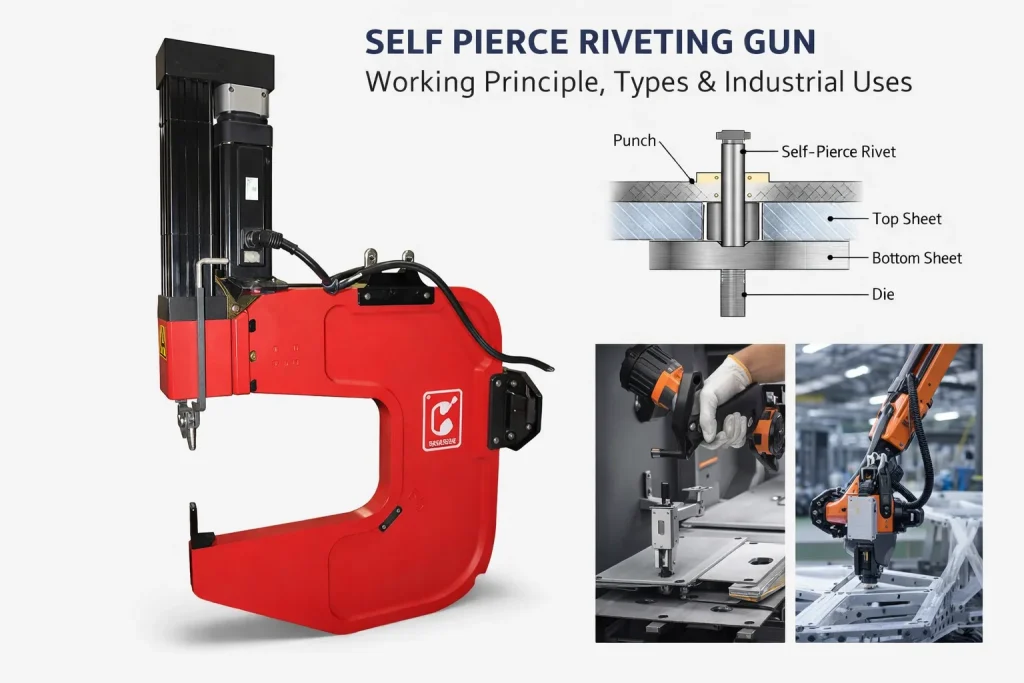
In self-pierce riveting (SPR), a semi-tubular rivet is precision-driven through the upper sheets of material and forms a locked connection in the lower sheet using a specially designed die. The result is a flush, fatigue-resistant joint with minimal impact on surrounding materials or coatings.
Heron’s flush self-pierce riveting machine (FSPR) builds on this core principle, providing manufacturers not just with the ability to join dissimilar or coated metals, but to do so at high speed, with low energy consumption, and with process monitoring that ensures every single joint is robust and repeatable.
Industrial Evolution Drives Demand for SPR
The pressure to decarbonize, electrify, and lightweight vehicles is snowballing, not just in automotive but in consumer products, renewable energy, and infrastructure. Engineers are bringing new alloys, multi-layer stacks, carbon composites, and lightweight metals into product design.
However, these same innovations make joining more complex: heat from welding can distort, weaken, or corrode these sensitive materials. Traditional mechanical fasteners like bolts or screws are slower to install, create stress concentrations, and may require large edge distances or additional machining.
Metal joining with self-pierce riveting machine technology meets this challenge with an elegant solution, joining aluminum to steel, magnesium, high-strength alloys, or pre-painted sheets seamlessly and securely, even in difficult-to-access spots. And because the process does not require pilot holes, there’s less risk of misalignment or waste.
Anatomy of Heron’s SPR Solutions
Flush Self-Pierce Riveting (FSPR) Explained
Heron’s FSPR systems represent a leap over classic SPR, both in hardware and process control. The “flush” aspect means the head of the installed rivet sits level with the metal surface, leaving an almost invisible joint—critical for aesthetics on automotive exteriors or consumer goods.
Key to this performance is the combination of:
-
Advanced Rivet Geometry: Heron’s semi-tubular premium rivets are engineered for maximum forming and interlock strength without damaging surrounding material, able to handle mixed stacks.
-
Robust, Adaptable Hardware: Stationary and robotic machines are available, offering anywhere from 20 to 80 kN of force depending on part thickness and stacking requirements.
-
Precision Dies and Tooling: Minimizing mold change frequency, Heron’s quick-change dies accommodate varied geometries and rapid adjustment.
-
Energy-Efficient Drives: Both pneumatic-hydraulic and servo motor-powered units provide rapid cycles (under 1 sec/rivet) and low operating costs.
-
Online Quality Monitoring: Integrated sensors and a real-time feedback loop capture force, position, and forming details, ensuring defect-free joints and enabling full traceability.
Advantages of Metal Joining with Self-Pierce Riveting Machine
1. High-Speed Automation
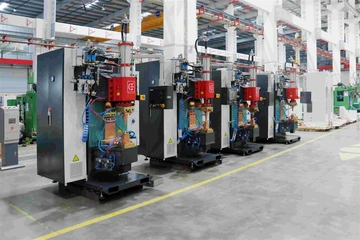
Heron’s SPR machines are designed around high-speed production, with robotic cells or automated stations capable of hundreds of cycles per hour. This is indispensable in automotive production lines where cycle speed is crucial.
2. Connection Quality and Structural Integrity
The cold joining process gives high shear and peel strength, outperforming spot welds (especially in aluminum and certain steels). Finished joints are vibration- and fatigue-resistant, with no need for accessory washers or secondary fasteners.
3. Clean, Minimal Impact Assembly
Because there’s no heat, there’s no thermal damage, distortion, or change in coating and corrosion resistance. The flush finish requires little or no post-process cleanup and is ready for paint or further assembly.
4. Versatility Across Materials and Thicknesses
Self-pierce riveting excels with multilayer stacks, joining steel to aluminum, or even unusual combinations (i.e., aluminum+magnesium, or metal-composite hybrids). It’s perfectly positioned for tomorrow’s mixed-material designs.
5. Low Running Costs and Maintenance
Heron’s technology uses less energy, reduces mold change and adjustment time, and optimizes tool lifespan—lowering per-joint manufacturing costs and downtime.
6. Green Manufacturing Credentials
SPR makes it easier to comply with tightening regulations on emissions and workplace safety: it uses no hazardous materials, produces no fumes, and generally operates in clean, quiet cells.
Major Industry Applications of Heron’s Self-Pierce Riveting Machine
1. Automotive
Nowhere has the impact been greater than automotive. Self-pierce riveting has enabled new lightweight vehicle architectures, including all-aluminum or multi-material bodies, battery cases, and crash structures in electric vehicles. For a technical deep dive, see Flush Self-Pierce Riveting Machines in Automotive Production for an expert perspective on integration, cycle planning, and quality control in automotive lines.
2. Aerospace
In aerospace, FSPR secures complex, weight-optimized structures where fatigue and inspection requirements are stringent. The absence of thermal distortion preserves the high strength of modern alloys.
3. Electronics and Appliances
For manufacturers of smart devices, appliances, or battery modules, Heron’s SPR systems create strong, nearly invisible joints with delicate covers, busbars, or thin-walled components—vital for style and function.
CHECK THIS OUT: Flush Self-Pierce Riveting Machines in Automotive Production
New Materials, New Possibilities
With decarbonization and electrification accelerating, products from e-cars to kitchen devices now feature intricate material stacks and more complex internal frameworks. Heron’s FSPR machines feature compact and flexible heads that reach tight spots previously thought impossible with traditional riveting—and the company offers solutions for both robotic end-effectors and manual or semi-automatic workstations.
1. Process Control & Integrated Quality
Heron’s online monitoring system is a key differentiator. Every rivet operation is continuously assessed in real time; feedback is fed into a closed-loop control system ensuring instant adjustment for varying materials, die wear, or subtle stack differences. Every joint’s data is logged for full traceability—making defect escapes and recalls far less likely.
Thanks to this process control, manufacturers benefit from higher first-time yield, lower scrap rates, and stronger compliance with ISO and automotive OEM requirements.
2. Maintenance, Adaptation, and After-Sale Support
Heron builds long-term relationships by not only delivering world-class technology but also supporting every stage: from consultation, material stack analysis, and machine customizations, to operator training, remote diagnostics, and 24/7 technical response. Tooling changes are fast and simple, and all major wear components are engineered for longevity and swift service.
3. Productivity & Sustainability Gains
“Metal joining with self-pierce riveting machine” solutions are changing what’s possible in mass production:
-
Processes run cooler, cleaner, and safer for workers
-
Joint appearance and overall quality improve—critical for premium consumer brands
-
Energy, maintenance, and consumable costs dramatically drop versus welding on similar applications
-
Next-generation lines are ready to join even the most challenging combination of lightweight, coated, or high-strength materials
The Future of Metal Joining is Now
For manufacturers seeking a blend of speed, design freedom, sustainability, and low total cost of ownership, Heron’s technology stands ready. Whether you’re planning a greenfield EV plant, modernizing an appliance line, or seeking the most reliable, data-driven joints in aerospace, “metal joining with self-pierce riveting machine” is becoming the new industry standard.
Experience the transformation for yourself by exploring Heron’s full self-pierce riveting machine portfolio and consult their engineering team for a tailored solution that aligns with your next big innovation.