Every plant manager who has sat through a resistance welding quote has hit the same wall: the supplier asks whether you want medium frequency DC or capacitor discharge, and the answer isn’t obvious from a datasheet. The MFDC vs capacitor discharge welder decision isn’t about which machine is newer or more powerful. It’s about which one matches your material, your joint geometry, and your cycle time target. Get it wrong, and you end up with either wasted energy costs or welds that fail QC on thin-gauge or dissimilar-metal parts.
Heron has built both platforms for over 30 years, supplying automotive body shops, compressor manufacturers, and electrical component lines across dozens of countries. This comparison walks through how each technology actually works, where each one earns its keep, and what to check before you commit budget to either.
Why This Comparison Comes Up on Every Production Floor

Most buyers land on this question after a part fails on their existing equipment, not before they’ve bought anything. A compressor terminal that welded fine on an AC spot welder starts showing inconsistent nugget size once volumes scale up. A stud that used to bond cleanly on galvanized steel starts splattering once the coating spec changes. At that point, the real question shifts from “which welder is better” to “which welder is built for this exact application.”
Procurement teams in automotive and general manufacturing usually weigh three things at once: energy delivery method, weld consistency across shifts, and total cost of ownership including electrode wear. MFDC and capacitor discharge welders answer those three questions differently, which is why the comparison keeps coming up in RFQs.
How MFDC Welding Delivers Current to the Joint
Medium frequency DC welding converts incoming AC power to a high-frequency signal, typically around 1,000 Hz, then rectifies it to a smooth DC output before it reaches the electrodes. That steady current delivery is what gives MFDC welding its reputation for consistent penetration on thicker or higher-strength materials.
Heron’s MFDC lineup runs in two families. The H series covers 220 to 880 KVA for heavier automotive body, motor, and bolt-welding applications, while the E series covers 110 to 440 KVA for lighter compressor terminal, appliance, and electrical component work. Because the current output stays consistent throughout the weld cycle, MFDC welding tends to be the default choice where multiple welds per part need to look and perform identically, shift after shift.
How Capacitor Discharge Welding Stores and Releases Energy
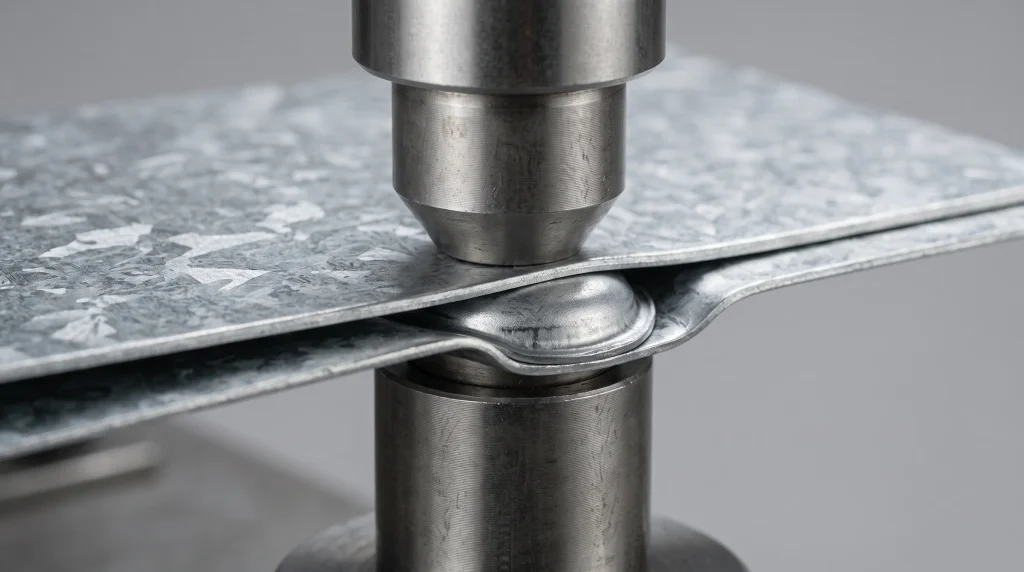
Capacitor discharge welding takes a different approach entirely. Instead of drawing continuous current, the machine charges a bank of capacitors over a short period, then discharges that stored energy into the joint in a single, extremely fast pulse, often measured in milliseconds. That speed limits the heat-affected zone, which matters when you’re welding thin sheet, dissimilar metals, or parts sensitive to distortion.
Heron’s capacitor discharge welders are offered in the H series, covering 10 to 40 KJ for heavier projection and stud welding, and the L series, covering 3 to 6 KJ for lighter precision work. Because so little heat spreads beyond the weld point, capacitor discharge machines are common on parts like nuts, studs, and pins welded onto coated or thin-gauge sheet, where a slower current delivery would warp or discolor the surface.
MFDC vs Capacitor Discharge Welder: Matching Technology to Part

The MFDC vs capacitor discharge welder decision comes down to three questions: what material thickness are you joining, how many welds does the part need, and how sensitive is the surrounding surface to heat.
When MFDC Is the Right Call
MFDC welding fits parts with heavier gauge steel, multiple weld points per cycle, or applications where consistent penetration across thousands of cycles matters more than raw speed. Automotive body panels, motor housings, and bolt-to-cover welds on compressors are common fits, since these parts need repeatable strength without the risk of current drift between welds.
When Capacitor Discharge Wins
Capacitor discharge welding fits stud and nut projection welding, thin sheet joins, and parts where minimizing heat spread protects a coating or a nearby component. Reservoir covers, silver contact tips, and appliance components with painted or plated surfaces typically favor this route, since the discharge is over before heat has a chance to travel.
Neither technology outperforms the other across the board. A plant running both automotive body welds and stud welding for brackets will often run both machine types side by side, not choose one over the other.
What Heron Builds Into Both Platforms
Heron manufactures both MFDC and capacitor discharge welders from standard, modular components, which means machines can be configured to match a specific KVA or KJ requirement without a full custom engineering cycle. Electrodes, transformers, and controls are produced in-house, so replacement parts and consumables come from the same source as the original machine, which shortens downtime when tooling wears out.
Every welder ships with the option to add real-time monitoring, which tracks weld current, force, and displacement on every cycle. For plants running quality audits or IATF documentation, that data record answers the “prove it” question auditors ask without needing a separate monitoring system bolted on afterward.
Getting the Right Machine Specified the First Time
The fastest way to avoid a costly mismatch is to bring actual part specs into the conversation before ordering: material type and thickness, coating, target cycle time, and expected weld count per shift. Heron’s engineering team reviews these details against both MFDC and capacitor discharge configurations and recommends a KVA or KJ range rather than pushing a default. For plants that run both technologies, Heron also builds them as complementary lines rather than one-off machines, so consumables, controls, and service support stay standardized across the floor.
If your team is still weighing the MFDC vs capacitor discharge welder decision, sending over your part drawing or a sample is the quickest way to get a straight answer instead of a generic recommendation.

Frequently Asked Questions
Q1. Is capacitor discharge welding faster than MFDC welding?
Yes, in terms of the actual weld pulse. Capacitor discharge welding releases stored energy in milliseconds, while MFDC welding sustains current over a longer cycle. Overall part throughput depends more on fixturing and part handling than on this difference alone.
Q2. Which technology uses less energy per weld?
Capacitor discharge welding typically draws less total energy per weld because the discharge is so brief, which is one reason it’s common on high-volume stud and nut welding lines.
Q3. Can one machine do both MFDC and capacitor discharge welding?
No. The two technologies use different power delivery systems, so they’re built as separate machine platforms. Plants that need both processes typically run separate MFDC and capacitor discharge welders on the same line.
Q4. Does material thickness decide which welder to choose?
It’s one of the biggest factors. Thicker, higher-strength steel generally favors MFDC welding for consistent penetration, while thin sheet or coated surfaces often favor capacitor discharge welding to limit heat spread.
Q5. How do I know which one fits my current production line?
The most reliable way is to share your part specifications, material, thickness, coating, and required weld count, with a welding equipment manufacturer directly. Heron’s team reviews these details before recommending a KVA or KJ configuration.
Q6. Does Heron offer both MFDC and capacitor discharge welders?
Yes. Heron manufactures both product lines from standard modular components, with MFDC welders from 110 to 880 KVA and capacitor discharge welders from 3 to 40 KJ, configurable to match specific applications.
If your production line is still weighing MFDC against capacitor discharge, Heron’s welding engineers can review your part drawings and recommend a configuration built for your exact volume and material. Request a machine spec recommendation and get a straight answer before you commit to either platform.