Nut projection welding is an efficient and precise resistance welding process that plays a critical role in automotive manufacturing and structural assembly, where joint reliability directly affects vehicle safety and long-term durability.
As lightweight materials, high-strength steels, and galvanized steels become standard in vehicle design, nut projection welding using customized nut welders has emerged as the most reliable and scalable joining solution.
This article provides a technical analysis of nut projection welding principles, process characteristics, key manufacturing challenges, and explains how Heron’s medium-voltage capacitor discharge nut projection welding technology addresses these issues in high-volume automotive production.

1. What Is Nut Projection Welding?
1.1 Definition of Nut Projection Welding
Nut projection welding is a resistance welding process in which one or more projections are pre-formed on the nut or mating parts. Under electrode force and current, heat generated at the projection contact creates a molten weld nugget, permanently joining the nut to the base material.
This process is widely used to attach small components like nuts, studs, and fasteners to larger stamped or formed parts, making it ideal for automotive manufacturing.
In automotive production, nut projection welding is critical. A single vehicle body contains about 2,000 nuts, with over 500 requiring welding. Many of these nuts are structural or safety-critical components used in body connections, chassis assemblies, and load-bearing joints. Weld integrity directly impacts vehicle safety, durability, and long-term reliability.
1.2 Nut Projection Welding Process Principles

The nut projection welding process consists of three phases:
Squeeze Phase
Under electrode force, the projection contacts the base sheet, increases the contact area, and breaks through surface oxides to ensure proper projection alignment.
Current and Heating Phase
As current is applied, the projection collapses and localized heating occurs at the contact area. Individual contact points melt and expand, forming a weld nugget and surrounding plastic zone of sufficient size.
Cooling and Solidification Phase
After current is cut off, the molten nugget solidifies under pressure, forming a stable and mechanically robust welded joint.
The key to nut projection welding lies in concentrating current at the projection. Extremely high current density is generated in a very short time, producing rapid localized heating and controlled nugget formation. This controlled energy input is one of the key reasons nut projection welding delivers consistent weld quality in high-volume automotive production.
2. Key Technical Challenges in Nut Projection Welding
Despite its advantages, nut projection welding presents several technical challenges:
2.1 Unstable Weld Quality
The most common issue is unstable weld quality, typically manifested as:
- Insufficient weld penetration, causingnut pull-out or fatigue failure during vehicle assembly.
- Incomplete projection collapse, resulting in false welds with no effective nugget formation.
- Poor concentricity between nut and base material, affecting downstream assembly accuracy.
These issues largely stem from traditional AC welders that use constant current output, which leads to unstable heat input or insufficient peak current during nugget formation. In high-volume automotive lines, this limitation significantly reduces the overall reliability of nut projection welding processes.
2.2 Material Limitations and Process Compatibility
As lightweighting trends accelerate, nut projection welding must accommodate increasingly complex material combinations:
- Galvanized steels:Traditional processes often damage zinc coatings beyond the weld zone, requiring grinding or post-treatment.
- High-strength and hot-stamped steels (e.g., Usibor® 1500): Excessive heat input can cause heat-affected zone softening and reduced joint strength.
- Dissimilar material joining (e.g., steel-aluminum):Conventional processes struggle with oxidation, spatter, and inconsistent weld formation.
2.3 High Positioning and Alignment Requirements
Multi-point nut projection welding places strict demands on part alignment and projection dimensions. Misalignment can lead to:
- Weld position deviation, affecting downstream assembly.
- Inconsistent projection dimensions,causing welding quality variations.
- Uneven electrode force distribution,resulting in localized incomplete welds or excessive penetration.
2.4 Equipment Dependence and Cost Considerations
Manufacturers also face operational and cost challenges:
- High electrode pressure requirement:
Requires high-power welding equipment with substantial initial investment costs.
- High energy consumption:
Traditional welding equipment exhibits high no-load power consumption, with welding material costs exceeding 15% of total production line expenses.
- Labor dependency:
Nut placement and welding quality rely heavily on operator expertise, with significant variability in performance stability across workers.
- High maintenance costs:
Rapid electrode wear, frequent downtime, and substantial maintenance requirements.
3. Advanced Nut Projection Welding Technology: Medium-Voltage Capacitor Discharge Systems
3.1 Technology Principle and Core Innovations
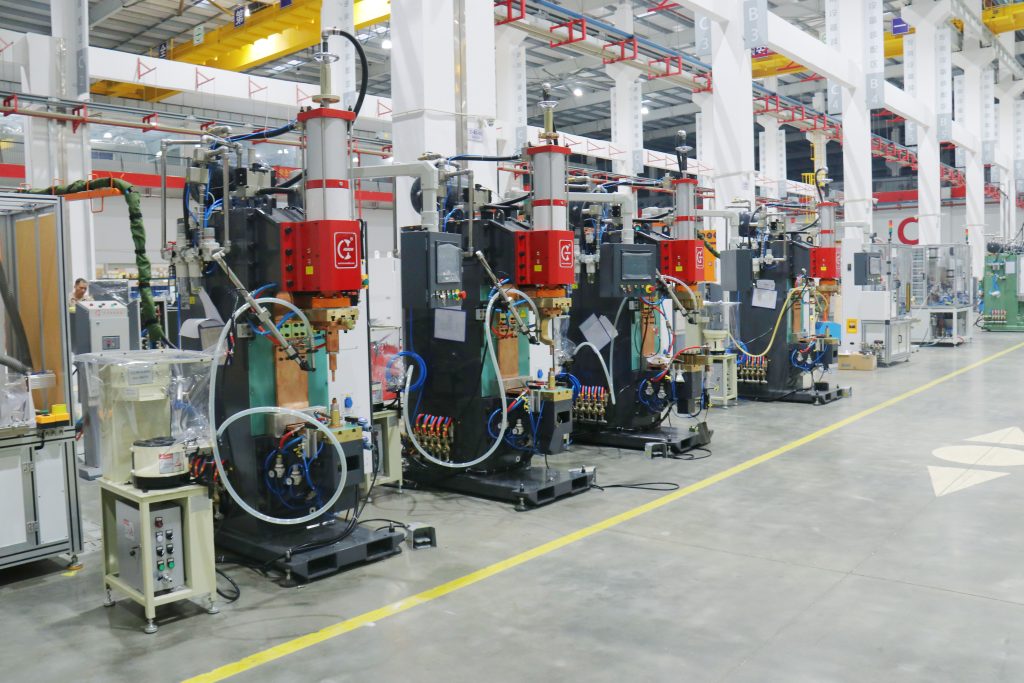
In 2010, Heron pioneered medium-voltage capacitor discharge nut projection welding technology, specifically designed to improve weld stability and energy efficiency in automotive manufacturing. The system uses a three-phase AC power supply to charge through a welding transformer under precise controller supervision. Once charged, the system disconnects from the power grid and releases low-voltage, ultra-high current to perform the weld.

Key innovations include:
- High-integrity weld nugget formation
Ultra-high current is delivered within microseconds, ensuring nugget formation before the projection softens or collapses prematurely, ultimately forming a reliable weld nugget.
- Thread and geometry protection
Compared with traditional resistance welding, parts are removed in a near-cool state with minimal heat-affected zone, virtually eliminating thread deformation.
- Energy saving and low consumption
Under the same application scenarios, charging power consumption is reduced by approximately 50%, and cooling water demand is reduced by 50% compared with traditional welding machines.
3.2 Technological Advantages and Targeted Solutions to Nut Projection Welding Challenges
Heron’s medium-voltage capacitor discharge projection welding machine provides a comprehensive solution for nut projection welding challenges in automotive manufacturing:
| Nut Projection Welding Challenge | Heron Medium–Voltage Capacitor Discharge Projection Welding Machine Solution |
| Unstable Weld Quality | Progressive current output ensures reliable nugget formation and eliminates cold or false welds. |
| Material Limitations and Process Compatibility | Suitable for various materials such as high-strength steel, hot-formed steel, and galvanized steel; protects the galvanized layer in non-welded areas without requiring post-treatment. |
| High Positioning and Alignment Requirements | Integrated high-precision fixtures and automated nut feeding systems reduce manual variability. |
| Equipment Dependence and Cost Considerations | Low energy consumption (annual energy cost is about 40% lower than traditional AC welders); compact footprint; eliminates tapping, rework, and repair welding processes, reducing labor and material costs. |
3.3 Structural Design and System Reliability
Heron’s medium-voltage capacitor discharge projection welding machine incorporates multiple engineering optimizations:
- Self-developed transformers and controllers
Backed by 35 years of manufacturing expertise, ensuring long service life and stable component supply.
- Extended electrodelifespan
Electrode lifespan is extended by 2 times, reducing replacement frequency and maintenance costs.
- Modular system architecture
Standardized, interchangeable modules simplify installation, commissioning, and future upgrades.
4. Automotive Applications of Nut Projection Welding Machines
Nut Projection Welding for Automotive Subframes
In automotive structural applications, nut projection welding machines must deliver consistent strength, positioning accuracy, and cycle time stability. A leading automotive parts manufacturer adopted customized Heron nut projection welding machines for subframe production, successfully resolving multiple issues:
- Unstable weld quality
Capacitor discharge technology ensures consistent weld strength and dimensional compliance, eliminating cold welds and misaligned nuts.
- Insufficient positioning accuracy
Precision locating pins and pneumatic clamping ensure accurate nut placement and reliable post-weld assembly fit.
- Production efficiency bottlenecks
The equipment achieves a cycle time of 5 seconds per weld, fully meeting the customer’s line cycle time requirements and ensuring production capacity.
- High labordependency
While maintaining flexible manual loading, nut feeding, welding, and part indexing were automated—significantly reducing operator variability.
As Industry 4.0 adoption accelerates, Heron’s medium-voltage capacitor discharge nut projection welding technology is positioned to play a critical role in next-generation nut welding applications—particularly in new energy vehicles, aerospace, and other safety-critical industries. By delivering superior weld integrity, lower energy consumption, and greater process stability, Heron provides manufacturers with a robust foundation for building safer, more reliable products.