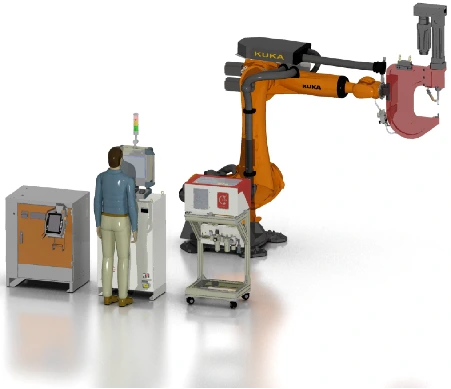
Every automotive fuel tank, shock absorber, water heater, and electric kettle on a production line has one thing in common: somewhere in its manufacturing process, two pieces of sheet metal needed to be joined in a continuous, leak-tight seam. Getting that seam right — consistently, at production speed, across thousands of cycles per shift — is exactly what a resistance seam welding machine is built to do.
Unlike spot welding, which produces discrete individual nuggets, a seam welding machine uses rotating roller electrodes to create an overlapping continuous weld along the entire seam length. The result is a structurally strong, gas-tight or liquid-tight joint that no other resistance welding process can match for sealed container and tubular component applications. This guide covers how seam welding machines work, what differentiates machine types, what to evaluate when specifying one, and how Heron Intelligent Equipment’s range — 50KVA to 200KVA in MFDC and AC configurations — addresses the full spectrum of industrial OEM seam welding requirements.
How a Resistance Seam Welding Machine Works
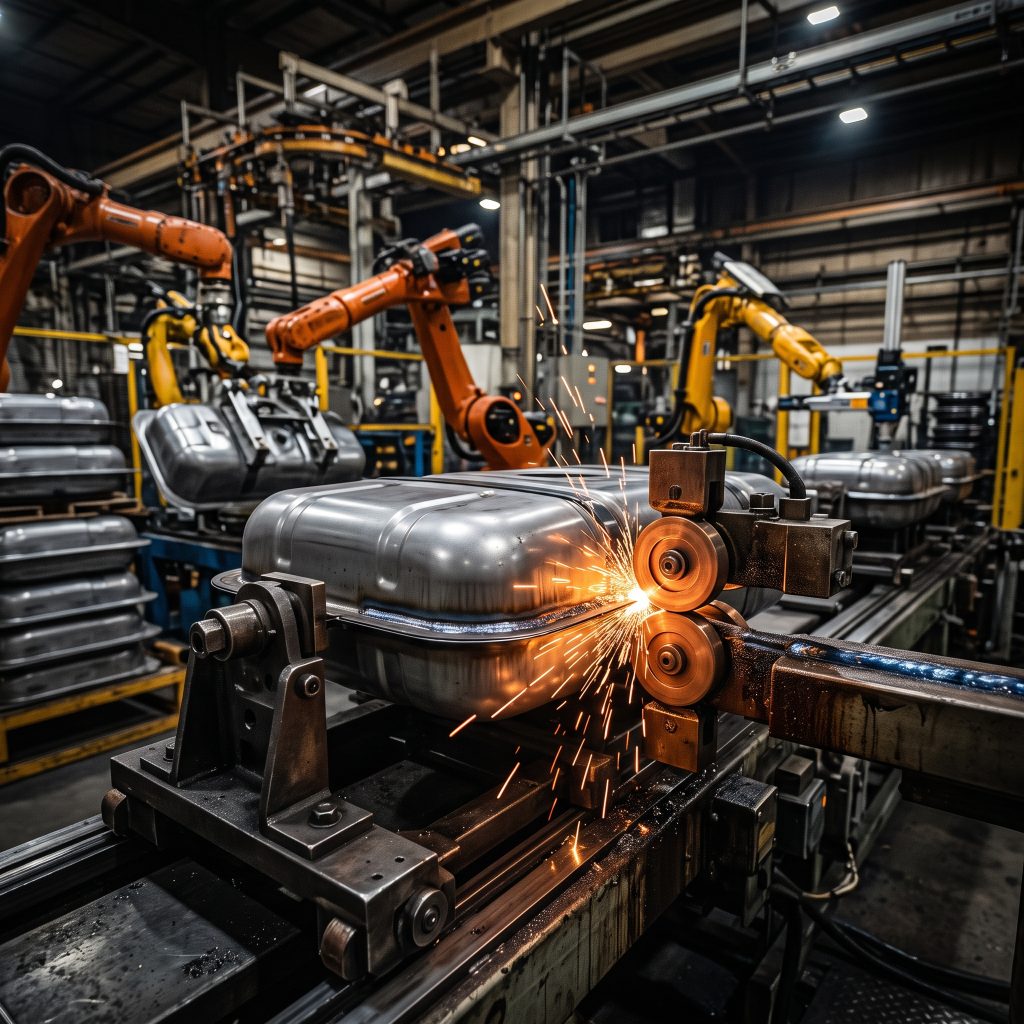
A seam welding machine passes overlapping sheet metal or tubular components between two rotating disc-shaped roller electrodes. Electrical current flows through the electrodes and into the workpiece, generating resistance heat that fuses the materials together. As the rollers rotate and advance the workpiece, timed current pulses create a continuous seam of overlapping weld nuggets — sealed and consistent across the entire joint length.
The roller electrodes serve two functions simultaneously: applying the clamping force needed for good electrical contact and feeding the workpiece through the weld zone at controlled speed. Because the electrodes are continuously water-cooled, a seam welding machine sustains continuous high-duty-cycle operation without electrode overheating — a critical requirement for high-volume OEM production lines. For more details.
The overlapping nugget structure produces joints that are inherently superior to spot-welded flanges for sealed container applications. No gap exists between weld spots, eliminating leak paths and delivering consistent mechanical strength across the entire seam. For fuel tanks, shock absorbers, water heaters, and pressure vessels, a seam welding machine delivers sealing performance that spot welding cannot achieve.
Types of Seam Welding Machines for OEM Production
Circular vs Longitudinal Configuration
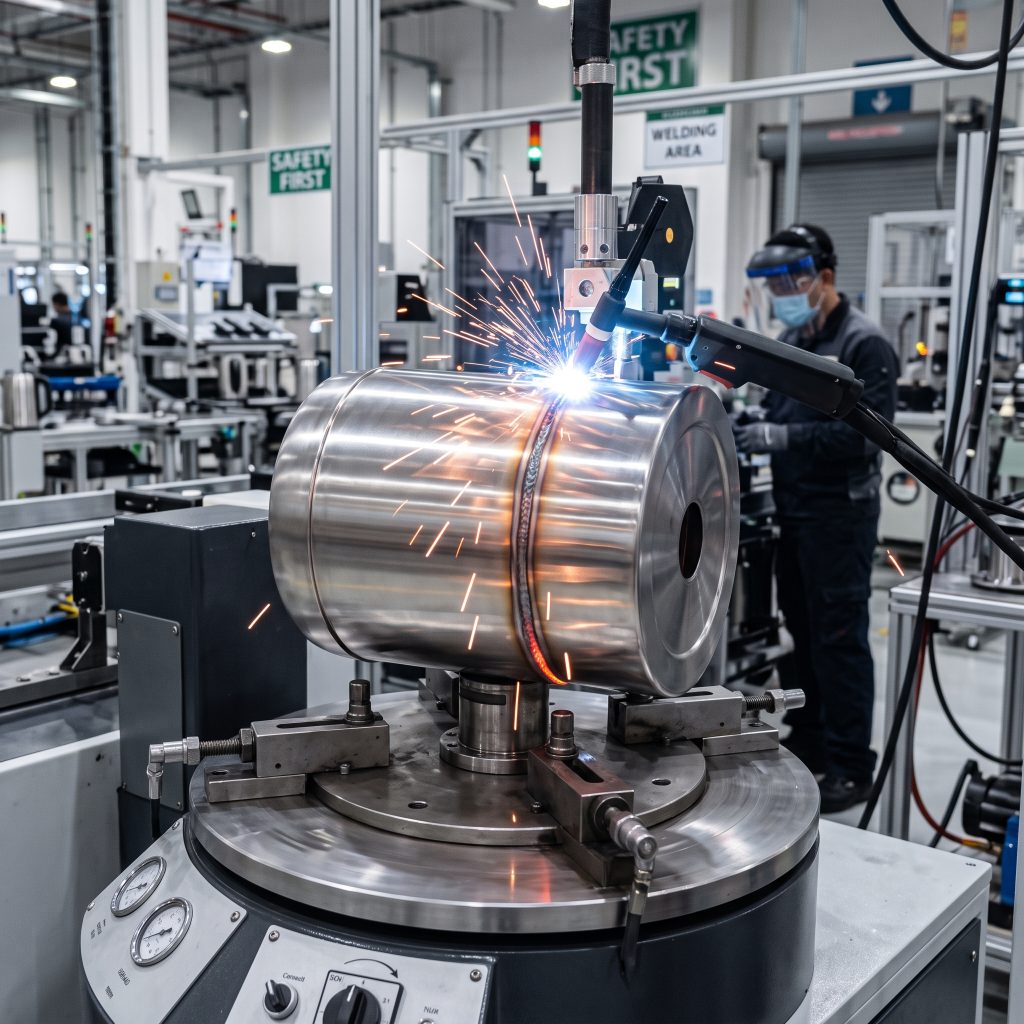
Circular seam welding machines weld the circumferential seam of cylindrical or tubular components — rotating the part under the roller electrodes to complete the circular joint in one continuous pass. Standard for oil heaters, electric kettles, shock absorber bodies, water tanks, and automotive fuel tank end caps.
Longitudinal seam welding machines weld along the straight length of a component — feeding it linearly through a fixed electrode assembly to join tube bodies, tank profiles, metal drums, and rectangular duct assemblies. Joint pre-accuracy is less critical since roller electrodes align and compress the seam flanges during welding.
MFDC vs AC Seam Welding Machines
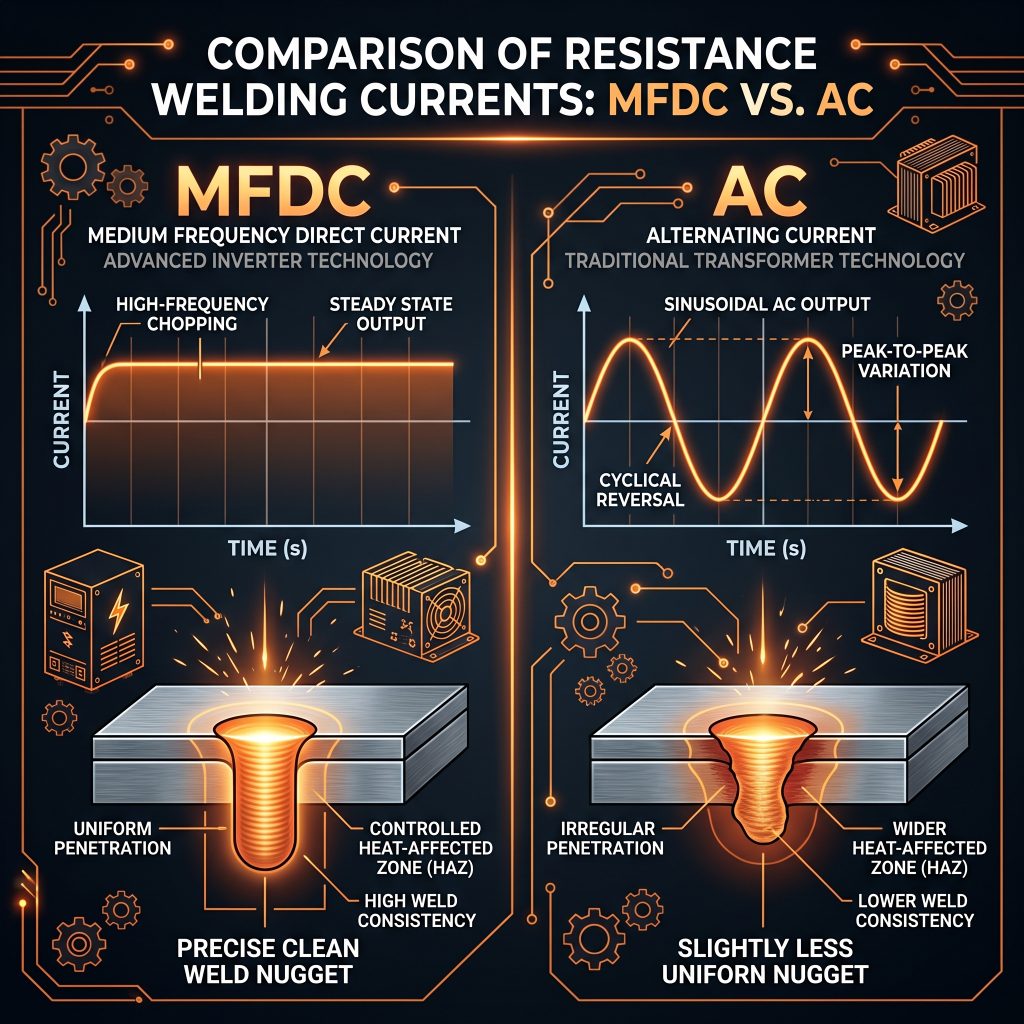
AC seam welding machines operate at mains frequency (50/60 Hz) and are well-established, cost-effective, and reliable for standard carbon steel, stainless steel, and aluminum at conventional production speeds. For OEM lines on consistent material specifications where capital cost is the primary constraint, AC seam welding machines deliver proven performance.
MFDC seam welding machines operate at medium frequency (1,000–4,000 Hz) with stable direct current output. Faster current rise, more precise heat control, and more consistent nugget geometry make MFDC the better choice for thin-gauge materials, coated steels, and aluminum alloys where AC’s sinusoidal profile causes inconsistent nugget formation. MFDC also delivers meaningful energy savings over AC at equivalent output — a material operating cost advantage on continuous production lines.
Key Criteria for Choosing a Seam Welding Machine
KVA range and materials — output must match both the material specification and component geometry. Thin-gauge stainless steel kettle bodies require lower heat input than thick-wall carbon steel fuel tank assemblies. Confirm the machine’s KVA range, electrode force, and electrode geometry cover your full production mix.
Welding speed and throughput — seam welding speed directly determines cycle time. Confirm the machine’s speed range matches the pulse frequency and overlap percentage your joint specification requires — and allows for planned production rate increases.
Cooling and continuous operation — OEM seam welding is a high-duty-cycle process. The machine’s forced water-cooled circulation must maintain stable electrode temperature under full production load without requiring cooling breaks that interrupt line flow.
Weld quality and monitoring — for leak-tight and pressure-retaining applications, every seam weld must be verified. Confirm the machine supports inline process monitoring capturing current, electrode force, and speed data for quality assurance and production traceability.
Heron’s Seam Welding Machines for Industrial OEM Production
Heron Intelligent Equipment manufactures a complete resistance seam welding machine range — MFDC and AC, circular and longitudinal — covering 50KVA to 200KVA for automotive, home appliance, electrical, and hardware OEM applications globally.
MFDC Longitudinal Seam Welder (200KVA) — MFDC precision in a longitudinal configuration for tubular components, rectangular tank bodies, and linear seam applications where stable DC output and tight heat control improve weld quality on demanding materials.
MFDC Circular Seam Welder (165–200KVA) — circumferential seam welding with MFDC’s faster current rise and consistent DC output. Ideal for shock absorber bodies, oil heaters, water tanks, and cylindrical components where coated or thin-gauge material specifications demand tighter heat control than AC provides.
AC Circular Seam Welder (50–200KVA) — broad output range for circular seam welding on standard carbon steel, stainless steel, and aluminum components. The versatile choice for OEM lines producing mixed-gauge component ranges on established material specifications.
AC Longitudinal Seam Welder (50–200KVA) — proven performance for straight seam applications on tubes, tank bodies, and metal drum assemblies across hardware, automotive, and industrial manufacturing sectors.
All Heron seam welding machines feature forced water-cooled circulation for high-load continuous operation, multiple welding method options, and compatibility with Heron’s real-time quality monitoring system for in-process weld quality assurance and full production traceability.
Contact Heron’s engineering team to discuss the right seam welding machine configuration for your production line.
MFDC vs AC Seam Welding Machines: Quick Comparison
| Criteria | MFDC Seam Welding Machine | AC Seam Welding Machine |
|---|---|---|
| Current type | Direct current (DC) | Alternating current (AC) |
| Heat control precision | High | Moderate |
| Thin-gauge and coated materials | Excellent | Good on standard grades |
| Weld nugget consistency | High | Moderate |
| Energy efficiency | Higher | Lower at equivalent output |
| Capital cost | Higher | Lower |
| Heron output range | 165–200KVA | 50–200KVA |
| Best suited for | Demanding materials, high-mix OEM | Standard steel/aluminium, cost-sensitive lines |
Where Heron’s Seam Welding Machines Are Deployed
Automotive — fuel tank body seams, shock absorber tubes, and pressurised hydraulic assemblies where gas-tight and liquid-tight joint integrity is a safety requirement.
Home appliances — electric kettle bodies, oil heater tanks, and water heater inner tanks where circular and longitudinal seam welds must deliver leak-tightness alongside acceptable surface finish.
Hardware and industrial — metal drums, HVAC duct assemblies, and storage tank bodies where longitudinal seam welding on carbon and stainless steel must meet structural and containment specifications at high volume.
Electrical — transformer housings and sealed electrical enclosures where seam welding delivers joint continuity that spot-welded flanges cannot achieve.
Explore Heron’s home appliance and automotive parts case studies to see seam welding machines in real OEM environments, or contact Heron’s engineering team to specify the right machine for your application.
Frequently Asked Questions
Q1. What is a resistance seam welding machine and how does it differ from spot welding?
A resistance seam welding machine uses rotating roller electrodes to create a continuous, overlapping seam of weld nuggets — producing a sealed, leak-tight joint across the entire seam length. Spot welding produces discrete individual nuggets at set intervals, leaving gaps unsuitable for pressure-retaining or liquid-tight applications. Seam welding machines are the standard solution for fuel tanks, water heater tanks, and cylindrical assemblies where joint continuity is a production requirement.
Q2. What is the difference between circular and longitudinal seam welding machines?
A circular seam welding machine rotates the component under the roller electrodes to weld the circumferential seam of cylindrical parts — kettles, oil heaters, shock absorber bodies. A longitudinal seam welding machine feeds the component linearly through the electrode assembly to weld along the straight length — tubes, rectangular tank bodies, metal drums. The right configuration depends entirely on the component geometry.
Q3. When should I choose MFDC over AC for a seam welding machine?
Choose MFDC when your material specification includes thin-gauge sheets, coated steels, or aluminum alloys requiring tighter heat control and more consistent nugget formation than AC provides. AC seam welding machines remain cost-effective for standard carbon and stainless steel on consistent, well-defined material grades where output variability does not compromise joint quality.
Q4. Can Heron’s seam welding machines be customised for specific production requirements?
Yes. Beyond the standard MFDC and AC range, Heron designs custom seam welding machines and complete production line solutions tailored to specific component geometries, material specifications, and throughput requirements — integrating automated handling, fixture systems, and quality monitoring from standalone machines to fully integrated OEM production lines.
Conclusion
A resistance seam welding machine is the production foundation for every OEM line requiring continuous, leak-tight seam joints — from automotive fuel tanks to home appliance water heaters to industrial metal drums. Choosing the right configuration — circular or longitudinal, MFDC or AC, and the correct KVA range — directly determines weld quality, throughput, and total cost of ownership.
Heron’s seam welding machine range covers every industrial OEM seam welding requirement: 50–200KVA output, MFDC and AC technology, circular and longitudinal configurations, forced water-cooling for continuous operation, and custom production line integration — backed by over 30 years of resistance welding expertise.