Resistance Spot Welding Process plays a critical role in modern manufacturing, enabling companies to join sheet metal components quickly, efficiently, and with a high degree of consistency. From automotive assembly plants and HVAC production facilities to appliance manufacturing and electrical equipment fabrication, this welding method remains one of the most widely adopted metal joining technologies in industrial production.
Its ability to create strong weld joints without the need for filler materials or excessive heat input makes it a preferred solution for manufacturers focused on productivity, quality, and cost control.
As production demands continue to increase, manufacturers must ensure that every weld meets strict performance and quality standards. Even small variations in welding current, electrode force, or weld time can affect weld strength, product durability, and overall manufacturing efficiency.
This is why understanding the resistance spot welding process is essential for production engineers, welding specialists, plant managers, and OEM manufacturers seeking reliable and repeatable welding results.
With the growth of automation, robotics, and Industry 4.0 technologies, resistance spot welding has evolved beyond a simple joining process into a highly controlled manufacturing operation supported by advanced welding machines, intelligent controllers, and real-time monitoring systems.
Resistance Spot Welding Process: How Modern Manufacturers Achieve Strong, Consistent Welds
In this guide, we will explain how the resistance spot welding process works, the key principles behind weld formation, critical welding parameters, industrial applications, common challenges, and the strategies modern manufacturers use to achieve strong, consistent welds.
Manufacturers today face constant pressure to improve production efficiency, maintain product quality, and reduce operational costs. Whether producing automotive components, electrical equipment, HVAC systems, or household appliances, achieving reliable metal joints remains a critical part of the manufacturing process.
The resistance spot welding process has become one of the most widely used metal joining methods because it offers speed, repeatability, and compatibility with automated production environments. Unlike conventional welding methods that require filler materials, resistance spot welding joins metal sheets through controlled heat generated by electrical resistance and pressure.
As manufacturing facilities continue adopting automation and smart production technologies, resistance spot welding remains an essential solution for creating strong, consistent welds at high production volumes.
What Is the Resistance Spot Welding Process?
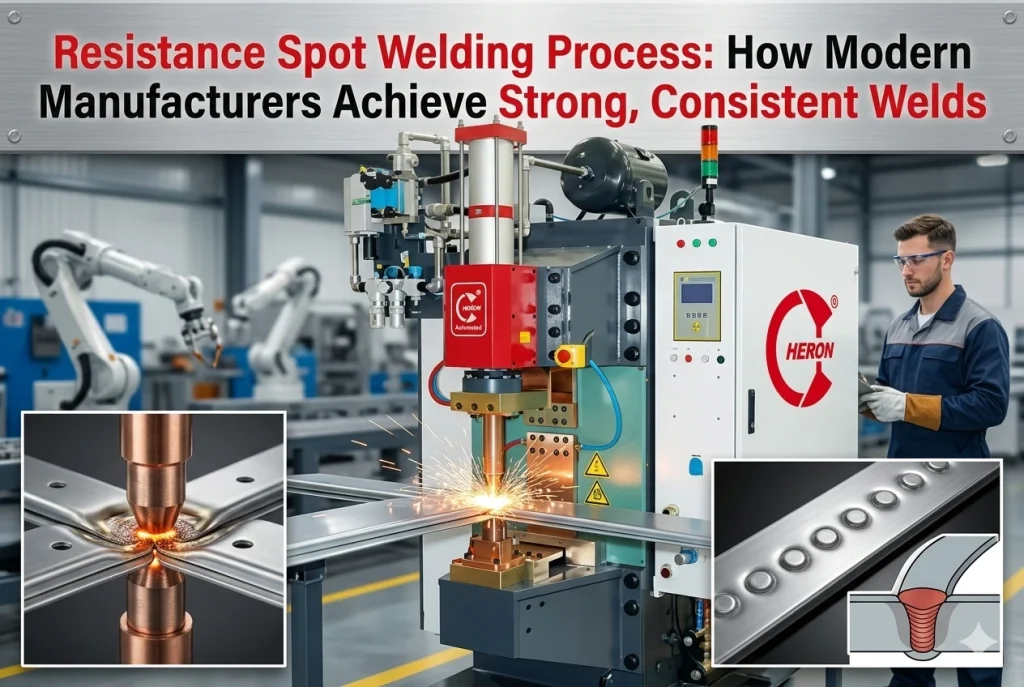
The resistance spot welding process is a resistance welding technique used to join two or more metal sheets by applying electrical current and pressure through copper electrodes.
When current passes through the metal surfaces, electrical resistance generates heat at the contact point. The heat causes the metal to soften and form a molten weld nugget. Once the current stops, pressure is maintained until the weld solidifies, creating a permanent joint.
The process is commonly used for:
- Automotive body panels
- Appliance manufacturing
- HVAC components
- Electrical enclosures
- Compressor assemblies
- Sheet metal fabrication
Because of its speed and consistency, resistance spot welding is often integrated into automated production lines and robotic welding cells.
How the Resistance Spot Welding Process Works: Step-by-Step Overview
Understanding the welding sequence helps manufacturers optimize weld quality and production efficiency.
Material Preparation and Joint Alignment
Before welding begins, metal sheets are positioned accurately to ensure proper contact between surfaces.
Surface contaminants such as oil, rust, dirt, or coatings can affect electrical conductivity and weld quality. Proper preparation helps achieve consistent results.
Key preparation activities include:
- Surface cleaning
- Material positioning
- Joint alignment verification
- Fixture setup
Accurate preparation reduces defects and improves process stability.
Electrode Force Application
Copper electrodes apply controlled pressure to the workpieces before electrical current is introduced.
The electrode force serves several purposes:
- Maintains contact between metal sheets
- Controls contact resistance
- Helps form the weld nugget
- Prevents excessive spatter
Proper force application is essential for producing strong weld joints.
Electrical Resistance Heating and Weld Nugget Formation
Once pressure is applied, electrical current passes through the metal sheets.
Heat is generated according to the resistance welding principle:
- Higher resistance produces more heat
- Heat concentrates at the interface between materials
- Localized melting occurs
- A weld nugget forms between the sheets
The size and quality of the weld nugget directly influence weld strength and durability.
Hold Time and Weld Solidification
After current flow stops, electrode pressure remains for a short period.
This hold time allows:
- Nugget solidification
- Grain structure stabilization
- Weld strength development
Maintaining adequate hold time improves weld integrity and reduces defects.

Key Principles Behind Resistance Spot Welding
Several factors determine the effectiveness of the resistance spot welding process.
The Role of Welding Current
Welding current is the primary source of heat generation.
Insufficient current may result in:
- Weak welds
- Small nugget formation
- Incomplete fusion
Excessive current can cause:
- Burn-through
- Electrode damage
- Excessive spatter
Current must be optimized based on material type and thickness.
Electrode Force and Contact Resistance
Electrode pressure influences electrical resistance and heat generation.
Proper force helps:
- Maintain stable electrical contact
- Improve nugget formation
- Reduce surface damage
- Increase weld consistency
Balancing force and current is critical for process optimization.
Heat Generation and Weld Formation
Heat generated during spot welding follows Joule’s Law, where heat output depends on current, resistance, and time.
Manufacturers control these variables to achieve:
- Proper fusion
- Desired nugget diameter
- Strong weld joints
- Repeatable results
Understanding the Welding Cycle
A typical welding cycle includes:
- Squeeze Time
- Weld Time
- Hold Time
- Off Time
Careful control of each stage ensures production reliability.
Essential Resistance Spot Welding Parameters for Consistent Weld Quality
Welding Current
Current levels directly impact heat generation.
Manufacturers adjust current according to:
- Material type
- Sheet thickness
- Joint design
- Production requirements
Weld Time
Weld time determines how long current flows through the workpieces.
Short weld times improve productivity but must still provide sufficient heat for proper fusion.
Electrode Pressure
Pressure affects both resistance and nugget formation.
Optimized pressure improves:
- Weld strength
- Surface appearance
- Process consistency
Electrode Material and Design
Copper alloy electrodes are commonly used because they offer:
- Excellent electrical conductivity
- High thermal conductivity
- Long service life
Electrode geometry also affects current distribution and weld quality.
Equipment Used in the Resistance Spot Welding Process
Resistance Spot Welding Machines
Modern resistance spot welding machines provide precise control over:
- Current
- Force
- Timing
- Monitoring functions
Advanced systems improve process stability and production efficiency.
Welding Electrodes and Welding Guns
Electrodes deliver current and pressure simultaneously.
Welding guns may be:
- Manual
- Pneumatic
- Servo-controlled
- Robotic
Selection depends on production requirements.
Welding Controllers and Monitoring Systems
Modern welding controllers help manufacturers:
- Monitor welding parameters
- Detect process deviations
- Improve quality control
- Reduce scrap rates
Real-time monitoring supports consistent production outcomes.
Automated Spot Welding Systems for High-Volume Production
Automated welding systems offer:
- Increased throughput
- Reduced labor requirements
- Consistent weld quality
- Improved process repeatability
Many automotive manufacturers rely heavily on robotic resistance spot welding systems.
Benefits of the Resistance Spot Welding Process in Industrial Manufacturing
Fast Production Cycles
Spot welding is one of the fastest metal joining methods available.
Cycle times are often measured in milliseconds, enabling high-volume manufacturing.
Strong and Consistent Weld Joints
When parameters are properly controlled, manufacturers can achieve:
- Reliable weld strength
- Repeatable performance
- Long-term durability
Cost-Effective Manufacturing
Resistance spot welding typically requires:
- No filler metal
- No shielding gas
- Minimal consumables
This helps reduce operating costs.
Compatibility with Automation and Robotics
The process integrates easily with:
- Robotic cells
- Automated assembly lines
- Smart manufacturing systems
This makes it ideal for Industry 4.0 environments.
Common Resistance Spot Welding Challenges and How to Overcome Them
Electrode Wear and Maintenance
Electrodes gradually wear during production.
Regular maintenance helps maintain:
- Current consistency
- Weld quality
- Equipment performance
Weld Spatter and Surface Defects
Excessive heat or incorrect parameters can produce spatter.
Solutions include:
- Current optimization
- Pressure adjustment
- Electrode maintenance
Inconsistent Weld Nugget Formation
Variation in material conditions or process settings can affect nugget size.
Manufacturers should implement:
- Process monitoring
- Parameter validation
- Preventive maintenance programs
Weak Weld Strength and Quality Issues
Poor weld strength often results from:
- Low current
- Incorrect force
- Contaminated surfaces
Root-cause analysis helps identify corrective actions.
How Manufacturers Improve Weld Consistency and Production Efficiency
Process Optimization Strategies
Manufacturers continuously optimize:
- Current settings
- Electrode force
- Cycle times
- Cooling systems
Optimization improves both quality and productivity.
Quality Control and Weld Inspection
Common inspection methods include:
- Peel testing
- Chisel testing
- Destructive testing
- Non-destructive testing
Regular inspection ensures compliance with production standards.
Real-Time Monitoring and Process Control
Advanced monitoring systems can track:
- Current output
- Force application
- Electrode performance
- Weld quality indicators
This supports data-driven manufacturing decisions.
Advanced Welding Automation Solutions
Industrial manufacturers increasingly adopt automated welding technologies to improve productivity and reduce process variation.
Companies such as Heron Welder provide resistance welding solutions that support automated production environments, helping manufacturers achieve greater process control and operational efficiency.
Industrial Applications of Resistance Spot Welding
Automotive Manufacturing
Automotive production remains one of the largest users of resistance spot welding.
Vehicle bodies may contain thousands of spot welds that ensure structural integrity and safety.
Electric Vehicle Component Production
EV manufacturers use spot welding for:
- Battery modules
- Structural components
- Lightweight assemblies
Consistent weld quality is essential for performance and reliability.
HVAC and Compressor Manufacturing
Resistance spot welding supports the production of:
- Compressor housings
- HVAC assemblies
- Refrigeration components
Home Appliance Production
Manufacturers use spot welding to assemble:
- Washing machines
- Refrigerators
- Ovens
- Dishwashers
Electrical Equipment and Sheet Metal Fabrication
The process is widely used for:
- Electrical cabinets
- Metal enclosures
- Industrial control panels
Resistance Spot Welding Process vs Other Metal Joining Methods
Resistance Spot Welding vs Projection Welding
Projection welding uses raised projections to concentrate current and heat.
Spot welding is often preferred for sheet metal applications requiring speed and flexibility.
Resistance Spot Welding vs Seam Welding
Seam welding creates continuous welds using rotating electrodes.
Spot welding creates individual weld points and is generally faster for many assembly applications.
Resistance Spot Welding vs Laser Welding
Laser welding offers precision and deeper penetration.
Resistance spot welding often provides a more cost-effective solution for high-volume sheet metal manufacturing.
Future Trends in Resistance Spot Welding Technology
Smart Manufacturing and Industry 4.0
Manufacturers increasingly integrate welding systems with factory networks for real-time data collection and analysis.
Robotic Spot Welding Integration
Robotics continues to improve:
- Productivity
- Precision
- Repeatability
Advanced MFDC Welding Systems
Medium Frequency Direct Current (MFDC) technology offers:
- Better energy efficiency
- Improved weld control
- Higher production performance
Data-Driven Welding Process Control
Manufacturers are leveraging production data to:
- Predict maintenance needs
- Optimize parameters
- Improve overall equipment effectiveness
How Modern Manufacturers Choose the Right Resistance Spot Welding Solution
When selecting a resistance spot welding system, manufacturers should evaluate:
- Material specifications
- Production volume
- Automation requirements
- Quality standards
- Future scalability
A properly selected welding solution supports long-term productivity, weld consistency, and operational efficiency.
Frequently Asked Questions (FAQs)
1. What is the resistance spot welding process?
The resistance spot welding process is a metal joining method that uses electrical current and pressure to fuse two or more metal sheets together. Heat is generated through electrical resistance at the contact point, forming a weld nugget that creates a strong and permanent joint.
2. What factors affect resistance spot welding quality?
Several factors influence weld quality, including welding current, weld time, electrode force, electrode condition, material thickness, surface cleanliness, and machine settings. Proper control of these variables helps ensure strong and consistent welds.
3. What industries commonly use resistance spot welding?
Resistance spot welding is widely used in automotive manufacturing, electric vehicle production, HVAC systems, compressor manufacturing, household appliance production, electrical equipment fabrication, and sheet metal processing industries.
4. How can manufacturers achieve stronger and more consistent welds?
Manufacturers can improve weld consistency by optimizing welding parameters, maintaining electrodes regularly, monitoring process data, implementing quality control procedures, and using advanced welding equipment with precise control capabilities.
5. What are the advantages of automated resistance spot welding systems?
Automated resistance spot welding systems increase production speed, improve weld consistency, reduce operator errors, lower labor costs, and support high-volume manufacturing environments. They also enable real-time process monitoring and data collection.
6. What materials can be welded using the resistance spot welding process?
The process is commonly used for low-carbon steel, galvanized steel, stainless steel, and certain aluminum alloys. Material type, thickness, and conductivity play important roles in determining the appropriate welding parameters.
7. Why is weld nugget formation important in resistance spot welding?
The weld nugget is the fused area created between metal sheets during welding. Its size and quality directly affect joint strength, durability, and overall weld performance. Proper nugget formation is essential for achieving reliable weld quality.
8. What are the most common resistance spot welding defects?
Common defects include weak welds, insufficient fusion, excessive weld spatter, electrode indentation, expulsion, cracks, and inconsistent nugget formation. These issues are often caused by improper welding parameters or poor equipment maintenance.
9. How does resistance spot welding compare to laser welding?
Resistance spot welding is generally more cost-effective for high-volume sheet metal production and requires less specialized equipment. Laser welding offers higher precision and deeper penetration but often involves higher equipment and operating costs.
10. How is Industry 4.0 changing the resistance spot welding process?
Industry 4.0 technologies are improving resistance spot welding through real-time monitoring, automated quality control, predictive maintenance, data analytics, and robotic integration. These advancements help manufacturers increase productivity, reduce downtime, and maintain consistent weld quality across production lines.
Summary : Maximizing Weld Quality, Productivity, and Manufacturing Performance with the Right Resistance Spot Welding Process
The resistance spot welding process remains one of the most effective methods for joining sheet metal in modern manufacturing. Its ability to deliver strong welds, fast cycle times, and repeatable performance makes it essential across industries such as automotive, HVAC, appliance, electrical equipment, and EV production.
By understanding welding principles, controlling critical parameters, implementing quality control measures, and adopting automation technologies, manufacturers can achieve stronger weld joints, higher productivity, and more reliable production outcomes. As manufacturing continues to evolve, resistance spot welding will remain a foundational technology supporting efficient and consistent metal joining operations.