Resistance welding remains the dominant joining process in automotive body-in-white (BIW) manufacturing, driven by its proven reliability, high productivity, cost-effectiveness, and continuous technological advancements. Although technologies such as laser welding, riveting, and adhesive bonding continue to expand their applications, resistance welding remains the first choice for high-volume vehicle production. Its excellent compatibility with thin-gauge sheet metal, weld cycle times as short as 0.2–0.5 seconds, and easy integration into automated production lines allow resistance welding to account for more than 80% of joining points in a typical BIW assembly.

I. Process Compatibility Driven by Body-in-White (BIW) Structural Requirements
1.1 Ideal for Thin-Sheet Metal Joining
Modern vehicle bodies are primarily built from cold-rolled steel, galvanized steel, and high-strength steel sheets, with thickness ranging from 0.5 mm to 3 mm. Because heat is generated only at the weld interface, resistance welding minimizes thermal distortion while maintaining dimensional accuracy and surface finish. Compared to laser welding, resistance welding offers greater tolerance for part dimensional variations and assembly gaps. It consistently delivers stable weld quality under normal production conditions, reducing the need for frequent process adjustments and supporting reliable high-volume manufacturing.
1.2 Meeting Critical Strength and Safety Requirements
A typical passenger vehicle body-in-white contains approximately 3,000 to 6,000 weld points. The quality and distribution of these welds directly affect body stiffness, crash safety performance, and long-term durability. Resistance welding delivers consistent joint strength and repeatable performance throughout production. Compared with conventional mechanical fastening methods, resistance welded joints typically offer superior shear strength and structural integrity, with shear strengths typically around 4 kN.
In safety-critical structures such as A-pillars, B-pillars, and door sill beams, resistance welding offers additional benefits. Its small heat-affected zone and filler-free process help preserve the mechanical properties of the base material while reducing the risk of brittle failures that can occur in some dissimilar-material joining applications.

II. Productivity and Cost Advantages for High-Volume Manufacturing
2.1 Fast Cycle Times for Mass Production
Resistance welding is designed for high-volume automotive manufacturing. Individual weld cycles typically range from 0.2 to 0.5 seconds, enabling extremely high production throughput. When combined with robotic servo welding guns, automated welding cells can achieve more than 60 welds per minute while maintaining consistent quality. This level of productivity often exceeds that of many riveting and laser welding processes.
For vehicle programs producing more than 300,000 units annually, resistance welding provides a clear cost advantage. The cost per weld point is typically only 30–50% of that of laser welding, while lower equipment and integration costs help manufacturers achieve a faster return on investment.
2.2 Lower Operating and Lifecycle Costs
Unlike many alternative joining technologies, resistance welding requires neither shielding gas nor filler material. This simplifies production and can reduce energy consumption by more than 25% compared to many conventional welding processes. Maintenance requirements are also generally lower than those associated with laser welding equipment, helping manufacturers reduce long-term operating costs.
Resistance welding also offers excellent production flexibility. A single resistance welding equipment can often support multiple vehicle platforms through parameter adjustments, allowing for faster model changeovers and more flexible manufacturing. By comparison, laser welding equipment frequently requires more extensive reprogramming and process validation when adapting to new materials or component designs, resulting in higher modification costs and longer implementation times.
III. Continuous Innovation Is Expanding the Capabilities of Resistance Welding
3.1 Advancing Lightweight Material Joining
The growing use of lightweight materials continues to challenge automotive joining technologies. While conventional resistance welding historically faced limitations when joining aluminum alloys and dissimilar materials, recent innovations have greatly expanded its capabilities.
Advanced weld nugget control technologies such as NCW (Nugget Control Welding) allow manufacturers to precisely control heat input and weld formation. This enables high-strength steel-to-aluminum joining while reducing the risk of brittle intermetallic layers. The resulting joints can achieve lap shear strengths above 6 kN, meeting the structural requirements of modern lightweight vehicle designs.
Recent advancements in welding equipment have also improved the economics of aluminum joining. Heron’s resistance welding solutions can reduce aluminum welding operating costs by up to 90% in selected applications while supporting demanding requirements such as die-cast aluminum structures, tube-to-sheet assemblies, and other complex lightweight components. These developments are accelerating the adoption of multi-material vehicle structures and steel-aluminum hybrid body designs throughout the automotive industry.
3.2 Intelligent Welding for Enhanced Quality Control
Modern resistance welding equipment has evolved far beyond traditional welding equipment. Through the integration of real-time monitoring and intelligent process control, manufacturers can achieve higher levels of quality assurance and process stability. Key welding parameters such as current, force, and displacement can be monitored and adjusted in real time through closed-loop control. This enables manufacturers to move beyond traditional sampling inspections and implement 100% online quality monitoring and real-time process control. As a result, weld defects can be detected earlier, process consistency can be improved, and overall production quality can be enhanced.
The widespread adoption of medium-frequency DC (MFDC) inverter power supplies, servo welding guns, and advanced monitoring systems has further increased welding precision. With millisecond-level control of critical welding parameters, today’s resistance welding technologies can reliably meet the demands of high-strength steels, multi-layer material stacks, and other challenging automotive applications.
IV. A Mature Manufacturing Ecosystem and Proven Industry Standards
4.1 Highly Developed Production Infrastructure
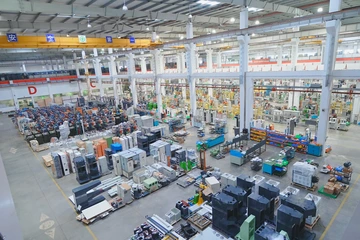
Resistance welding is firmly established in automotive body production worldwide. More than 80% of welding stations in body-in-white(BIW) assembly lines are built around resistance welding processes. From pedestal welders and suspended spot welding guns to fully integrated robotic welding guns, the industry has developed a mature manufacturing ecosystem that includes equipment suppliers, automation solutions, process standards, and quality control systems.
As the resistance welding industry continues to mature, advancements in power electronics, process control, and equipment manufacturing are driving greater accessibility and cost efficiency. The increasing availability of high-performance medium frequency direct current (MFDC) inverter welding systems and other advanced technologies is helping automotive manufacturers reduce both capital investment and long-term maintenance costs while maintaining consistent production quality.
4.2 Supporting the Future of Lightweight and Electric Vehicles
As the transition to electric vehicles continues, resistance welding remains a key manufacturing technology for components such as battery trays, battery housings, and motor assemblies. For example, resistance-welded stainless-steel battery trays can reduce weight by 5%, increase battery space by 5% -10%, and enhance fire resistance performance. These benefits align closely with the industry’s priorities of safety, driving range, and manufacturing efficiency.
The growing adoption of multi-material vehicle architectures is also creating new opportunities for resistance welding. Advances in process control and dissimilar-material joining technologies have expanded its application beyond traditional same-material welding, enabling reliable joining solutions for increasingly complex steel-aluminum hybrid structures. As a result, resistance welding is becoming an even more important technology for lightweight vehicle production and cost reduction.

Conclusion: Why Resistance Welding Remains Essential in Automotive Manufacturing
Resistance welding remains the preferred joining technology in automotive manufacturing because it delivers the right balance of productivity, quality, reliability, and cost. Although technologies such as laser welding, self-piercing riveting, and adhesive bonding continue to evolve, resistance welding is also advancing through innovations such as NCW technology, intelligent monitoring systems, MFDC inverter power supplies, and servo welding guns. As vehicle manufacturers pursue lightweight designs, higher levels of automation, and greater production efficiency, resistance welding remains one of the most practical and scalable joining solutions available. Its ability to support both conventional steel structures and emerging multi-material vehicle architectures ensures that it will continue to play a central role in the future of automotive manufacturing. More than simply a joining process, resistance welding remains a critical technology enabling the next generation of lightweight, intelligent, and highly efficient automotive production.