Self Pierce Riveting Gun: Working Principle, Types & Industrial Uses
What Is a Self Pierce Riveting Gun?
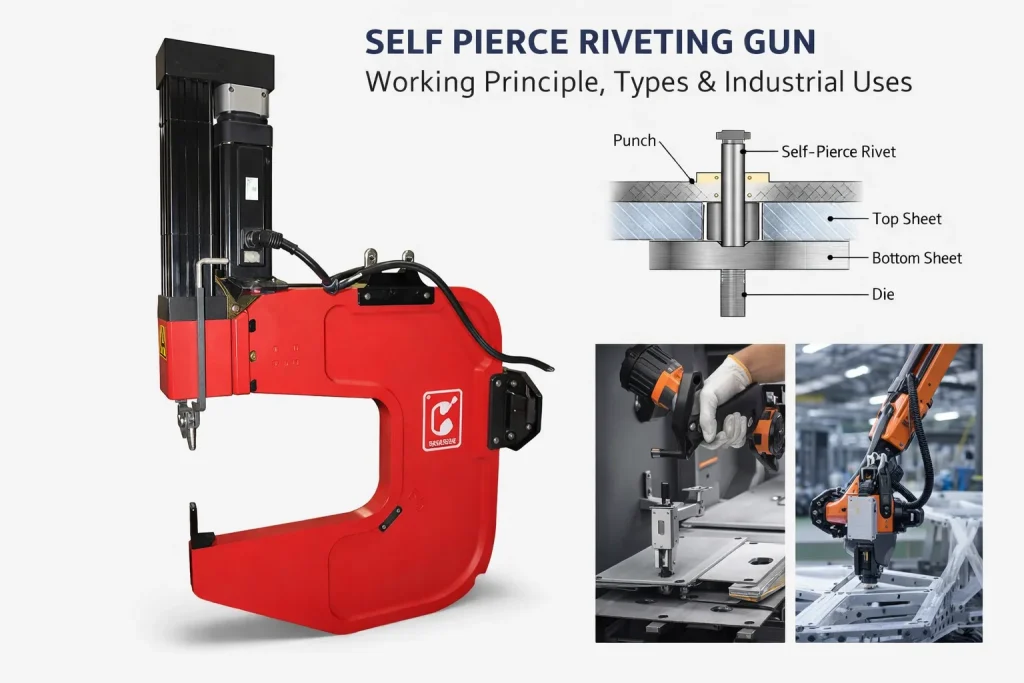
A self pierce riveting gun is an industrial joining tool used in self piercing riveting (SPR) systems to mechanically join two or more sheets of material without pre-drilling holes. It is widely used in automotive manufacturing, sheet metal production, and lightweight structural assembly.
Unlike traditional welding or bolting, the SPR gun creates a cold mechanical joint by driving a specially designed rivet through the top sheet and partially into the bottom sheet. The rivet deforms and locks the materials together using a die system underneath.
Key Characteristics:
- No pre-drilling required
- No heat generation (cold joining process)
- Suitable for dissimilar materials
- High-speed automated production compatibility
Commonly Used In:
- Automotive body structures
- Appliance manufacturing
- HVAC duct systems
- Aluminum and multi-material assemblies
A self pierce riveting gun is typically part of a complete self piercing riveting system, which includes feeding units, controllers, and force monitoring systems.

How Does a Self Pierce Riveting Gun Work? (Working Principle)
The working principle of a self pierce riveting gun is based on mechanical deformation and controlled force application.
Step-by-Step Process:
- Material Positioning
Two or more sheets (e.g., aluminum + steel) are aligned over a die. - Rivet Feeding
A rivet is automatically fed into the gun system. - Piercing Action
The self piercing rivet is driven through the top sheet under high force. - Die Deformation
The bottom sheet is pressed into a die cavity, allowing material flow. - Mechanical Locking
The rivet legs flare outward, forming a strong mechanical interlock. - Joint Completion
A permanent, load-bearing joint is formed without heat.
Engineering Principle:
The process relies on:
- Plastic deformation of metal sheets
- Force-controlled riveting pressure
- Cold forming technology
Why It Matters:
- Eliminates heat affected zones (HAZ)
- Preserves material strength
- Enables joining of coated and mixed materials
This is why manufacturers like Heron Welder integrate SPR systems into high-efficiency production lines for automotive and industrial assembly.
Key Components of a Self Piercing Riveting Gun
A modern SPR gun is a precision-engineered device with multiple integrated systems:
1. Rivet Feeding System
Automatically delivers rivets into the gun head for continuous operation.
2. Punch Unit
Applies controlled force to drive rivet through material layers.
3. Die Unit
Supports lower sheet and enables controlled material flow.
4. Hydraulic / Servo Drive System
Generates force ranging from medium to high pressure depending on application.
5. Control System
Monitors:
- Force curve
- Rivet positioning
- Cycle time
- Quality consistency
6. Safety & Feedback Sensors
Ensure accurate joining and prevent defects.
Types of Self Pierce Riveting Guns
Different industrial applications require different SPR gun configurations.
1. Manual Self Pierce Riveting Gun
- Operator-controlled
- Used in low-volume production
- Flexible but slower
2. Pneumatic Riveting Gun
- Uses compressed air
- Suitable for medium production lines
- Cost-effective solution
3. Hydraulic SPR Gun
- High force capability
- Used in automotive structural parts
- High durability and precision
4. Servo-Driven Riveting Gun
- Fully controlled by servo motors
- High precision force control
- Ideal for automated production lines
5. Robotic Self Piercing Riveting System
- Integrated with robotic arms
- Used in automotive body-in-white production
- Fully automated high-speed manufacturing
These systems are commonly integrated into Heron Welder automated welding and joining solutions for industrial clients.
Industrial Uses of Self Pierce Riveting Gun
The self pierce riveting gun system is widely used in industries requiring strong, lightweight, and high-speed joining.
1. Automotive Body Assembly
Used for:
- Car doors
- Roof panels
- Chassis structures
SPR is preferred because it joins aluminum and high-strength steel without weakening the structure.
2. Sheet Metal Manufacturing
Used in:
- Electrical enclosures
- Control cabinets
- Metal frames
3. HVAC Industry
Used for:
- Air ducts
- Cooling system housings
- Ventilation panels
4. Appliance Manufacturing
Used in:
- Washing machines
- Refrigerators
- Industrial equipment housings
5. Battery Pack Assembly (EV Industry)
Used for:
- Lithium battery enclosures
- Lightweight structural frames
- High-strength safety assemblies
Advantages of Self Pierce Riveting Over Welding
Self piercing riveting is increasingly replacing welding in modern manufacturing.
Key Advantages:
- No heat-affected zone (HAZ)
- Suitable for coated materials
- Strong joint strength across dissimilar metals
- No surface preparation required
- Lower distortion compared to welding
Engineering Insight:
Welding can weaken materials due to heat exposure, while SPR maintains base material integrity.
Self Pierce Riveting Gun vs Spot Welding: Key Differences
| Feature | Self Pierce Riveting | Spot Welding |
|---|---|---|
| Heat Usage | None | High heat required |
| Material Compatibility | Dissimilar metals | Limited |
| Surface Damage | Minimal | Possible oxidation |
| Strength | High mechanical lock | Fusion-based |
| Automation | Fully compatible | Fully compatible |
This makes SPR ideal for modern lightweight manufacturing, especially in automotive and EV industries.
How to Choose the Right Self Pierce Riveting Gun
Selecting the right SPR gun depends on production requirements.
Key Factors:
- Material type (aluminum, steel, composites)
- Sheet thickness
- Production speed requirement
- Automation level
- Force requirement (kN rating)
Industrial Tip:
For high-volume manufacturing, servo-driven or robotic SPR systems are preferred due to repeatability and quality control.
Common Challenges and Solutions in SPR Systems
1. Rivet Misalignment
Solution: Improve feeding system calibration
2. Material Cracking
Solution: Optimize force settings and die selection
3. Inconsistent Joint Quality
Solution: Use real-time monitoring systems
4. Tool Wear
Solution: Regular maintenance and high-grade die materials
Why Choose an Industrial Self Pierce Riveting Gun Manufacturer
A reliable manufacturer ensures:
- System integration with production lines
- Custom engineering support
- Long-term maintenance service
- Automation compatibility
Companies like Heron Welder focus on delivering industrial-grade riveting and welding automation systems for global manufacturers.
Case Study: Automotive Production Line Integration
In a recent automotive project, a robotic SPR system was integrated into a body-in-white assembly line:
Results:
- 35% faster joining cycle time
- 28% reduction in production defects
- Improved multi-material joining capability
- Reduced welding dependency
This demonstrates how SPR technology improves modern manufacturing efficiency and product quality.
Final Insight
The self pierce riveting gun is not just a tool it is a core enabling technology for modern lightweight manufacturing. With increasing demand for aluminum, EV structures, and mixed-material designs, SPR systems are becoming a standard in global production lines.
For manufacturers like Heron Welder, this latest technology represents a key part of next-generation automated welding and joining solutions.