Sheet metal spot welders are widely used for joining metal components in automotive, appliance, electrical, and other high-volume manufacturing industries. Using controlled welding current and electrode pressure, these welders ensure consistent weld quality, strong joints, and reliable production performance.
Sheet metal spot welders are applied across various industries, including automotive components, home appliances, new energy, and electrical assemblies. Selecting the right equipment requires careful consideration of material characteristics, sheet thickness, welding requirements, and production capacity.
This guide explains how sheet metal spot welders work, the key factors affecting weld performance, and how Heron provides customized resistance welding solutions for different manufacturing needs.

I. How Sheet Metal Spot Welding Works
Sheet metal spot welding is based on the Joule heating principle ( Q = I²Rt ), where heat is generated by the resistance of current flow through the metal sheets. During welding, heat is produced mainly at the interface between the sheets, causing the material to soften and form a weld nugget within milliseconds.
Welding Process
When welding current passes through two overlapping metal sheets, heat is generated at the sheet interface where electrical resistance is highest. As the temperature rises, a localized molten area forms and develops into a weld nugget. After cooling and solidification, the weld nugget creates a permanent joint between the metal sheets with consistent weld strength.
Challenges in Aluminum Spot Welding
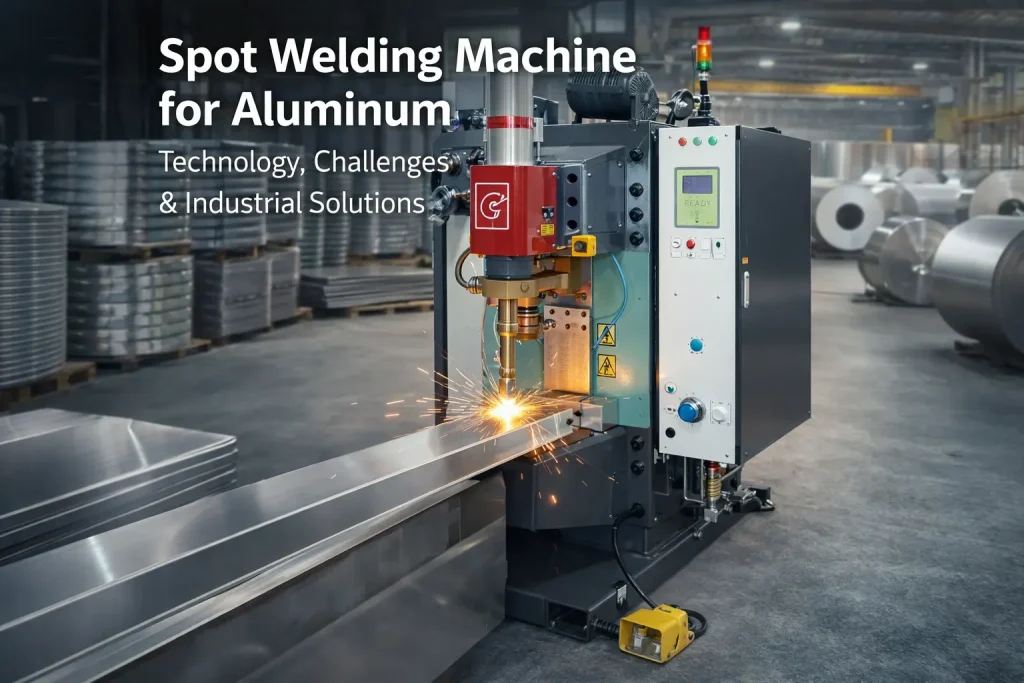
With the growing adoption of aluminum components in automotive and other manufacturing applications, aluminum spot welding has become increasingly important. Compared with carbon steel, aluminum alloys have higher electrical and thermal conductivity, requiring higher welding current and more precise heat control during the welding process. In addition, aluminum surfaces naturally develop a thin oxide layer (Al₂O₃), which increases contact resistance and can affect weld nugget formation.
Welding aluminum requires spot welders with high current output and fast response control. A sheet metal spot welder must deliver the required welding energy within a short period of time to break through the oxide layer while minimizing heat loss, ensuring stable weld nugget formation and consistent weld performance.
The Role of Closed-Loop Control Systems
Sheet metal spot welders equipped with closed-loop control systems can continuously monitor welding parameters and make automatic adjustments during the welding process. Through secondary current feedback and constant voltage or constant power control, the system compensates for variations caused by power fluctuations, electrode wear, and material changes. This closed-loop control capability improves weld consistency by maintaining a stable weld nugget size throughout production.

II. Advanced Welding Solutions: Heron‘s Equipment Portfolio
With over 30 years of experience in resistance welding technology, Heron develops and manufactures welding equipment designed for high-volume and automated production applications.
Our portfolio includes MFDC sheet metal spot welders, servo robotic welding guns, and automated welding production lines, supporting automotive, new energy, and other manufacturing industries with consistent weld quality, improved productivity, and flexible production capabilities.
1. MFDC Sheet Metal Spot Welders: Precise Heat Control for Aluminum Welding
Aluminum spot welding presents unique challenges due to its high thermal conductivity and tendency to generate weld spatter. Heron’s MFDC sheet metal spot welders address these challenges with precise DC current control and a frequency range of 1 kHz to 4 kHz.
Compared with traditional AC spot welding machines, MFDC technology provides more precise current regulation and improved heat control during the welding process. Combined with millisecond-level multi-pulse welding technology, Heron’s welders control heat input throughout each welding cycle, including preheating, welding, and cooling stages. This control strategy reduces the risk of cracking and improves weld consistency in applications such as EV battery trays and aluminum body structures.

2. Servo Robotic Welding Gun: Automated Spot Welding Equipment for Automotive Manufacturing
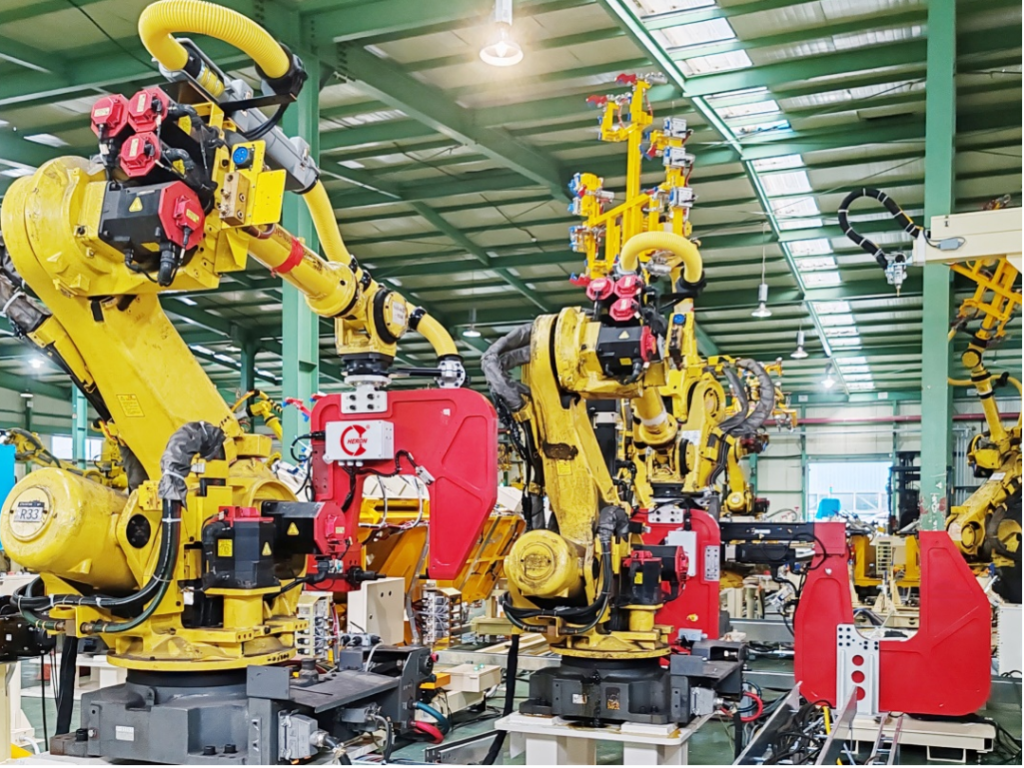
In highly automated automotive production lines, Heron’s lightweight servo robotic welding guns are developed for flexible spot welding applications. These servo welding guns can also be configured as part of a complete sheet metal spot welder system for automated production.
Compared with traditional pneumatic welding guns, the servo-driven system provides precise digital control of electrode force with real-time adjustment during welding. With a standardized interface design and up to 80% commonality across models, Heron’s welding guns can be integrated with various six-axis robot platforms for streamlined deployment and easier system configuration. The servo control system supports shorter cycle times and consistent weld performance in automated production.

3. Multi-Spot Welding Automated Production Lines for High-Volume Production
Heron develops modular multi-spot welding production lines for high-volume manufacturing of complex structural components.
The system integrates multiple MFDC spot welding machines, servo robotic welding guns, and precision positioning fixtures to synchronize welding operations across multiple stations. The modular configuration supports consistent welding performance, efficient production flow, and scalable automation for large-scale manufacturing applications.
III. Industry Applications: From Spot Welding Machine to Automated Welding Production Lines
Heron’s resistance welding solutions are applied across automotive, new energy, and other manufacturing industries, supporting high-volume production with stable welding performance and process control.
1. Automotive Spot Welding Solutions for Lightweight Vehicle Manufacturing
In body-in-white production for new energy vehicle manufacturers such as GAC Aion, BYD, and XPeng, Heron welding systems are applied to key structural components, including battery pack enclosures, A/B pillar reinforcements, and other body structures.
Equipped with zero-spatter welding technology and the HRC650 resistance welding monitoring system, Heron solutions deliver real-time process monitoring and complete welding data traceability. These technologies support lightweight vehicle structures by maintaining consistent weld quality and improving process reliability for safety-critical components.

2. Aluminum Spot Welding Solutions for Home Appliance Manufacturing
In refrigeration compressors and home appliance manufacturing, Heron welding solutions are applied to aluminum component assembly processes. For aluminum components such as air-conditioning heat exchangers and refrigerator evaporators, Heron’s MFDC welding technology provides precise dynamic resistance control to maintain consistent weld quality, stable sealing performance, and repeatable welding results.
Multi-point welding and seam welding automation systems streamline production processes, reduce energy consumption, and minimize manual operations.
With decades of experience in resistance welding technology, Heron develops welding systems focused on precision control, production flexibility, and process reliability. Heron’s technologies support manufacturers in automotive and aluminum applications with reliable welding performance and consistent process control.