Spot welding power supply selection directly affects weld consistency, material compatibility, and production cost. With over 30 years of experience, Heron has seen that engineers often focus on equipment specifications, but overlook the process physics that actually control weld quality. This article compares MFDC and AC systems and provides a practical framework for choosing the right solution.
I. Fundamental Differences: Current Output
The key difference between AC and MFDC spot welding lies in how current is delivered during the weld cycle.
Traditional AC spot welding systems operate at line frequency (50Hz) and use transformers to produce a sinusoidal current. Because the current crosses zero in each cycle, so heat input is intermittent. This lowers thermal efficiency and makes the process more sensitive to surface condition and circuit variation. As a result, AC systems have limited ability to maintain stable current control.
Heron’s MFDC spot welding provides a more stable and controllable current output. The power conversion process is: three-phase AC input → rectification → filtering → IGBT inverter (converted to 1000 Hz) → transformer step-down → secondary rectification to DC.
The output is continuous DC with no zero-crossing, enabling stable heat input during spot welding. This improves process control beyond waveform characteristics. With low inductive loss and fast inverter response, MFDC systems achieve millisecond-level current control, improving weld consistency and repeatability.

II. Performance Comparison: MFDC vs AC
MFDC and AC spot welding differ in three areas: process stability, energy efficiency, and system integration.
In terms of process stability, AC spot welding operates at low frequency and is sensitive to power fluctuations. Performance also drops when welding high-conductivity materials such as aluminum alloys and galvanized steel. Because of the waveform, AC spot welding produces more spatter, leading to greater variation in weld strength and quality.
By contrast, Heron’s MFDC spot welding systems operate at an inverter frequency of around 1,000Hz, allowing real-time current adjustment during the weld cycle. This enables the system to compensate for dynamic resistance changes and reduce spatter. This is especially important in multi-layer or dissimilar material spot welding, where stable heat input improves weld consistency.
In terms of energy efficiency, AC spot welding systems typically operate at a power factor of around 0.6, resulting in higher energy loss. Unbalanced three-phase loading can also increase stress on the plant power system.
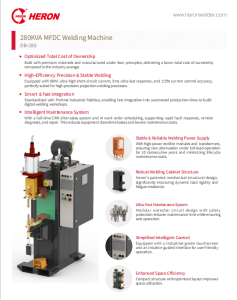
Heron’s MFDC spot welding systems are designed for efficient power conversion. They achieve a power factor above 0.98 and reduce energy consumption by 30%–50%. They also shorten weld cycles (typically more than 20% faster) and reduce electrode wear, lowering the total cost of ownership (TCO).
In terms of automation integration, AC spot welding systems rely on large, heavy transformers, which limit their compatibility in robotic production lines where weight and space are critical.
Heron’s MFDC spot welding systems use high-frequency transformers, reducing size and weight to about one-third of comparable AC systems. This compact design improves compatibility with robotic welding guns, enhancing production line flexibility and space utilization.
III. Spot Welding Selection Guide: Application-Based Decision Making
There is no single best solution in spot welding—only the right solution for a given application. Based on Heron’s global experience supporting Fortune 500 manufacturers, the following guidelines can help with your selection.
For applications involving difficult-to-weld materials—such as aluminum alloys, ultra-high-strength steels, or hot-formed steels—MFDC spot welder is generally the better choice. It is also preferred when tight control of weld appearance and mechanical performance is required, such as in automotive body structures or precision electronic components. Stable heat input helps reduce defects like cold welds and burn-through, while improving overall weld consistency.
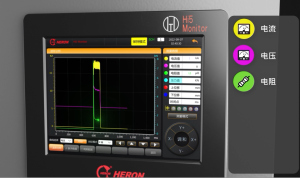
For manufacturers moving toward automation and digitalization, MFDC spot welder offers clear advantages. These systems integrate with PLC and MES platforms for real-time monitoring and full traceability. Fast response and precise current control also help meet cycle time and quality targets in automated production lines. In contrast, AC welders respond more slowly and offer lower control resolution, which can limit performance in high-demand production environments.
AC spot welder remains a practical option for cost-sensitive applications, especially when working with standard low-carbon steel and moderate quality requirements. However, long-term factors should be considered. Rising energy costs and stricter environmental regulations are reducing the advantages of AC systems, particularly in efficiency and operating costs.
IV. Choosing the Right Spot Welding Partner: Experience Drives Results
Selecting a spot welding solution requires more than just equipment—it requires engineering expertise and application knowledge.
At Heron, we provide application-driven spot welding solutions based on medium-frequency inverter technology. With over 30 years of experience, 92 core patents, and more than 6,000 installed systems worldwide, we combine proven technology with practical application experience.
Our portfolio includes MFDC spot welder and capacitor discharge projection welder, designed for stable performance, high efficiency, and reliable operation. Integrated digital controls and intelligent system design help manufacturers streamline production and maintain consistent weld quality.
As manufacturing requirements continue to evolve, selecting the right partner is a long-term decision. Heron provides scalable spot welding solutions that support future production needs.