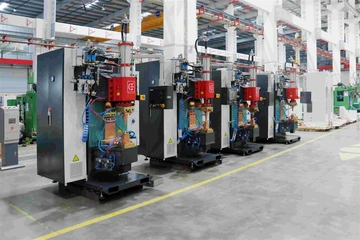
Busbar welding machine applications involving copper busbars and flexible copper connectors requires precise heat control, consistent joint quality, and reliable process monitoring. Heron’s DB-2000 high-power MFDC welder is built for low-voltage electrical components, including distribution busbars, circuit breaker busbars, and multi-layer copper foil connectors. Dedicated tooling and clamping, real-time process monitoring, independent cooling, and weld data tracking support stable production, consistent weld quality, shorter cycle times, and meet production requirements in low-voltage electrical manufacturing.
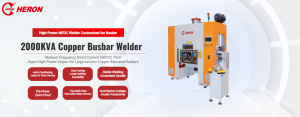
1. High-Power MFDC Welding for Copper Busbars
Copper dissipates heat quickly, making it challenging to achieve sufficient fusion at the joint. Heron’s DB-2000 KVA MFDC welder features digital control, three selectable power modes, and a maximum electrode force of 49 KN to handle demanding copper welding applications.
Consistent fusion and low contact resistance: Controlled welding energy helps achieve sound fusion within the joint, reducing the risk of porosity and incomplete fusion. Low contact resistance helps meet the temperature-rise requirements for low-voltage switchgear and controlgear assemblies.
Lower power consumption: MFDC inverter technology offers lower power consumption than conventional AC resistance welding, helping reduce electricity costs in continuous production.
Flexible process settings: The welder handles thick copper busbars, multi-layer copper foil flexible connectors, and tin-plated copper components. Adjustable welding parameters and electrode force help achieve sufficient fusion in rigid busbars while limiting excessive compression of flexible copper foil.
2. Integrated Tooling and Part Clamping
Accurate positioning and secure clamping are essential for consistent busbar welds. Heron’s DB-2000 features an integrated part preparation unit to ensure repeatable positioning and clamping before welding.
Automatic tooling changeover and dual-cylinder clamping: The tooling switches automatically between weld points, reducing manual repositioning. The pneumatic clamping system delivers up to 49 KN of force, with gradual pressure buildup to keep copper busbars and flexible connectors firmly in place. Consistent clamping helps maintain close contact between copper foil layers and reduces the risk of gaps, porosity, and incomplete fusion.
Parts detection and error prevention: Sensors check for part presence, orientation, and correct positioning before welding. If a connector is missing or incorrectly positioned, the machine triggers an alarm and stops the cycle, helping prevent defective batches and reduce material waste in high-volume production of flexible busbar assemblies for low-voltage electrical equipment.
3. Weld Penetration Control to Prevent Burn-Through and Incomplete Fusion
A high-precision displacement sensor measures part height before welding to detect incorrect loading and variations in material thickness. During welding, the machine monitors the process in real time and cuts off the welding current when the preset limit is reached. For low-voltage copper busbars, precise control of heat input helps achieve adequate fusion while limiting burn-through and thermal distortion. Maintaining busbar flatness also reduces post-weld straightening and helps meet dimensional requirements for subsequent switchgear assembly.
4. Dual Chillers for Continuous Production
High-power copper busbar welding requires effective cooling to maintain stable operation during long production runs. Heron’s DB-2000 uses two independent chillers, pre-weld cooling, and four water circuits, with real-time temperature monitoring. If a cooling fault occurs, the machine triggers an alarm and stops automatically. Effective cooling helps limit thermal distortion, extend electrode life, and reduce downtime from electrode replacement, keeping production running reliably in low-voltage electrical manufacturing.
5. Dual-Station Layout for Stable Cycle Times
The DB-2000 uses separate welding and pre-clamping stations to keep production moving. While one part is being welded, the operator can load and pre-clamp the next part and complete vision inspection at the other station. This reduces idle time between cycles and supports a cycle time of 60–80 seconds per part, with an output of approximately 400 pieces per 8-hour shift. Material transfer carts and storage racks help streamline part handling. For irregularly shaped busbars with multiple weld points, a custom stacked-electrode assembly allows several joints to be welded in one clamping cycle, further improving throughput.
6. Welding Data Traceability for Low-Voltage Electrical Manufacturing
The DB-2000 records key welding data for each part, including welding current, electrode force, penetration depth, and weld time. Production records can be exported via USB for quality checks and traceability. With network connectivity, service personnel can access equipment logs and fault codes remotely to diagnose problems faster and reduce unplanned downtime.
7. Safety Protection and Production Support
The DB-2000 is equipped with safety light curtains, interlocked safety doors, emergency stops, and a three-color status light to support safe operation. Designed for busbar and copper flexible connector production in the low-voltage electrical industry, the DB-2000 combines welding equipment with application-specific process support. Heron provides welding trials, process validation, equipment commissioning, and operator training to help manufacturers address issues such as weak welds, inconsistent joint quality, and long changeover times before full-scale production. For your low-voltage busbar or copper flexible connector application, send your parts to Heron’s process laboratory in Guangzhou for free welding trials and a tailored process proposal.