Projection welding is widely used in galvanized nut fastening applications where weld consistency, thread protection, and production efficiency are critical. For many manufacturers, weld splash and thread deformation remain common challenges during nut welding operations. In many cases, these issues result from unsuitable welding methods or unstable process control.
Medium-voltage capacitor discharge projection welding provides a highly stable and efficient solution by releasing stored energy within milliseconds, enabling strong joint formation while minimizing heat damage to the nut threads and zinc coating. This article explains the working principles, process advantages, and industrial applications of galvanized nut projection welding, while also helping manufacturers choose suitable welding equipment for automated production lines.
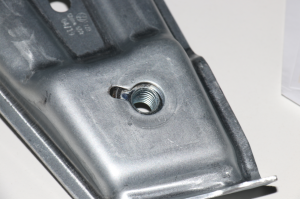
Principles and Industrial Advantages of Capacitor Discharge Welding
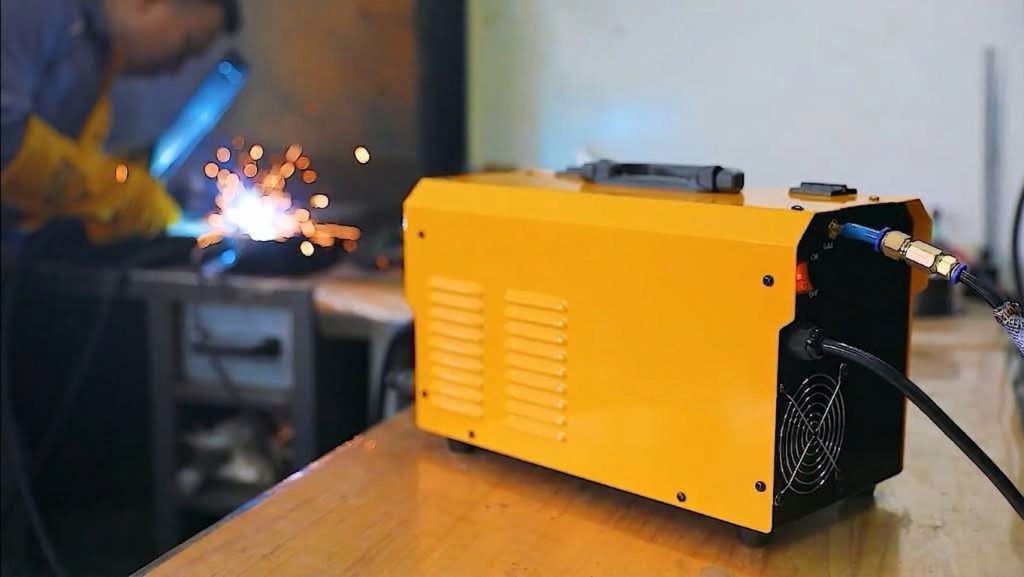
Capacitor discharge (CD) technology is widely used in modern welding applications because it can deliver highly focused energy within milliseconds. Compared with traditional AC resistance welding, capacitor discharge welding offers higher power density, faster discharge speed, and lower overall heat impact. These characteristics make the process especially suitable for galvanized nut welding applications, where excessive heat can easily cause zinc burn-off, weld splash, or thread damage. By precisely controlling welding energy and electrode force, manufacturers can achieve stable weld quality, reduced heat deformation, and improved production consistency.
In automotive, appliance, and industrial hardware manufacturing, medium-voltage capacitor discharge welding has become a preferred joining solution for high-strength steel and coated materials.
Principles and Procedure of Projection Welding
2.1 Principle of Projection Welding
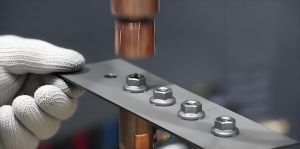
Projection welding relies on resistance heating concentrated at the pre-formed projections on the nut base. During the welding process, high current passes through these focused contact areas under controlled electrode force. The projections rapidly compress and form molten metal at the interface. At the same time, applied force ensures strong metal bonding between the galvanized steel sheet and the nut, ultimately forming a strong weld joint after cooling.
Compared with conventional spot welding, this process provides more concentrated heat generation, higher production efficiency, improved positioning accuracy, better multi-point joining capability, and less visible surface marking. These advantages make the process highly suitable for automated fastening production lines.
2.2 Projection Welding Procedure
The projection welding sequence typically consists of the following phases:
(1) Material preparation: Ensure the galvanized steel sheets and nuts are free of heavy oil, dirt, or excessive lubricants that could affect welding stability during production.
(2) Alignment and Positioning: Load the nut into the fixture, using an insulated locating pin to ensure accurate alignment between the nut and sheet hole.
(3) Squeeze Phase: The welding electrodes close and apply controlled squeeze pressure to ensure stable contact at the projection points.
(4) Current Application (Welding Phase): The capacitor bank releases a high-current pulse through the nut. The rapid heat input compresses the projections and completes the weld within milliseconds.
(5) Hold and Inspection (Cooling Phase) : Electrode pressure is maintained during cooling to ensure weld stability. Completed parts then undergo strength or quality testing, such as push-out or torque testing to verify weld reliability.
Critical Process Controls in Projection Welding
To achieve stable and repeatable projection welding quality on galvanized steel components, manufacturers should focus on the following key process controls:
1. Managing Zinc Layer Contact Stability
Instead of relying on complex pre-weld chemical cleaning, manufacturers can optimize electrode force to ensure stable current flow through the zinc coating and maintain consistent welding performance.
2. Real-time Parameter Coordination
Real-time coordination of welding current, electrode pressure response, and discharge time is essential for reducing weld splash while preventing thread deformation.
3. Maximizing Energy Efficiency
Medium-voltage capacitor discharge welders deliver energy within an extremely short time frame, reducing heat spread to surrounding materials. This helps minimize heat deformation, lower power consumption, and improve overall production efficiency.
Why Choose Heron’s Projection Welding Technology?
Heron specializes in advanced resistance welding solutions tailored for high-strength steel (HSS), hot-stamped steel, and galvanized components. Our medium-voltage capacitor discharge (CD) welders deliver ultra-precise, high-energy pulses that eliminate traditional pain points like surface pitting, zinc vaporization, and thread crushing.
Engineered to meet the stringent structural safety standards of the automotive industry, Heron’s technology provides the high-volume reliability your production line demands. With over 30 years of deep expertise in metal joining and recognition as a National High-Tech Enterprise, Heron delivers stable, high-yield, and fully automated projection welding equipment that global manufacturers trust.