Capacitor Discharge Welding System for Metal Fastening Automation: Industrial Solutions for High-Speed Production Lines
1. Introduction to Capacitor Discharge Welding System for Metal Fastening Automation
Capacitor discharge (CD) welding is a high-speed metal fastening technology widely used in automated manufacturing environments where precision, repeatability, and cycle time are critical.
A capacitor discharge welding system for metal fastening automation is designed to join metal studs, pins, and fasteners to conductive surfaces using stored electrical energy released in a controlled pulse. This process is widely used in automotive production, sheet metal fabrication, electrical enclosures, HVAC manufacturing, and industrial assembly lines.
Unlike conventional welding methods, CD welding delivers energy in milliseconds, enabling low heat input, minimal surface damage, and high-speed fastening cycles, making it ideal for automated production lines.
In modern smart factories, systems like those developed by Heron Welder are integrated into robotic and semi-automated production lines to improve productivity and consistency.
2. What Is Capacitor Discharge Welding (CD Welding) Technology?
Capacitor discharge welding is a controlled energy storage welding process where electrical energy is stored in capacitors and discharged instantly through a welding circuit.
Key Definition:
A capacitor discharge stud welding system uses stored electrical energy to create a short-duration arc that fuses a metal fastener to a base material without excessive heat penetration.
Working Principle:
- Electrical energy is stored in capacitors
- A stud or fastener is placed on the workpiece
- Energy is discharged in milliseconds
- A small arc melts the base surface and stud tip
- Pressure joins both surfaces instantly
Key Feature:
- Extremely short weld time (typically 1–3 milliseconds)
- No shielding gas required
- Minimal distortion and surface damage
This makes CD welding highly suitable for precision fastening technology in automated production systems.
3. How Capacitor Discharge Welding System Works in Automated Production Lines
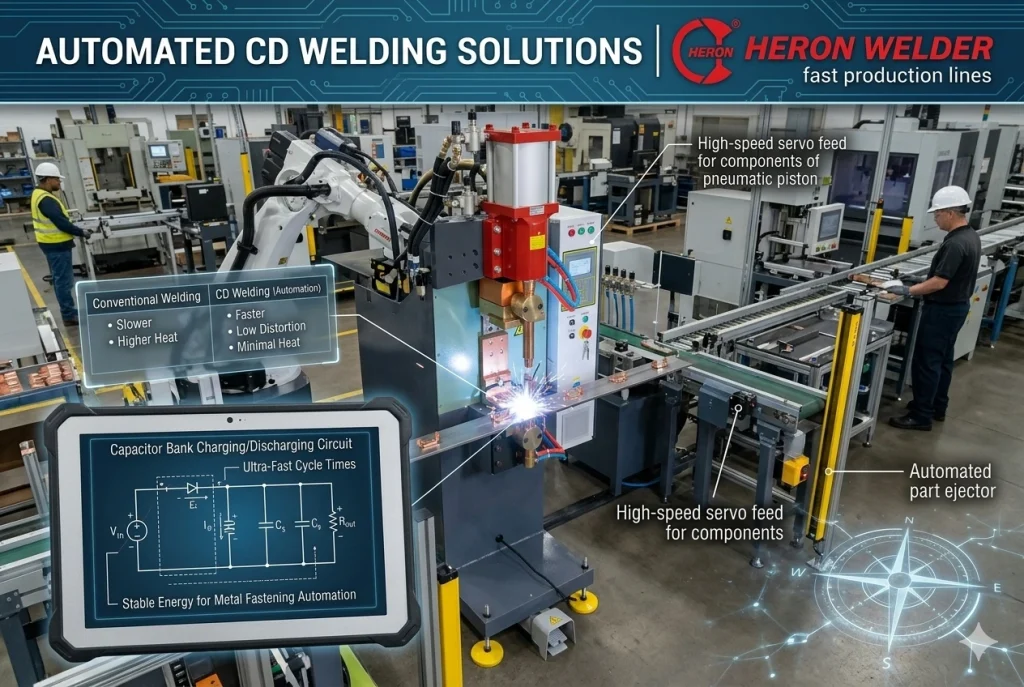
In automated manufacturing, CD welding systems are integrated into high-speed assembly lines with robotic or semi-robotic control.
Step-by-Step Process:
- Fastener Feeding System
- Automatic stud feeding ensures continuous operation
- Positioning System
- Robotic arm or fixture aligns the fastener
- Energy Charging Phase
- Capacitors are charged to a preset voltage
- Discharge Activation
- Stored energy is released instantly
- Welding Phase
- Controlled arc forms a molten micro-zone
- Solidification
- Joint solidifies within milliseconds
Automation Integration:
- PLC-controlled systems
- Robotic welding arms
- Inline conveyor synchronization
This integration enables continuous production line welding systems used in automotive and appliance manufacturing.
4. Key Components of a Capacitor Discharge Welding System
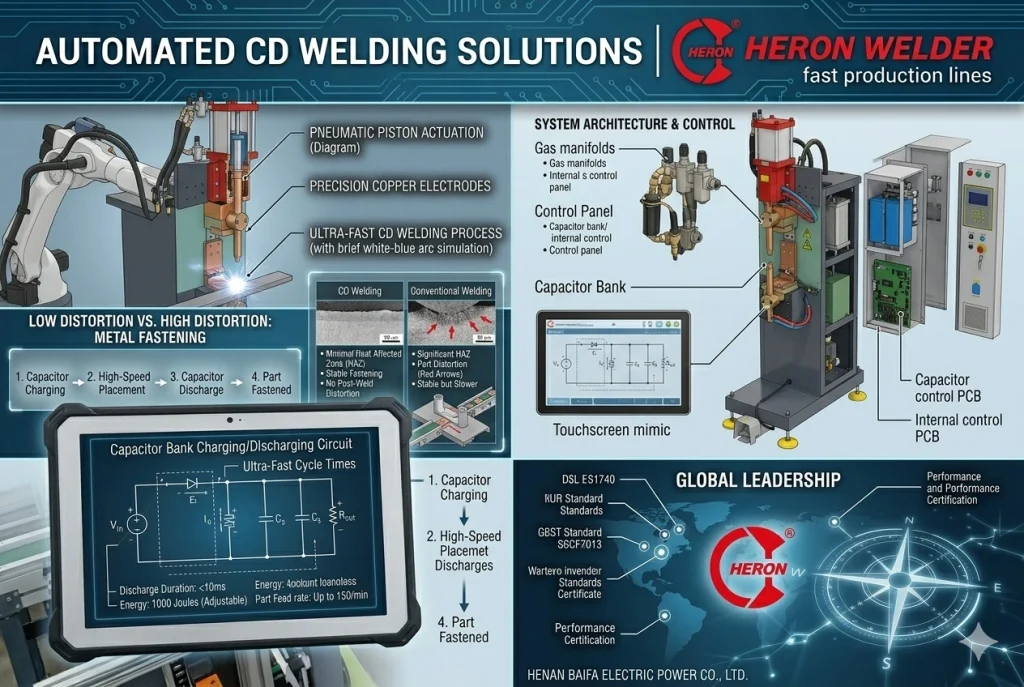
A modern CD welding system for metal fastening automation includes several precision-engineered components:
1. Power Supply Unit
- Stores electrical energy in capacitors
- Controls voltage and discharge timing
2. Welding Gun
- Holds and positions stud or fastener
- Ensures alignment accuracy
3. Stud Feeding System
- Automated fastener delivery
- Essential for mass production
4. Control System
- PLC or CNC integration
- Real-time welding parameter adjustment
5. Grounding System
- Ensures electrical stability and safety
Together, these components form a high-speed industrial metal joining system designed for continuous operation.
5. Advantages of Capacitor Discharge Welding for Metal Fastening Automation
CD welding provides multiple industrial benefits that make it superior in automation environments.
Key Advantages:
1. High-Speed Operation
- Cycle time in milliseconds
- Ideal for high-throughput manufacturing
2. Low Heat Input
- Minimal thermal distortion
- Protects thin sheet metals
3. Precision Fastening
- Accurate stud placement
- Consistent weld quality
4. No Consumables Required
- No filler material or shielding gas
5. Clean Welding Process
- No slag or spatter
- Reduces post-processing
Industrial Impact:
This makes CD welding one of the most efficient fastening automation technologies in modern manufacturing systems.
6. Applications of CD Welding in Industrial Manufacturing
Capacitor discharge welding systems are widely used across multiple industries:
Automotive Industry
- Body-in-white assembly
- Sensor and bracket fastening
- Structural reinforcement points
Electrical Manufacturing
- Switchgear enclosures
- Panel boards
- Grounding studs
HVAC Industry
- Compressor housing assembly
- Sheet metal fastening systems
Appliance Manufacturing
- Washing machines
- Refrigeration units
Structural Engineering
- Metal panel fastening
- Lightweight structural assemblies
These applications highlight the importance of industrial metal fastening solutions in automated production environments.
7. Capacitor Discharge Welding vs Traditional Welding Methods
| Feature | CD Welding | Resistance Welding | Arc Welding |
|---|---|---|---|
| Heat Input | Very Low | Medium | High |
| Cycle Time | Milliseconds | Seconds | Seconds–Minutes |
| Automation Suitability | High | High | Medium |
| Surface Damage | Minimal | Moderate | High |
| Precision | Very High | High | Medium |
Key Insight:
CD welding is superior for precision fastening in automated production lines, especially where speed and surface protection are critical.
8. Integration of CD Welding Systems in Smart Factory Automation
Modern manufacturing systems require seamless integration with Industry 4.0 environments.
Integration Features:
- Robotic welding arms
- PLC-controlled production lines
- IoT-enabled monitoring systems
- Real-time welding data tracking
Smart Factory Benefits:
- Predictive maintenance
- Production efficiency monitoring
- Reduced downtime
- Automated quality control
Companies like Heron Welder develop systems that support integration into automated metal fastening systems and robotic production lines.
9. Performance Benefits in High-Speed Production Lines
CD welding systems are designed for continuous industrial operation.
Key Performance Metrics:
- Cycle time: 1–3 ms per weld
- High repeatability accuracy
- Stable weld quality across long runs
Manufacturing Benefits:
- Increased production output
- Reduced labor dependency
- Lower rejection rates
- Faster assembly line throughput
This makes it ideal for high-speed manufacturing automation systems.
10. Selection Guide for Capacitor Discharge Welding System
Choosing the right system depends on industrial requirements.
Key Selection Factors:
1. Material Type
- Steel
- Stainless steel
- Aluminum alloys
2. Production Volume
- Low-volume batch production
- High-volume automated lines
3. Fastener Type
- Studs
- Pins
- Specialized fasteners
4. Automation Level
- Manual systems
- Semi-automatic systems
- Fully robotic integration
5. Power Requirements
- Energy storage capacity
- Voltage control precision
Selecting the correct industrial metal joining system ensures long-term production efficiency.
11. Future of Capacitor Discharge Welding in Industrial Automation
The future of CD welding is strongly linked with automation and smart manufacturing.
Emerging Trends:
- AI-based welding parameter control
- Fully autonomous robotic welding cells
- Real-time quality inspection systems
- Digital twin manufacturing models
Industry Direction:
Manufacturers are shifting toward:
- Fully automated fastening systems
- Zero-defect production lines
- Energy-efficient welding technologies
CD welding will continue to play a key role in next-generation industrial fastening automation systems.
Frequently Asked Questions (FAQs)
1. What is a capacitor discharge welding system for metal fastening automation?
A capacitor discharge welding system is an industrial fastening technology that uses stored electrical energy released in milliseconds to weld studs or fasteners onto metal surfaces. It is widely used in automated production lines for fast, precise, and low-heat metal joining.
2. How does capacitor discharge welding work in automated production lines?
The system charges capacitors with electrical energy and releases it instantly through a welding gun. The energy creates a brief arc that fuses the fastener to the base material. In automated lines, robotic systems control positioning, timing, and feeding for continuous production.
3. What materials can be used in capacitor discharge welding?
Capacitor discharge welding is commonly used on:
- Mild steel
- Stainless steel
- Aluminum (with specific settings)
It is ideal for conductive metals used in industrial manufacturing.
4. What are the advantages of capacitor discharge welding in automation?
Key advantages include:
- Extremely fast cycle times (milliseconds)
- Low heat input and minimal distortion
- High repeatability and precision
- No need for filler materials or shielding gas
- Easy integration into automated production systems
5. Where is capacitor discharge welding used in industry?
It is widely used in:
- Automotive body assembly
- Electrical panel manufacturing
- HVAC equipment production
- Appliance manufacturing
- Sheet metal fabrication industries
6. What is the difference between capacitor discharge welding and resistance welding?
Capacitor discharge welding uses stored electrical energy released instantly, while resistance welding relies on continuous current and pressure. CD welding offers faster cycle times, lower heat input, and better suitability for thin sheet metal fastening.
7. Can capacitor discharge welding be fully automated?
Yes, capacitor discharge welding systems can be fully integrated into robotic and PLC-controlled production lines. Automated stud feeding, positioning systems, and synchronized discharge control make it ideal for smart factory environments.
8. Is capacitor discharge welding suitable for high-speed production lines?
Yes, it is specifically designed for high-speed production lines. The welding process takes only milliseconds, making it highly efficient for mass production and continuous manufacturing systems.
9. What industries benefit most from capacitor discharge welding systems?
Industries that benefit the most include:
- Automotive manufacturing
- Electrical equipment production
- HVAC systems
- Industrial machinery manufacturing
- Metal fabrication and assembly industries
10. What factors should be considered when selecting a capacitor discharge welding system?
Important factors include:
- Type of material being welded
- Production speed requirements
- Level of automation (manual, semi, or fully automated)
- Fastener type and size
- Integration compatibility with production lines
Summary
A capacitor discharge welding system for metal fastening automation is a critical technology in modern industrial manufacturing. Its ability to deliver fast, precise, and low-heat fastening makes it ideal for automated production lines.
From automotive assembly to electrical enclosures, CD welding systems enable manufacturers to achieve:
- Higher productivity
- Better weld consistency
- Lower operational costs
- Full automation integration
As smart factories continue to evolve, technologies like those offered by Heron Welder will remain essential in building efficient, high-speed production systems for global industries.