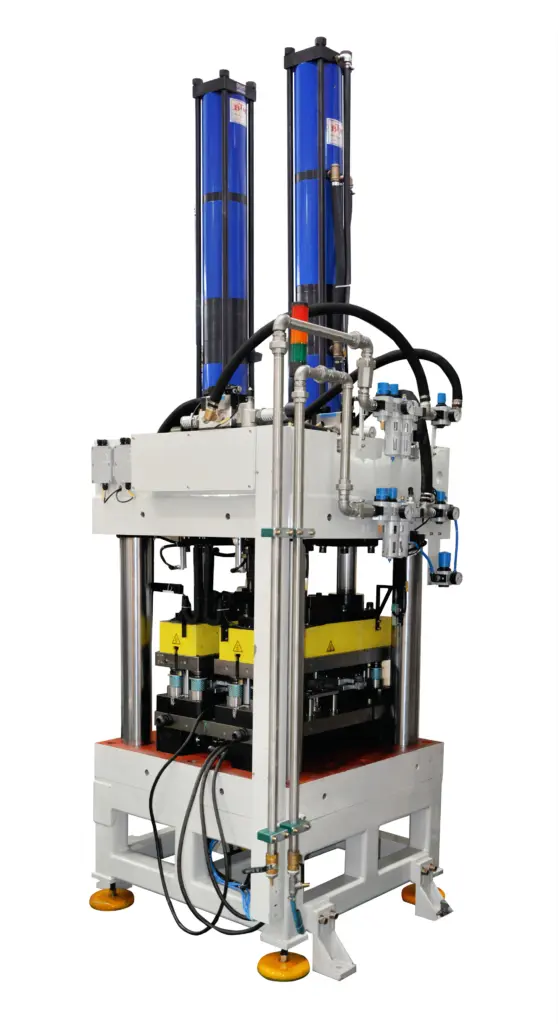
Walk through any modern automotive body assembly plant and you will find threaded fasteners welded to body panels, door beams, pillars, and bumper reinforcements at hundreds of points per vehicle. These are not decorative welds — they are structural attachment points for safety-critical components. The challenge is that the materials these fasteners are welded to have become significantly harder to join. Hot-stamping boron steels with AlSi coatings, galvanized ultra-high-strength steels, and high-strength structural panels respond poorly to the heat input of conventional AC or MFDC resistance welding.
The capacitor discharge stud welder has become the preferred solution for these applications — delivering the precise, ultra-short energy pulse that demanding automotive materials require without the thermal damage that conventional welding produces. This guide explains what makes an industrial-grade capacitor discharge stud welder suitable for automotive OEM production, what to evaluate when specifying one, and how Heron Intelligent Equipment’s CDW technology addresses the most demanding fastener welding applications in automotive body manufacturing.
Why Automotive Body Fastener Welding Demands a Different Approach
The Hot-Stamping Steel Challenge
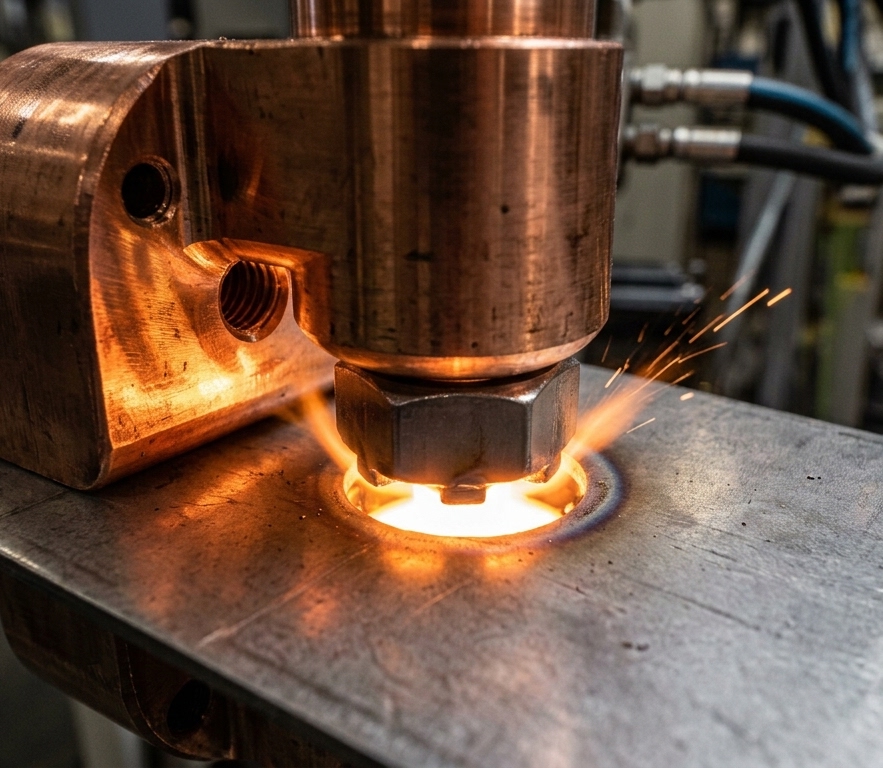
Hot-stamping press-hardened steel (PHS), coated with aluminum-silicon (AlSi) to prevent oxidation during forming, is the dominant structural material in modern automotive body pillars, door rings, and bumper beams. This AlSi coating forms an intermetallic layer at the surface that interferes with weld nugget formation during conventional resistance welding. Increasing current or weld time to burn through the coating generates excessive heat that softens the heat-affected zone — potentially compromising the structural integrity of safety-critical components.
A capacitor discharge stud welder resolves this at the process level. The ultra-short, high-current CDW pulse burns through the AlSi coating in milliseconds before significant heat can migrate into the surrounding material — producing clean, consistent nuggets regardless of coating variation across production batches. For more details, Click Here.
Why AC and MFDC Welders Fall Short
AC welding produces a sinusoidal current that passes through zero multiple times per cycle. During these zero-crossing points, the welding arc is interrupted — creating inconsistent nugget formation on small projection fasteners where the full weld must form in a single rapid pulse. MFDC eliminates zero crossings but still operates at slower current rise times than CDW. For projection welding of small fasteners on hot-stamping steel, where the projection melts and collapses within milliseconds, the slower MFDC rise time can miss the optimal nugget formation window — producing under-welded or inconsistent joints.
How a Capacitor Discharge Stud Welder Works
A capacitor discharge stud welder stores electrical energy in a capacitor bank between weld cycles, then releases that energy in a single controlled pulse through the welding transformer when the weld cycle triggers — completing the full weld within 10 to 30 milliseconds. Because the weld draws on stored energy rather than live grid power, the machine is completely isolated from grid voltage fluctuations during the weld cycle. This grid independence is a significant production advantage: voltage variation of ±10% on the incoming supply has zero effect on weld output, ensuring batch-to-batch consistency that conventional welders cannot guarantee.
Heron’s medium voltage CDW technology, developed and patented in 2010, advances this further. Using non-polarized metal film capacitors that do not decay or degrade over time, Heron’s CDW power supply delivers ±1% output repeatability across every weld cycle — ensuring the 10,000th weld on a production shift is as consistent as the first.
Key Criteria for Choosing a CD Stud Welder for OEM Production
Output energy range — match the machine’s energy range to your full fastener specification. Small M6 screw nuts on inner panels require 3–6 KJ. Structural fasteners on door beams and pillar assemblies require 25–40 KJ or more. The capacitor discharge stud welder must cover the full range without compromise.
Output repeatability and grid independence — in automotive OEM production, batch-to-batch weld consistency is a compliance requirement. Evaluate the machine’s output repeatability specification and whether the charging circuit protects against capacitor degradation over long production lifecycles.
Real-time quality monitoring — every structural fastener weld needs in-process verification. The capacitor discharge stud welder must integrate with an online monitoring system capturing current, voltage, pressure, and displacement for every cycle — with closed-loop correction and full traceability.
Automation compatibility — evaluate compatibility with automated nut and part feeders, robotic welding cells, and your production line’s control architecture. Production-grade CD stud welders must sustain high cycle rates without compromising weld quality or requiring manual intervention.
Heron’s Capacitor Discharge Stud Welders for Automotive OEM Applications
Heron Intelligent Equipment has manufactured capacitor discharge stud welders for automotive OEM production for more than 30 years. Heron’s CDW range — covering 3 KJ to 150 KJ output — is CE and CUL certified and specifically engineered for the industrial fastener welding applications that define automotive body manufacturing.
Medium Voltage CDW Technology — Heron’s proprietary medium voltage CDW architecture uses non-polarized metal film capacitors that do not degrade or risk explosion over long production lifecycles, delivering ±1% output repeatability. Current rises and completes the projection weld within 3 milliseconds — ensuring complete nugget formation before projection collapse. This is a fundamental advancement over both low-voltage and high-voltage CD alternatives.
L Series (3–6 KJ) — optimised for small screw and nut projection welding on hot-stamping and galvanized steels. Unique advantages in AlSi-coated fastener applications where AC welders produce inconsistent results. Short welding time, minimal heat-affected zone, lower energy consumption, and slow electrode loss translate directly into lower per-unit production cost and fewer rejected parts.
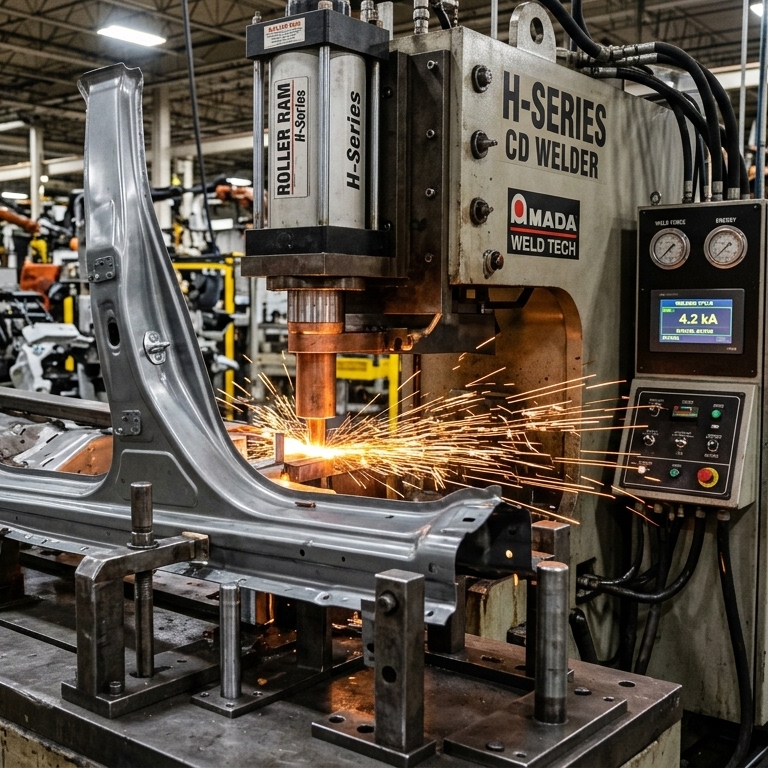
H Series (25–40 KJ) — engineered for structural fastener welding on door beams, front and rear bumpers, A-pillars, B-pillars, and roof covers. Equipped with a roller ram cylinder and rigid frame for reliable multi-point and ring projection welding on large-format body components. One-second charging time sustains the high cycle rates body assembly lines demand.
HRC650 Quality Monitoring — Heron’s HRC650 integrates with all CD stud welders, capturing five critical weld parameters in real time for every cycle, visualising dynamic welding curves, and flagging non-conforming welds before they leave the station. Full production traceability without post-production sampling.
Contact Heron’s engineering team to discuss the right capacitor discharge stud welder configuration for your fastener specification and production requirements.
CD Stud Welder vs AC vs MFDC: Side-by-Side Comparison
| Criteria | Capacitor Discharge (CDW) | AC Resistance | MFDC Resistance |
|---|---|---|---|
| Weld time | 3–30 ms | Multiple cycles | Moderate |
| Heat-affected zone | Minimal | Larger | Moderate |
| Hot-stamping steel (AlSi) | Excellent | Poor | Limited |
| Galvanized steel | Excellent | Moderate | Good |
| Grid independence | Complete | None | None |
| Output repeatability | ±1% | Grid-affected | Good |
| Electrode life | Long | Shorter | Moderate |
| Best for | Fastener projection welding on coated, UHSS steels | Mild steel spot welding | BIW structural spot welding |
Where Heron’s CD Stud Welders Are Deployed
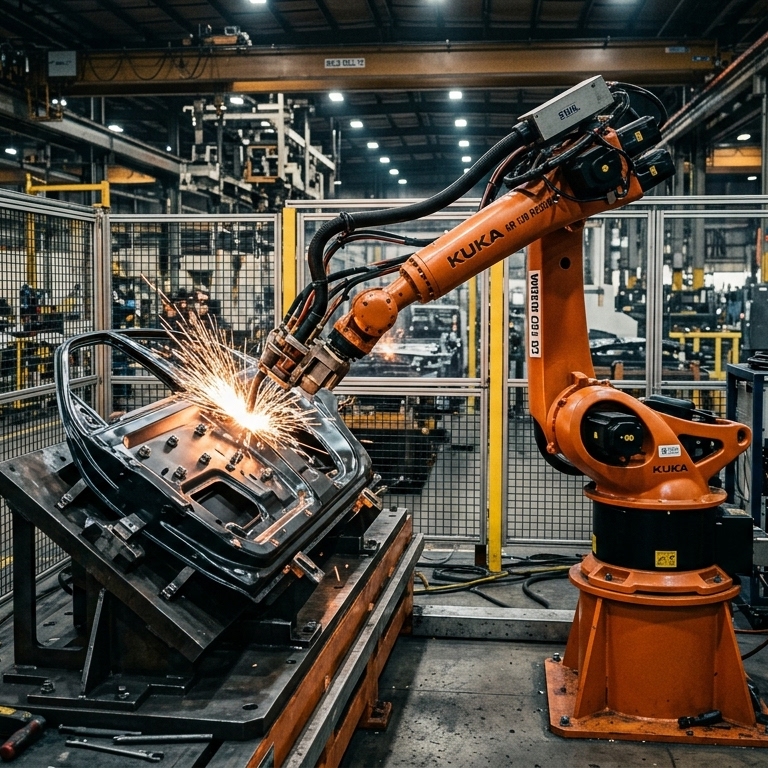
Heron’s capacitor discharge stud welders cover the full range of automotive body fastener welding applications — M6 to M10 nut projection welding on AlSi-coated pillar structures; structural stud welding on door beams and bumper reinforcements; high-volume screw nut welding on galvanized inner panels; and precision fastener welding on roof and cowl assemblies. Both L and H Series machines integrate with automated feeders and robotic welding cells, supporting high-volume NEV and ICE body production lines globally.
Explore Heron’s automotive body and parts case studies to see these capacitor discharge stud welders in real OEM production environments, or contact Heron’s engineering team to begin specifying the right CDW solution for your fastener application.
Frequently Asked Questions
Q1. What is a capacitor discharge stud welder and how does it differ from standard resistance welding?
A capacitor discharge stud welder stores energy in a capacitor bank and releases it in a single pulse — typically within 10–30 milliseconds — rather than drawing current continuously from the mains during the weld. This produces a faster, more precise weld with minimal heat-affected zone, making it the preferred solution for demanding materials like AlSi-coated hot-stamping steel where conventional resistance welding causes HAZ damage and inconsistent nuggets.
Q2. Why is CDW technology preferred for hot-stamping steel fastener welding?
The AlSi coating on hot-stamping steel creates a resistive barrier that conventional AC and MFDC welders overcome by increasing current or time — generating excessive heat and HAZ softening. A capacitor discharge stud welder’s rapid pulse burns through the coating before heat can migrate into the base material, producing consistent nuggets without compromising the structural integrity of the surrounding steel.
Q3. What energy range does Heron’s CD stud welder range cover?
Heron’s CDW range covers 3 KJ to 150 KJ. The L Series (3–6 KJ) handles small nut projection welding on inner panels and galvanized components. The H Series (25–40 KJ) covers structural fastener welding on door beams, bumpers, and pillar assemblies. The full range addresses over 90% of industrial projection welding applications in automotive body manufacturing.
Q4. What makes Heron’s medium voltage CDW different from standard CD welding?
Heron’s medium voltage CDW uses non-polarized metal film capacitors that do not degrade over time — unlike electrolytic capacitors in conventional CD systems — delivering ±1% output repeatability across years of production. It provides faster current rise than low-voltage systems and eliminates the safety infrastructure requirements of high-voltage alternatives.
Conclusion
Automotive body fastener welding on hot-stamping steel, galvanized UHSS, and coated structural materials has outgrown the capability of conventional AC and MFDC resistance welding. The capacitor discharge stud welder — with its ultra-short pulse, minimal HAZ, and complete grid independence — is the technically appropriate solution for the fastener welding challenges that define modern automotive body production.
Heron’s CDW range, built on proprietary medium voltage technology invented in 2010, covers every automotive OEM fastener application from precision L Series nut welding to heavy-duty H Series structural stud welding — with integrated quality monitoring, CE and CUL certification, and 30+ years of automotive joining expertise behind every machine.