
Electrodes for resistance welding decide whether a production line runs smoothly or stalls every few hours. They carry the current, deliver the force, and pull heat out of the weld zone, all within a fraction of a second. Pick the wrong electrodes for resistance welding and you face sticking, weak nuggets, and constant tip changes. Pick the right ones and you gain stable weld quality and a lower cost per joint.
This guide explains how electrodes for resistance welding work, which materials and shapes suit each job, and how to make them last. It is written for engineers, plant managers, and buyers who need dependable electrodes for resistance welding for automotive, appliance, electrical, and hardware production.
What Are Electrodes for Resistance Welding?
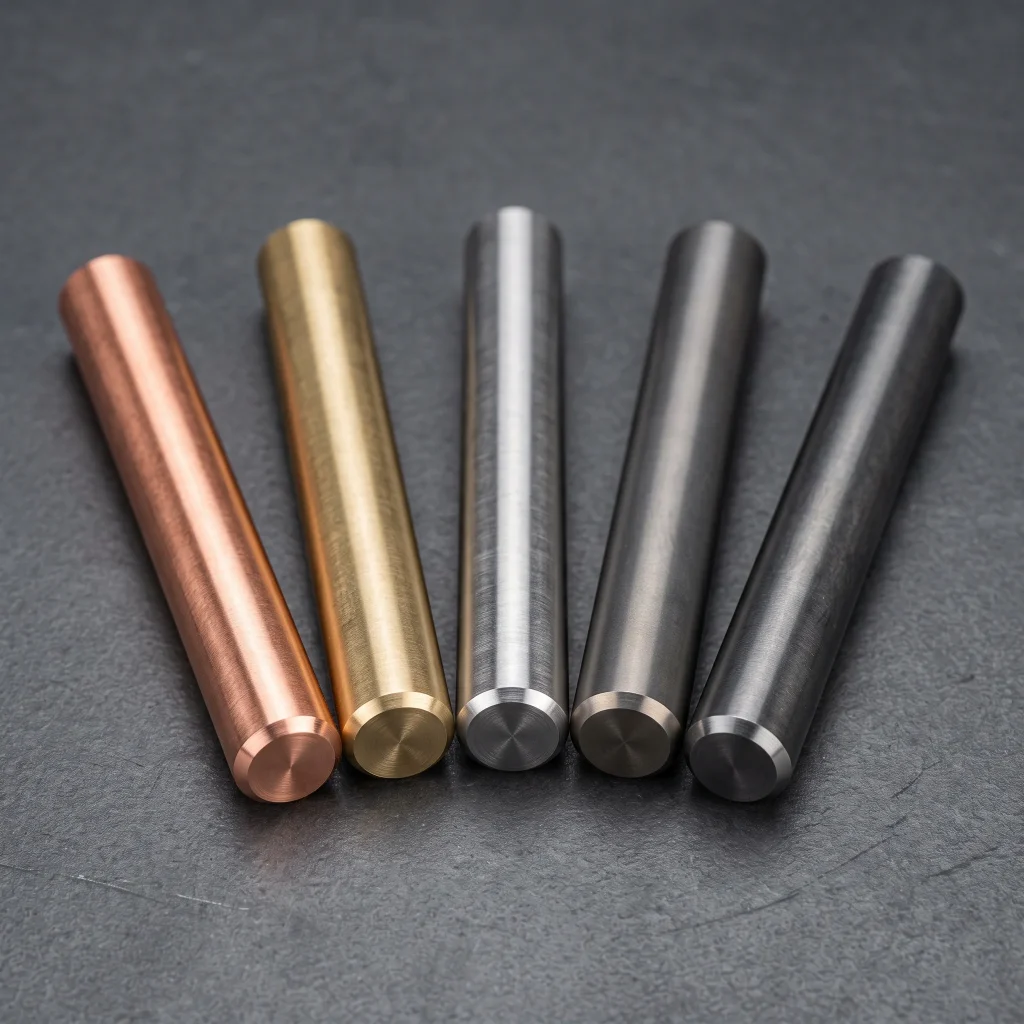
Electrodes for resistance welding are the conductive tools that press against the workpieces and pass welding current through them. In resistance welding, heat comes from the electrical resistance at the joint, not from an arc or a flame. The electrodes are the only parts of the machine that touch the work, so their condition directly controls weld quality.
Every set of electrodes for resistance welding performs three jobs at once:
- Conduct high current into the metal stack with minimal loss
- Apply and hold the clamping force during the weld cycle
- Remove heat from the surface so the sheet is not damaged
Because an electrode must stay hard when hot, conduct well, and be cooled efficiently, material and geometry matter far more than most buyers expect.
How Electrodes for Resistance Welding Work
When the machine fires, current flows through the upper electrode, the metal sheets, and the lower electrode. Resistance is highest at the interface between the sheets, so that is where the metal melts and forms a weld nugget. Internal water cooling keeps the electrode face below its softening point, which protects both the sheet surface and the tip itself.
Three variables drive the result: current, time, and force. The electrode face diameter sets the current density. A face that is too small overheats and mushrooms. A face that is too large spreads the current and produces a cold weld. Modern resistance welder platforms, such as MFDC and capacitor discharge systems, control these variables precisely. Even so, they can only perform as well as the electrodes allow.
Main Types of Electrodes for Resistance Welding
The right shape depends on the process and the part geometry. These are the main groups you will specify.
Spot Welding Electrode Caps and Tips
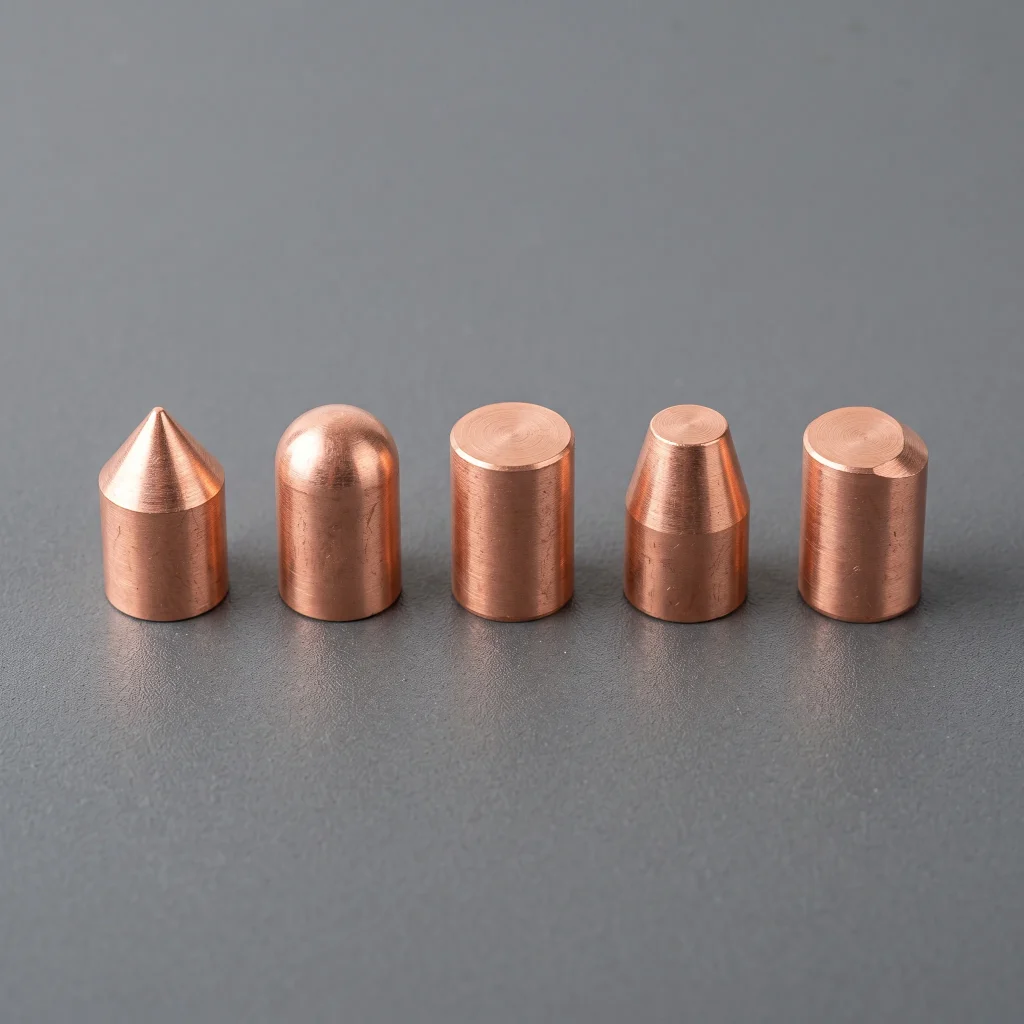
Spot welding is the most common application. Electrode caps slip onto a tapered shank, so operators replace a worn cap in seconds without removing the whole holder. Standard spot welding faces include pointed, dome, flat, truncated, and offset designs. Dome faces tolerate slight misalignment and suit coated steel. Flat faces give a consistent footprint on thin sheet. Offset shapes reach into tight corners.
Quality electrode caps with an accurate taper and good concentricity seat firmly, transfer current evenly, and cool efficiently. These are exactly the traits that make electrodes for resistance welding last.
Projection Welding Electrodes
Projection welding concentrates current at embossed points or fasteners such as nuts and bolts. The electrodes are larger and flat, and they are built to carry high force across several projections. They are usually made from harder alloys because the contact area is wide and the pressure is high. Wear shows up as dishing, so face flatness checks are essential.
Seam Welding Electrode Wheels
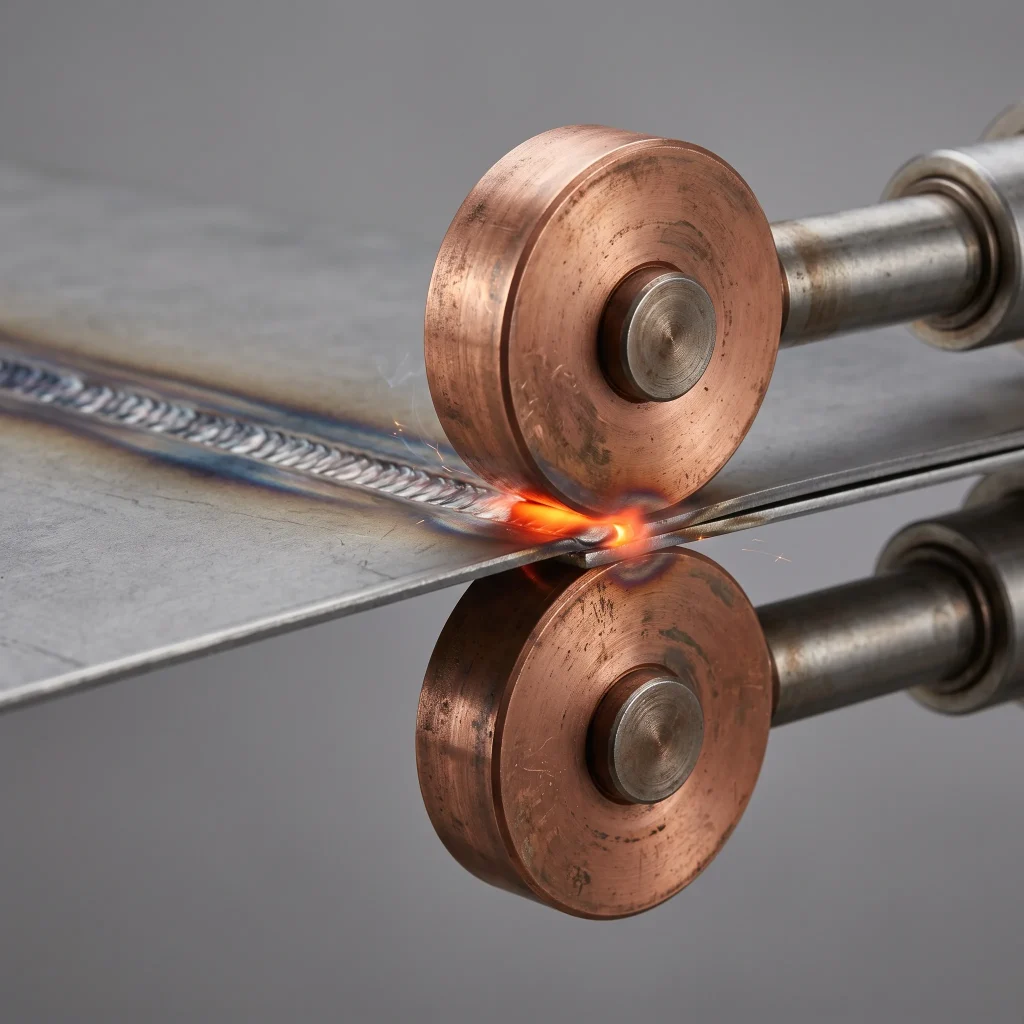
Seam welding replaces the tip with a rotating wheel to produce continuous, leak-tight joints in tanks, fuel containers, and compressor shells. Electrode wheels must hold their profile while rolling under load. Wheel width, bevel, and alloy are chosen according to sheet thickness and travel speed.
Electrode Arms, Rods, and Holders
Caps and wheels get most of the attention, but arms, rods, and connectors complete the current path. Poor contact in a holder creates heat and voltage loss long before the cap fails. Serious buyers therefore specify the whole assembly, including copper shunts and connectors, rather than the cap alone.
Materials Used in Electrodes for Resistance Welding
Pure copper conducts well but softens too easily under heat and force. Almost all electrodes for resistance welding are therefore made from copper alloys or composites that balance conductivity against hardness.
- Chromium copper (RWMA Class 2): The standard choice for mild steel and general spot welding. It offers a strong mix of conductivity and hardness.
- Zirconium and chromium-zirconium copper: Better resistance to softening, which makes it popular for coated steel and high-volume lines.
- Cobalt-beryllium copper (RWMA Class 3): Harder and stronger, so it suits projection welding and high-force applications.
- Dispersion-strengthened copper (RWMA Class 20): Holds its hardness at very high temperatures and resists mushrooming on demanding coated-steel work.
- Copper-tungsten and tungsten composites: Used where the electrode must resist arcing and sticking, such as when welding copper or brass.
No single alloy wins every job. The best electrodes for resistance welding match the alloy to the base metal, the coating, and the welder.
How to Select the Right Electrodes for Resistance Welding
Use this checklist when specifying electrodes for resistance welding for a new application:
- Base metal and coating. Galvanized, aluminized, and stainless steels each need different alloys and face sizes. Aluminium alloys wear electrodes faster and demand extra attention.
- Sheet thickness and stack-up. Thicker stacks need larger faces and more force. A common starting point for face diameter is roughly twice the sheet thickness plus 3 mm, which you then refine in trials.
- Welder type. MFDC machines deliver long, smooth current pulses, while capacitor discharge welders deliver very short, intense ones. Each affects heat build-up and wear differently.
- Cooling. Confirm water flow rate and cooling tube position. Cooling close to the face extends electrode life significantly.
- Part access. Complex assemblies may need offset caps or special arms, especially on robotic guns.
- Production volume. On high-volume lines, the cheapest cap is rarely the cheapest weld. Track welds per cap and welds per dressing cycle.
Following these six steps takes the guesswork out of choosing electrodes for resistance welding and gives you data to compare suppliers fairly.
Common Problems with Electrodes for Resistance Welding
Most failures trace back to a handful of causes:
- Mushrooming: The face spreads, current density drops, and welds turn cold. Use a harder alloy, correct force, and scheduled dressing.
- Sticking: The electrode bonds to the sheet, which is common on coated steel and aluminium. Check the alloy, lower the heat input, and clean the surface.
- Pitting and contamination: Zinc, oil, and scale build up on the face. Dress regularly and keep incoming sheet clean.
- Misalignment: Uneven wear and off-center nuggets point to misaligned arms or gun deflection. Realign and inspect the tooling.
- Shank overheating: Poor cooling or a loose taper is usually the cause. Restore water flow and reseat the caps.
Solving these issues early protects the machine and keeps electrodes for resistance welding working at full capacity.
Maintenance Tips to Extend Electrode Life
Good habits can double the service life of electrodes for resistance welding:
- Dress the faces on a fixed schedule with the correct cutter, never a file
- Use the controller’s stepper function to raise current as the tip wears
- Check cooling flow and water temperature every shift
- Keep tapers clean and dry so caps seat fully
- Align the upper and lower electrodes whenever tooling is changed
- Store spare caps in clean, sealed packaging
- Add real-time quality monitoring to catch drift before it creates scrap
Why Source Electrodes for Resistance Welding from Heron
Heron has focused on resistance welding since 1991 in Guangzhou, with more than 30 years of experience building welders for automotive, compressor, home appliance, electrical, and hardware manufacturers. Because we design the machines, we understand how electrodes behave on them.
Our range of electrodes for resistance welding covers caps, wheels, arms, rods, connectors, pins, and copper shunts, so you can source the full current path from one supplier. If you are unsure about the specification, our engineers can recommend a configuration. Contact our team with your material, thickness, and welder type for a tailored recommendation.
FAQs About Electrodes for Resistance Welding
Q1. What material is best for electrodes for resistance welding?
Chromium copper is the most widely used for mild steel. Coated steels often need zirconium or dispersion-strengthened copper, and projection welding usually calls for harder alloys.
Q2. How often should electrodes for resistance welding be replaced?
Replace them by weld count and weld quality, not by time. Uncoated steel can allow thousands of welds between changes, while coated steel and aluminium wear much faster. Run trials to set your own limit.
Q3. Can one electrode design weld different metals?
Sometimes, but it is rarely optimal. Changing the base metal or coating usually means changing the alloy or face shape too.
Q4. Why do my electrodes keep sticking?
Sticking usually comes from excess heat, a poor alloy match, or contaminated sheet. Review current, force, cooling, and surface cleanliness together.
Conclusion
Electrodes for resistance welding are small parts with a large effect on quality, uptime, and cost per weld. Match the alloy and shape to your material, protect them with good cooling and dressing, and track wear with real data. If you want help specifying electrodes for resistance welding for your line, send your application details to Heron and our team will guide you.

