Automotive nut welding is widely used in vehicle manufacturing to create reliable fastening points for body structures and ensure consistent assembly performance. Heron specializes in resistance welding technology, with extensive application experience in automotive nut welding, MFDC (Medium Frequency Direct Current) projection welding, and advanced CDW (Medium Voltage Capacitor Discharge) projection welding solutions for automotive applications.
MFDC projection welding has been widely adopted in automotive production due to its proven reliability and stable welding performance. However, for applications requiring high weld quality, low heat input, and higher production efficiency, CDW technology provides advantages with its rapid energy release and precise heat control.
Based on Heron’s welding database and production test results, this article compares MFDC and CDW projection welding technologies in terms of welding quality, energy consumption, power requirements, and operating costs.

1. Analysis of Projection Welding Principles
Projection welding generates heat by concentrating welding current at the designed projection area of the parts. Within a very short welding time, high current density rapidly melts the projection, while electrode force applies pressure to form a solid weld nugget and achieve a reliable joint.
According to Joule’s law (Q = I²Rt), sufficient welding heat (Q) must be generated within a limited time (t), which requires a high welding current (I). The key challenge in projection welding is to deliver the required energy quickly enough before mechanical deformation of the projection affects current concentration and weld formation.
1.1 MFDC Technology: Stable Current Control
MFDC (Medium Frequency Direct Current) projection welding delivers stable current output and has become a proven solution in automotive manufacturing due to its mature technology and reliable performance.
However, the welding current builds up more gradually compared with capacitor discharge technology, requiring a longer weld time (typically 20–100 ms) to generate the required heat input. During this period, the projection may soften before it is fully fused, resulting in early deformation, increased contact area, and reduced current density. These effects can influence weld nugget formation and increase the possibility of inconsistent weld quality.
1.2 CDW Technology: High-Peak Current in Milliseconds
CDW (Capacitor Discharge Welding) projection welding releases a high peak current within an extremely short welding duration (3–5 ms).
The rapid energy discharge melts the projection before significant deformation occurs, addressing the key requirement of projection welding – achieving high current density within a precisely controlled time frame. With concentrated heat input and minimal thermal exposure, CDW produces well-formed weld nuggets with consistent strength and reduced heat-related impact.
2. Advantages of CDW Projection Welding in Automotive Nut Welding Applications
In high-volume automotive production, automotive nut welding performance has a direct influence on manufacturing costs, product consistency, and overall production efficiency. Energy consumption, heat input, electrode wear, and weld stability are critical parameters when evaluating welding processes.
MFDC projection welding has been widely applied in automotive nut welding due to its proven reliability. However, CDW technology provides advantages in applications requiring lower heat input, reduced energy consumption, lower electrical demand, and longer component service life.
2.1 Welding Quality and Efficiency Comparison
MFDC Projection Welding
The relatively longer welding time in MFDC projection welding increases heat transfer to the surrounding material, resulting in a larger heat-affected zone.
Excessive heat input during automotive nut welding may cause discoloration or slight deformation of nut threads. In some cases, additional post-weld operations, such as thread correction or cleaning, may be required to ensure proper assembly.
CDW Projection Welding
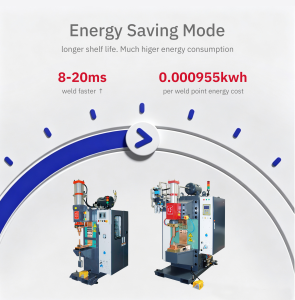
CDW completes the welding process within an extremely short cycle time (8–30 ms), concentrating heat within the projection area and minimizing the heat-affected zone.
The short welding pulse helps maintain thread integrity, with no visible discoloration or weld spatter. As a result, CDW significantly reduces post-weld processing and improves overall welding consistency.
2.2 Energy Consumption Comparison
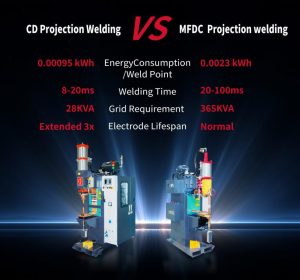
Under welding conditions using a 1.8 mm steel plate and M10 nut, CDW projection welding consumes only 0.000955 kWh per weld point, compared with 0.00230 kWh per weld point for MFDC welding. Compared with MFDC technology, CDW projection welding reduces energy consumption by approximately 58.5%.
For automotive OEMs with high-volume production requirements, the reduced power consumption can deliver significant long-term cost savings.
2.3 Grid Load Comparison
MFDC Projection Welding
MFDC projection welding draws power directly from the grid during the welding process. To achieve an output welding current of 80 kA, the equipment requires approximately 365 kVA of grid capacity.
Such high peak power demand increases requirements for transformers, cables, and electrical distribution systems. In some cases, instantaneous current demand may affect grid stability and require additional power infrastructure.
CDW Projection Welding
CDW uses a charge–disconnect–discharge sequence, where energy is stored in advance and released during the welding pulse rather than being supplied directly from the grid. For the same 80 kA welding current output, CDW requires only 28 kVA of grid capacity.
With significantly lower electrical demand, CDW can help manufacturers avoid costly grid upgrades, transformer expansion, and dedicated power cable installation.
2.4 Operating Cost Comparison
MFDC Projection Welding
As a consumable component, electrode service life has a direct impact on maintenance costs and production uptime.
The continuous current output of MFDC projection welding increases electrode temperature during operation, accelerating electrode wear and shortening service intervals.
CDW Projection Welding
Due to the extremely short welding duration, heat transfer to the electrodes is significantly reduced, lowering the thermal load during operation.
As a result, CDW projection welding typically provides more than three times longer electrode life compared with conventional welding technologies, reducing maintenance downtime and consumable costs.
The capacitor, as a key energy storage component, offers a service life of more than 10 years or 20 million cycles with minimal performance degradation. This helps reduce the risk of unexpected component failures and supports long-term production stability.
3. CDW Projection Welding: A Future-Oriented Solution for Automotive Nut Welding
In automotive manufacturing, automotive nut welding quality directly affects downstream assembly efficiency and vehicle structural integrity. A deformed thread may prevent proper bolt installation and can lead to additional repair work or component replacement, increasing production costs and material waste. Medium Voltage Capacitor Discharge (CDW) technology provides an advanced solution for automotive nut welding applications. Beyond a welding process upgrade, CDW improves energy efficiency, weld quality, and production performance through precise energy control and reduced heat input. By adopting CDW projection welding, manufacturers can achieve highly consistent weld quality while reducing long-term operating costs, making it a suitable solution for next-generation automotive manufacturing.