Resistance spot welding has been the backbone of steel joining in automotive and industrial manufacturing for decades. But the steels being welded today are fundamentally different from the mild steel grades that conventional AC spot welding was designed to handle. Advanced high-strength steels (AHSS), ultra-high-strength steels (UHSS), hot-stamping press-hardened grades, and galvanized coated steels now define the material landscape of modern OEM production lines — and they have pushed conventional AC spot welding to its limits.
Spot welding steel at OEM production quality on these grades requires a different approach to current control, heat management, and process consistency. This guide explains the technical difference between AC and MFDC spot welding, why it matters specifically for high-strength and coated steel grades, and how Heron Intelligent Equipment’s MFDC solutions address the real challenges of modern steel OEM production.
Why Spot Welding Steel Has Become More Demanding
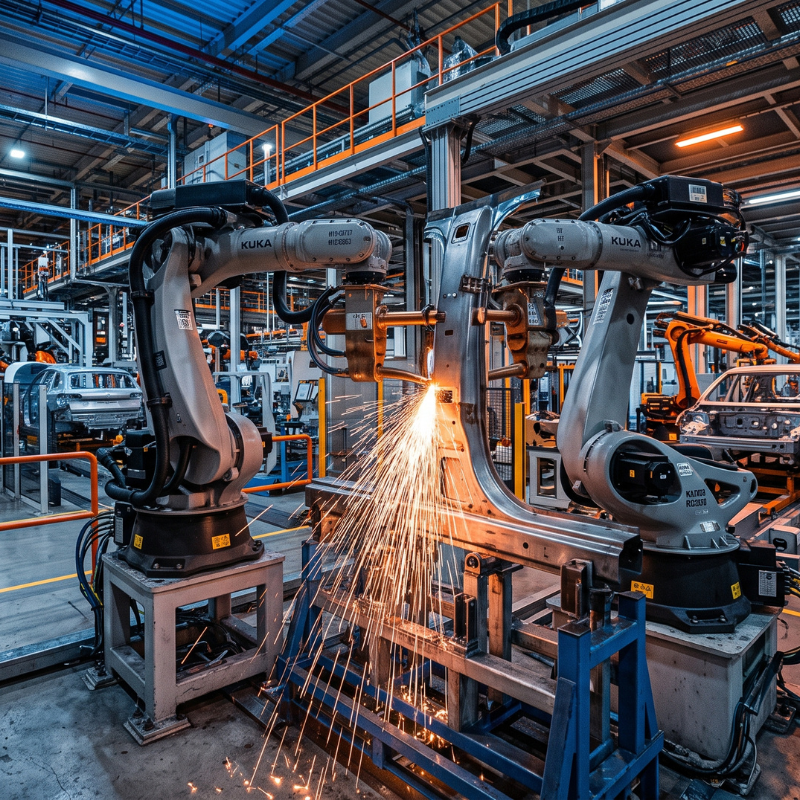
The automotive industry’s drive to reduce weight while meeting crash safety standards has progressively replaced mild steel with AHSS, UHSS, dual-phase, martensitic, and hot-stamping boron steels. These grades offer higher tensile strength — enabling thinner, lighter designs — but they come with significantly tighter process windows. Spot welding steel at AHSS and UHSS grades requires precise current control to achieve consistent nugget formation without expulsion, cracking, or heat-affected zone softening. The penalty for getting parameters wrong is not just a poor weld — it can mean structural compromise in safety-critical body components.
Conventional AC spot welding operates at mains frequency (50/60 Hz), producing a sinusoidal current that passes through zero twice per cycle. On mild steel with wide process windows, this is manageable. On AHSS, UHSS, and galvanized grades with tight windows, the variable instantaneous current of AC welding produces inconsistent heat input — leading to nugget variability, spatter, and rejection rates that cost OEM lines time and money.
How MFDC Spot Welding Works — and Why It’s Different
MFDC (Medium Frequency Direct Current) spot welding rectifies incoming mains AC to DC, inverts it to medium frequency (1,000–4,000 Hz), transforms it, and rectifies again — delivering a stable, continuous direct current at the electrodes with no zero crossings. The result is a welding current that is smooth, fast-rising, and precisely controllable throughout the weld cycle.
The medium frequency design also allows a significantly smaller, lighter transformer than an equivalent AC machine — a critical advantage for robotic welding gun applications where arm-mounted transformer weight directly affects robot performance and cycle speed.
Key Advantages of MFDC for Spot Welding Steel
Here are the essential points used for spot welding steel in MFDC:
Superior Weld Quality on AHSS and UHSS
MFDC’s stable DC output holds welding current precisely within the tight process window that AHSS and UHSS grades demand throughout the full weld cycle. AC’s sinusoidal waveform fluctuates continuously — spending portions of every cycle outside the optimal range. For automotive body structural components — B-pillars, door rings, roof reinforcements — where weld quality directly affects crash performance, MFDC produces consistently better nugget geometry, less spatter, and smaller heat-affected zones than AC at equivalent output.
Consistent Performance on Galvanized Steel
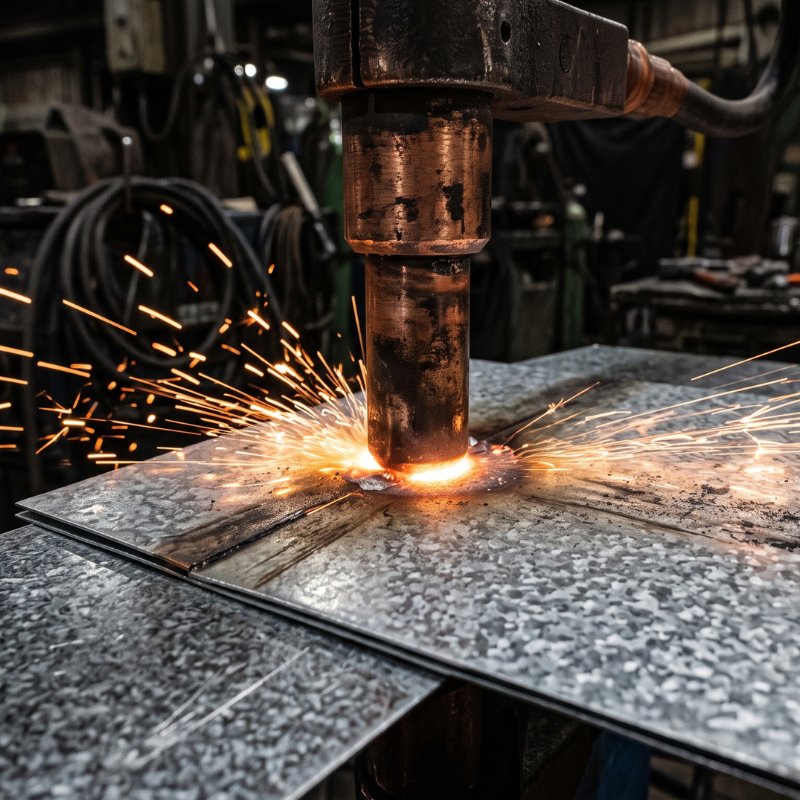
Zinc coating vaporises during spot welding steel on galvanized grades, creating gas that causes spatter, porosity, and inconsistent nugget formation if current is not precisely controlled. MFDC’s faster rise time and stable output deliver welding energy within a tighter window — reducing variability on zinc-coated surfaces, lowering electrode contamination from zinc vapour, and extending electrode life compared to AC systems on the same galvanized application.
Energy Efficiency and Lower Operating Cost
MFDC machines draw three-phase balanced power at medium frequency, eliminating the reactive power losses that characterise single-phase AC spot welding transformers. On high-duty-cycle OEM lines running spot welding steel continuously across multiple shifts, this efficiency difference produces measurable reductions in electricity consumption and operating cost. The compact MFDC transformer also generates less heat, reducing cooling energy requirements and contributing to longer equipment life.
Compact Transformer for Robotic Integration
For robotic spot welding steel applications where the transformer mounts directly on the robot arm, MFDC’s compact, lightweight design reduces gun assembly weight — allowing faster arm movement, better positioning accuracy, and lower mechanical wear on robot joints over the equipment lifecycle.
MFDC vs AC: Side-by-Side Comparison
| Criteria | MFDC | AC |
|---|---|---|
| Current output | Stable DC — no zero crossings | Sinusoidal AC — zero crossings twice per cycle |
| Weld quality on AHSS/UHSS | Excellent | Moderate — limited by waveform |
| Galvanized steel performance | Good — tighter process control | Variable — higher spatter risk |
| Heat-affected zone | Smaller | Larger |
| Energy efficiency | Higher — balanced 3-phase | Lower — reactive power losses |
| Transformer size | Compact and lightweight | Larger and heavier |
| Robotic integration | High — lightweight gun | Moderate — heavier gun assembly |
| Capital cost | Higher | Lower |
| Best for | AHSS, UHSS, galvanized, high-mix OEM | Mild steel, standard grades, cost-sensitive lines |
Heron’s MFDC Spot Welders for Steel OEM Production
Heron Intelligent Equipment has developed MFDC spot welding equipment for automotive and industrial OEM applications for over 30 years. Heron’s MFDC range covers stationary machines and robotic gun configurations engineered specifically for demanding steel grades and high-volume OEM production.
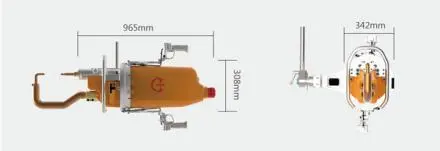
MFDC Spot Welding Machines (110–880 KVA) — stable DC output with fast current rise for consistent spot welding steel on AHSS, UHSS, galvanized, and standard carbon steel grades. Three-phase balanced power input and adaptive current control deliver energy efficiency and process consistency across single-station and multi-station body-in-white applications.
MFDC Robotic Welding Guns (300+ models) — C-type and X-type configurations for all major robot platforms. Arm-mounted MFDC transformer eliminates secondary cable losses, reduces gun weight, and sustains the high cycle rates automated body-in-white spot welding steel demands. Compatible with multi-arm, multi-station robotic cell layouts.
Real-Time Quality Monitoring — all Heron MFDC systems integrate with Heron’s quality monitoring platform, capturing current, voltage, electrode force, and displacement data for every weld cycle. Closed-loop corrections in real time, immediate flagging of out-of-specification welds, and full production traceability — standard for structural spot welding steel on safety-critical automotive components.
Contact Heron’s engineering team to discuss the right MFDC configuration for your steel grade, production volume, and automation requirements.
Where MFDC Spot Welding Steel Is Deployed
Automotive body — AHSS and UHSS B-pillar, door ring, roof, and floor structures where structural weld quality directly affects crash performance. Robotic MFDC guns deliver positioning precision and current stability at body-in-white cycle rates.
Automotive parts — galvanized steel brackets, seat frames, door beam reinforcements, and chassis components where zinc coating demands the tighter process control MFDC provides.
Home appliances — carbon steel and galvanized drum assemblies, heating brackets, and structural frames in washing machines, dryers, and HVAC equipment requiring sustained high-duty-cycle performance.
Hardware and industrial — steel shelving, enclosures, and formed steel assemblies where production throughput and weld consistency determine line profitability.
Frequently Asked Questions
Q1. What is the difference between AC and MFDC for spot welding steel?
AC produces a sinusoidal current with zero crossings that cause current interruptions — reducing consistency on demanding steel grades. MFDC produces stable DC with no zero crossings and fast current rise, maintaining precise heat input throughout the weld cycle. For spot welding AHSS, UHSS, and galvanized grades, MFDC delivers better nugget consistency, less spatter, and smaller heat-affected zones.
Q2. Why is MFDC preferred for spot welding AHSS and UHSS?
AHSS and UHSS have narrower process windows than mild steel. MFDC’s stable DC output holds welding current precisely within this window throughout the weld cycle. AC’s sinusoidal waveform fluctuates, spending portions of every cycle outside the optimal range — producing more variable results on high-strength grades where consistency is a safety-critical requirement.
Q3. Can Heron’s MFDC spot welders handle galvanized steel?
Yes. Heron’s MFDC spot welders are used in production for spot welding galvanized steel across automotive parts, appliance, and hardware OEM applications. MFDC’s faster current rise and stable output reduce spatter, electrode contamination, and nugget variability that zinc coatings introduce — improving quality and electrode life versus AC systems on the same application.
Q4. Are MFDC robotic welding guns suitable for body-in-white steel welding?
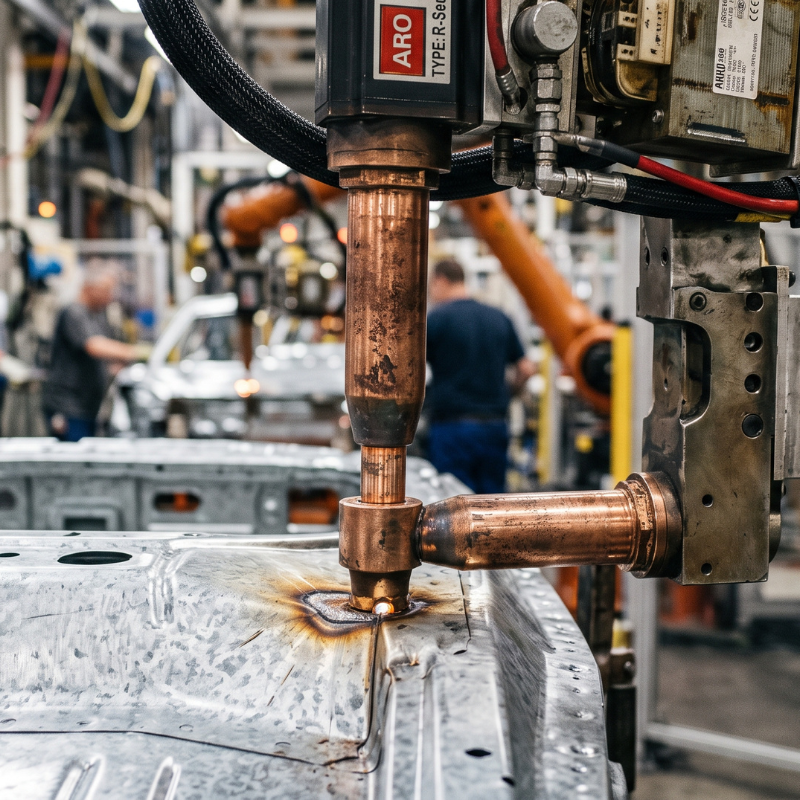
Yes. Heron’s MFDC robotic welding guns are specifically designed for automated spot welding steel on body-in-white lines. The compact, lightweight MFDC arm-mounted transformer reduces gun weight compared to AC configurations — allowing faster robot movement, better positioning accuracy, and lower mechanical wear across the equipment lifecycle.
Conclusion
Spot welding steel on AHSS, UHSS, galvanized, and coated grades requires the current stability, heat precision, and process control that MFDC technology delivers — and that conventional AC systems cannot reliably provide. The shift from mild steel to advanced grades in automotive, appliance, and industrial OEM manufacturing is not reversing — and the case for MFDC over AC for demanding steel applications grows stronger with every new material specification.
Heron Intelligent Equipment’s MFDC spot welding machines and robotic guns are engineered for these steel grades — delivering stable DC output, compact transformer design, energy-efficient operation, and integrated quality monitoring for global OEM production.