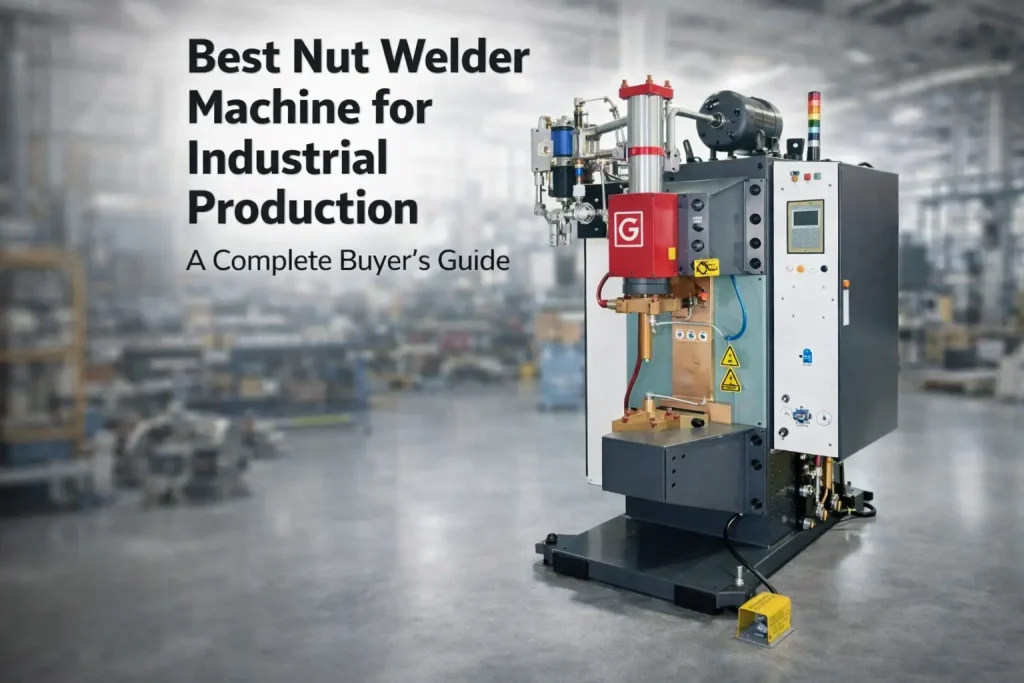
Nut Welder Machine for Industrial Production: A guide how choosing the right nut welder is a decision that impacts product quality, line efficiency, and long-term operating costs. In factories where speed and repeatability matter, a focused nut welding solution turns a routine fastener into a reliable, audit-ready joint.
This introduction outlines why nut welding deserves its own procurement checklist: the right machine reduces rework, shortens cycle time, and delivers consistent clamp strength across thousands of parts.
Whether you manage an automotive subassembly line, manufacture HVAC housings, or run an appliance production cell, the parameters you prioritize power control, electrode force, automation level, and quality monitoring will determine performance on the shop floor.
Practical factors like material thickness, nut geometry, and duty cycle shape the optimal technology choice (MFDC, capacitor discharge, or servo-driven systems). This opening sets the stage for a clear, application-driven evaluation so buyers can compare real tradeoffs and predict ROI with confidence.
Nut Welder Machine for Industrial Production: A Complete Buyer’s Guide
Metal joining in industrial production is a technical challenge with a direct impact on quality, throughput, and overall manufacturing cost. Among various joining methods, nut welding machine play a critical role in securely fastening nuts to sheet metals and components especially in automotive, electrical, HVAC, appliance, and industrial equipment manufacturing.
This guide breaks down everything industrial buyers need to know about choosing the best nut welder machine, from core technology differences to real production considerations, and how the right equipment improves efficiency, quality, and return on investment.
1. Introduction: Why Choosing the Best Nut Welder Machine Matters
Industrial production environments place heavy demands on joining systems. A weak or inconsistent nut weld can lead to product failures, recalls, excess rework, and significant downtime. Nut welding is not just about joining; it’s about producing repeatable, high-strength attachment points that meet strict quality requirements.
Nut welders are integral to:
-
Structural assemblies in automotive body applications
-
Fastening components in electrical cabinets and enclosures
-
Attaching threaded nuts in HVAC housings
-
Sheet metal furniture and appliance fabrication
Here’s why the right nut welder machine can make a measurable difference:
-
Productivity: Faster cycle times improve throughput.
-
Quality Assurance: Consistent weld strength reduces rejects.
-
Operational Cost: Efficient machines lower power usage and maintenance.
-
Scalability: Automated systems enable high-volume production.
In this guide, we explore what a nut welder machine is, how it works, and how to evaluate systems for your specific production environments.
2. What Is a Nut Welder Machine?
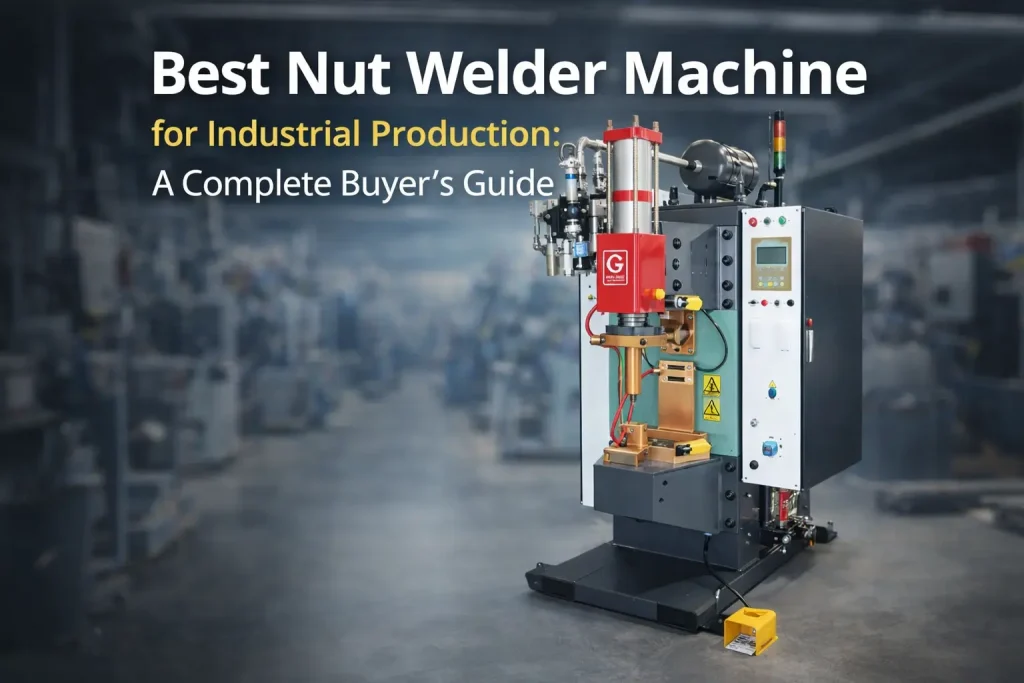
A nut welder machine is a type of resistance welding equipment specifically designed to attach nuts to thin or thick sheet metal surfaces by applying controlled electrical current and pressure. Unlike simple spot welders, nut welders often use projection welding, where raised points on the nut or projection features concentrate the welding force and energy.
Nut welding machines vary in technology and sophistication. The basic working mechanism involves:
-
Positioning the nut on the metal surface.
-
Applying force via electrodes.
-
Passing controlled current through the contact area to generate heat.
-
Forming a weld joint as the metal fuses under pressure.
The core benefit of projection and resistance nut welding is precision welds occur exactly where engineered, ensuring consistent strength and minimal distortion.
Nut Welding vs Spot Welding
Although related, these are distinct:
| Feature | Spot Welding | Nut Welding |
|---|---|---|
| Purpose | Joins two overlapping sheet metals | Attaches a nut or threaded piece to metal |
| Contact Points | Broad area | Defined projection or holding point |
| Equipment | Standard resistance welder | Specialized nut welder with tooling |
| Application | Sheet joining | Fastener attachment |
3. Common Industrial Applications of Nut Welding
Nut welders are essential across multiple industrial sectors where threaded fastening is required without pre-drilled holes or mechanical fasteners.
Automotive Body and Component Manufacturing
Nut welding machines are widely used in attaching nuts to:
-
Brackets
-
Frame supports
-
Door and hood assemblies
-
Engine components
Automotive production lines demand high cycle rates, precision, and weld repeatability to ensure safety and reliability especially in crash-critical areas.
Sheet Metal Fabrication & Enclosures
Electrical and industrial cabinets often use nut welds to secure mounting hardware. Nut welding increases rigidity and avoids mechanical fasteners that may loosen over time.
Home Appliance and HVAC Manufacturing
Nut welders improve assembly speed for frequent threaded fasteners in:
-
Air conditioner housing
-
Refrigeration cabinets
-
Washing machine frames
These environments benefit from consistent weld quality to minimize assembly errors and improve performance.
Electrical Equipment and Industrial Machinery
Nut welders are used in:
-
Control panels
-
Motor mounting brackets
-
Industrial housings
These applications require precise welding on varied material thicknesses with minimal metal distortion.
4. Types of Nut Welder Machines Used in Industry
Selecting the right nut welding machine starts with understanding core technology types.
4.1 AC Nut Welding Machines
Traditional AC welders use alternating current to generate heat. These systems are often more affordable and suitable for general resistance welding tasks.
Pros:
-
Lower initial cost
-
Simpler design
Limitations:
-
Less precise current control
-
Higher heat spread
AC systems are generally used in low-to-medium volume production where precision isn’t as critical.
4.2 Capacitor Discharge (CD) Nut Welders
Capacitor discharge welding delivers a high-energy, short-duration pulse, ideal for thin sheet metal and applications requiring minimal heat affected zones.
Advantages:
-
Fast welding cycle
-
Reduced distortion
-
Efficient for thin materials
Capacitor discharge systems are common in electronics and thin-gauge fabrication due to their precision and speed.
4.3 MFDC Nut Welding Machines
MFDC (Medium Frequency Direct Current) welding machines are widely preferred for high-quality nut welding in industrial environments.
Why MFDC?
-
Stable and controllable current waveform
-
Consistent weld heat
-
Reduced spatter and distortion
MFDC technology provides repeatability and controllability essential for automated production lines and complex welding tasks.
4.4 Servo-Controlled & Automatic Nut Welders
Servo-driven welders include robotic or automated feeding systems that integrate nut placement and welding into a unified workflow.
Key Benefits:
-
High throughput
-
Minimal operator intervention
-
Integration with smart line controls
Automated systems are ideal for high-volume production lines where consistency and cycle times are core performance metrics.
5. Key Factors to Consider When Choosing the Best Nut Welder Machine
Selecting the right system means balancing technical, operational, and business considerations.
5.1 Welding Power & Control Technology
The heart of any nut welder is its power system:
-
MFDC systems deliver consistent, stable welding heat preferred for precise quality needs.
-
Capacitor discharge systems are ideal for rapid, low-heat applications.
Important control features include adjustable current profiles, digital monitoring, and waveform tuning to maximize weld quality and reduce defect rates.
5.2 Welding Force & Electrode Design
Pressure consistency is critical. Nut welding requires precise electrode force management to ensure proper molten flow and joint formation. Ergonomic, long-life electrode tooling reduces changeover time and maintenance.
5.3 Automation & Production Speed
Manual, semi-automatic, and fully automatic systems impact throughput:
-
Manual systems fit small-batch or prototyping.
-
Semi-automatic machines improve speed with operator assistance.
-
Fully automatic systems integrate with conveyors, pick-and-place robots, or servo feeders for high-speed production.
Understanding production volume helps define automation levels and capital investment.
5.4 Welding Quality Monitoring & Data Feedback
Modern nut welders include real-time weld quality monitoring systems. These systems track:
-
Welding current profile
-
Force application
-
Weld time
-
Traceability data
Quality monitoring improves yield, reduces rework, and provides documented compliance with manufacturing standards.
5.5 Energy Efficiency & Operating Costs
Energy costs and machine uptime directly influence ROI. Machines with efficient control systems reduce cycle times, lower electricity usage, and minimize consumable wear.
6. Best Nut Welder Machine Configurations for Different Production Needs
Different production environments demand tailored solutions:
Small-Batch & Job-Shop Production
Configured with semi-automatic feeding and robust control systems, these machines balance flexibility and performance when volumes vary.
High-Volume Automotive Manufacturing
Fully automated MFDC nut welding machines with robotic integration and real-time quality tracking maintain cycle times that meet automotive production targets.
Robotic & Automated Production Lines
Systems that synchronize nut placement, welding, and inspection perform well in smart factories focusing on Industry 4.0 integration.
Custom Nut Welding Solutions
Industries with specialized components benefit from customized tooling, servo-controlled force application, and tailored control software optimized for specific part geometries.
7. Common Nut Welding Defects and How the Right Machine Prevents Them
Nut welding defects can originate from inconsistent parameters or improper equipment calibration.
Typical Defects & Causes:
-
Weak welds: insufficient current or force
-
Burn-through: excessive heat, poor current control
-
Spatter: unstable energy delivery
-
Weld inconsistency: lack of repeatability
The best nut welder machines maintain precise current, accurate force application, and controlled weld time to minimize these issues. Integrated monitoring systems further ensure process stability.
8. How to Select the Right Nut Welder for Your Industry
Industry demands and material specifications shape the selection criteria:
-
Material thickness: determines required output and welding technology
-
Nut size/type: affects electrode tooling and force requirements
-
Production volume: dictates automation level
-
Future scalability: planned upgrades and line expansion
Match these requirements with machine specifications for the best fit.
9. Why Industrial Buyers Choose Advanced Nut Welding Solutions
Advanced nut welding systems deliver:
-
Improved efficiency: higher throughput with reduced cycle times
-
Consistent quality: repeatable welds across runs
-
Lower operating costs: energy-efficient systems
-
Better integration: compatibility with automated workflows
-
Data visibility: real-time quality data for traceability
These benefits align with modern production goals for productivity and product reliability.
10. Why Choose Heron Welder for Nut Welding Solutions
Heron Welder offers a range of nut welding machines and resistance welding systems engineered for industrial environments. Key strengths include:
-
Expertise in MFDC & projection welding technologies that deliver consistent weld quality
-
Automation compatibility for high-volume production lines
-
Smart control and quality monitoring options that reduce defects and support traceability
-
Custom configuration support for unique production requirements
Heron Welder’s solutions address both technical challenges and industrial production goals, making them suitable for sectors including automotive, electronics, appliances, and industrial equipment manufacturing.
FAQs About Nut Welder Machines
1. What is a nut welder machine used for?
A nut welder machine is used to permanently attach threaded nuts to sheet metal or metal components using resistance or projection welding. It is widely used in automotive, appliance, HVAC, electrical enclosure, and industrial equipment manufacturing where strong, repeatable fastening points are required.
2. What is the difference between nut welding and spot welding?
Nut welding focuses on attaching a nut to a metal surface using projection points, while spot welding joins two overlapping metal sheets. Nut welding requires precise force and current control to ensure the nut is securely fused without damaging threads or base material.
3. Which welding technology is best for nut welding?
MFDC nut welding machines are commonly preferred for industrial production because they offer stable current control, consistent weld quality, and better energy efficiency. Capacitor discharge nut welders are suitable for thin materials and high-speed applications.
4. How do I choose the best nut welder machine for my production line?
Selection depends on material thickness, nut size, production volume, required automation level, and quality standards. Evaluating welding power, force control, monitoring features, and future scalability helps ensure the right fit.
5. Can nut welding be fully automated?
Yes. Modern nut welding systems can be fully automated with servo-driven feeding, robotic handling, and real-time quality monitoring. Automation improves cycle time, consistency, and reduces operator dependency in high-volume production lines.
6. What industries commonly use nut welder machines?
Nut welders are widely used in automotive manufacturing, electrical cabinet production, HVAC equipment, home appliances, metal furniture, and industrial machinery where threaded fastening points are essential.
7. What are common defects in nut welding and how can they be prevented?
Common defects include weak welds, nut pull-out, burn-through, and spatter. These issues are typically caused by improper current, force, or timing. Advanced control systems and weld monitoring help maintain stable and repeatable weld quality.
8. How important is weld quality monitoring in nut welding?
Weld quality monitoring is critical for detecting inconsistencies in current, force, or time during production. Real-time monitoring reduces scrap, supports traceability, and helps manufacturers meet quality and compliance requirements.
9. What maintenance is required for a nut welder machine?
Routine maintenance includes electrode inspection and replacement, calibration of welding parameters, cooling system checks, and software updates. Proper maintenance ensures consistent weld performance and extends machine lifespan.
10. Is a custom nut welding solution better than a standard machine?
For high-volume or specialized applications, a custom nut welding solution can provide better efficiency, accuracy, and integration with existing production lines. Custom tooling and control configurations help meet specific product and process requirements.
Conclusion: Making the Right Investment in a Nut Welder Machine
Choosing the right nut welder machine requires a balance of technical understanding, production needs, and strategic planning. By factoring in welding technology, automation requirements, quality monitoring, and long-term operating costs, manufacturers can select machines that improve productivity, reduce defects, and support robust production lines.
Investing in the best nut welder machine pays dividends in production reliability, cost control, and product quality making it a foundational choice for modern industrial manufacturing.