A weld that fails inspection almost never fails because of the power supply. It fails because someone specified the wrong gun for the joint geometry, the material stack, or the cycle time the line actually needs. Understanding spot welding gun types before you write a purchase order saves more rework than any control upgrade will.
For engineers and procurement teams sourcing resistance welding equipment, the decision usually comes down to structure (X-type, C-type, or manual), actuation (pneumatic or servo), and a set of specifications that determine whether the gun can actually do the job on your line, not just in a datasheet. This guide walks through the categories that matter and the numbers worth checking before you sign off on an order.
Why Gun Selection Decides Your Weld Quality Before the Power Supply Does
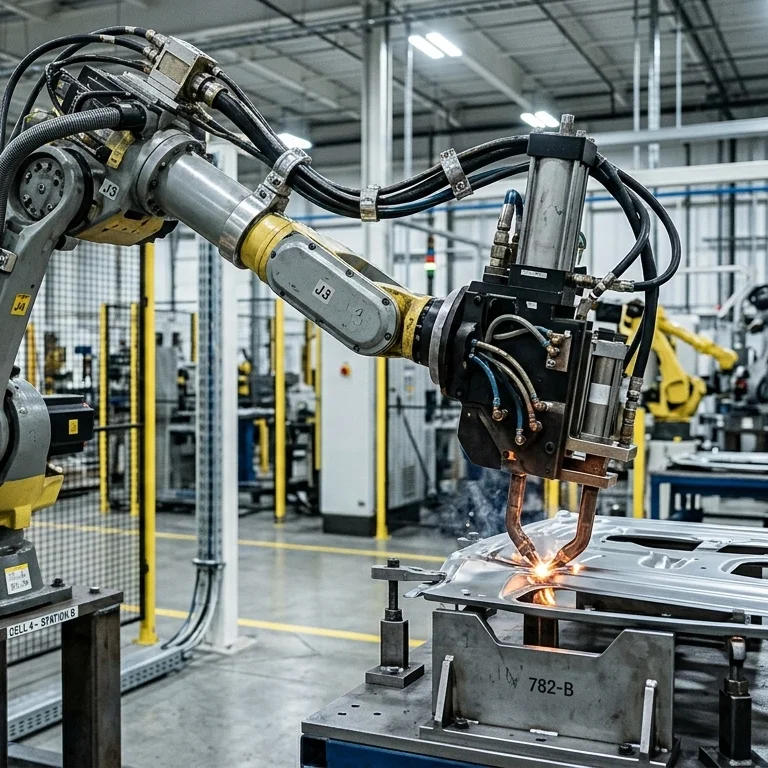
A spot welding gun applies clamping force to two or more metal sheets and passes current through the electrodes to create a fusion nugget at the joint. The gun’s geometry determines whether it can physically reach the weld point. Its force capacity and control system determine whether it can hold that force steady long enough to form a consistent nugget, shot after shot, for the life of the tooling.
Plants that treat gun selection as an afterthought, choosing whatever fits the robot flange or whatever the previous supplier used, tend to see electrode wear inconsistencies, splash, and nugget size variation that shows up in destructive testing months later. Getting the spot welding gun types right at the design stage is cheaper than retrofitting a welding cell after it’s running.
The Core Spot Welding Gun Types by Structure
Almost all spot welding gun types on a production floor fall into one of three structural families. Each one solves a different access and force problem.
X-Type Guns
X-type guns open like scissors, with both electrode arms pivoting around a central point. This geometry gives strong, direct clamping force and works well on flat or moderately curved panels where the joint sits close to the gun’s centerline. Heron’s X-Type Robotic Welding Gun with servo actuator is built for exactly this profile, using a compact servo drive to keep force delivery consistent across thousands of cycles.
X-type guns tend to be the default choice for automotive body-in-white applications like floor pans, roof rails, and door inner panels, where access is relatively open and cycle time matters more than reach.
C-Type Guns
In spot welding gun types, C-type guns have a C-shaped frame, with one electrode fixed and the other moving in a straight line toward it. That shape gives them better reach into recessed or offset joints, such as pillar sections, wheel wells, and other areas where an X-type gun’s swing radius simply won’t fit. Heron’s C-Type Robotic Welding Gun with servo actuator follows this configuration for exactly those tighter-access welds.
The tradeoff is usually a slightly larger footprint and, on some models, more moving mass for the robot to carry.
Manual Guns
Manual welding guns are one of the spot welding gun types that stay relevant anywhere robotic integration isn’t practical: low-volume runs, prototype work, rework stations, or cabinet and enclosure production where a human operator with a shorter electrode arm reaches thin plate faster than a robot cell would ever be programmed to. Heron builds manual guns from high-strength aluminum alloy castings specifically to keep them light enough for a full shift of handheld use while still holding up under repeated clamping cycles.
Pneumatic vs. Servo-Driven Actuation Changes the Spec Sheet
Structure decides reach. Actuation decides control precision, and this is where spot welding gun specifications start to diverge sharply between older and newer equipment.
Pneumatic guns use compressed air to drive the electrode arm closed. They’re simpler, generally cheaper to maintain, and fine for applications where force requirements don’t change much from weld to weld. But air pressure is harder to modulate in real time, so force overshoot and inconsistent electrode follow-up are common failure points as tooling wears.
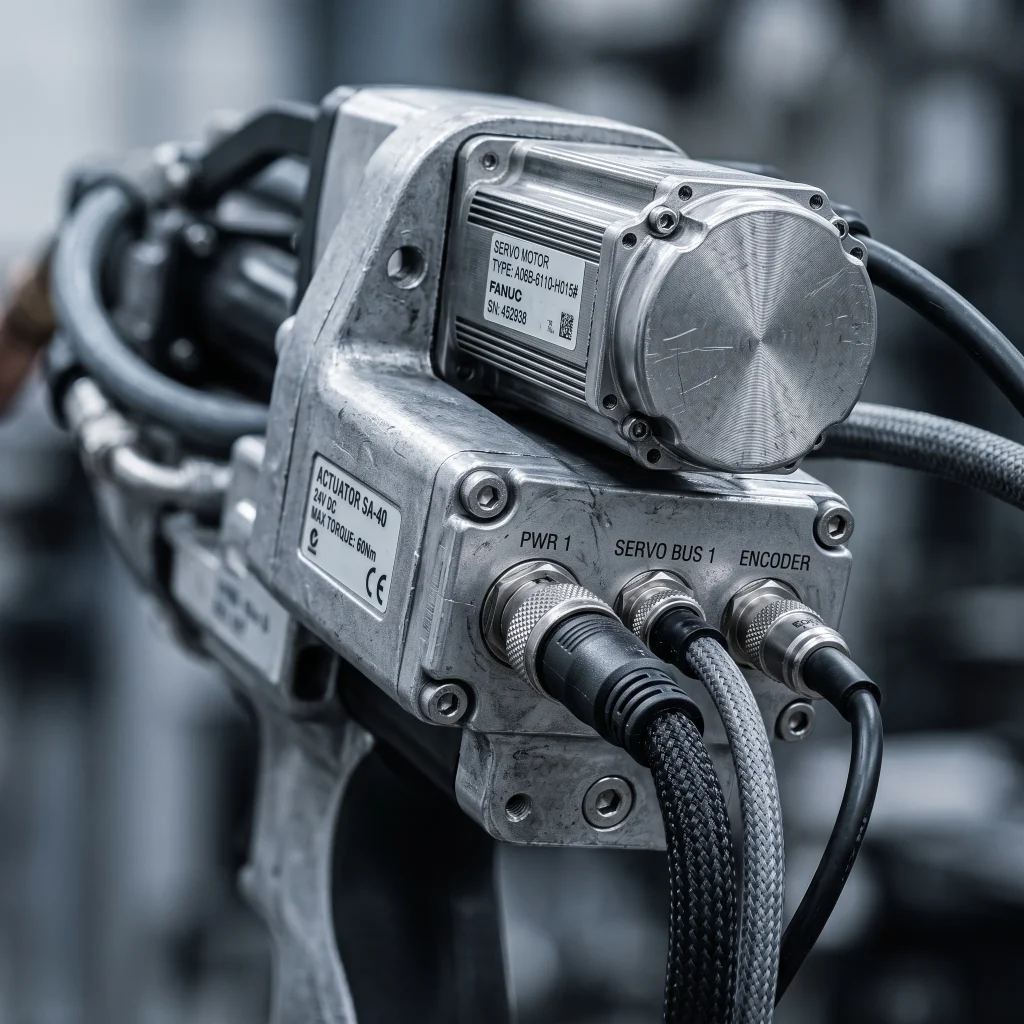
In spot welding gun types, servo-driven guns use an electric motor to control electrode position and force directly, which means the control system can adjust force mid-weld, track electrode wear, and hold tighter tolerances across a shift. This is why most new automotive-grade robotic gun specifications now default to servo actuation, even though the upfront cost runs higher than pneumatic. Heron’s servo-actuated X-type and C-type guns are built around this logic: compact servo drives that let the gun fit into smaller robotic cells while still delivering consistent electrode force.
Reading Spot Welding Gun Specifications the Way an Engineer Should
A datasheet on spot welding gun specifications full of numbers is only useful if you know which ones actually predict performance on your line. Three categories matter most in spot welding gun specifications.
Electrode Force and Throat Depth
Electrode force, measured in kilonewtons or pounds-force, has to match your material stack. Undersized force on high-strength steel or aluminum alloy produces weak nuggets and inconsistent penetration. Oversized force on thin gauge material causes electrode indentation and surface marking. Throat depth, the distance from the electrode centerline to the frame, determines whether the gun can even reach the joint on a deep panel without the frame fouling on adjacent structure.
Duty Cycle and Current Rating
Duty cycle tells you how much continuous work the gun and its integrated transformer can handle before thermal limits force a slowdown. A gun rated for a light duty cycle in a high-volume automotive cell will either derate itself mid-shift or fail early. Current rating needs to be matched to the resistance welding equipment feeding it, since an undersized gun on an oversized power supply wastes capacity, and the reverse creates a bottleneck nobody planned for.
Weight, Cable Routing and Robot Payload
In spot welding gun specifications, for robotic guns, weight isn’t a cosmetic spec. It’s a direct constraint on which robot models can carry the gun through its full range of motion without exceeding payload limits or slowing cycle time to compensate for arm strain. Cable and hose routing also matters more than it looks on paper. Poor routing on a densely packed welding cell leads to cable fatigue and unplanned downtime that has nothing to do with the weld itself.
Matching Spot Welding Gun Types to Material and Application
The right combination of structure and actuation depends heavily on what’s actually being joined and where.
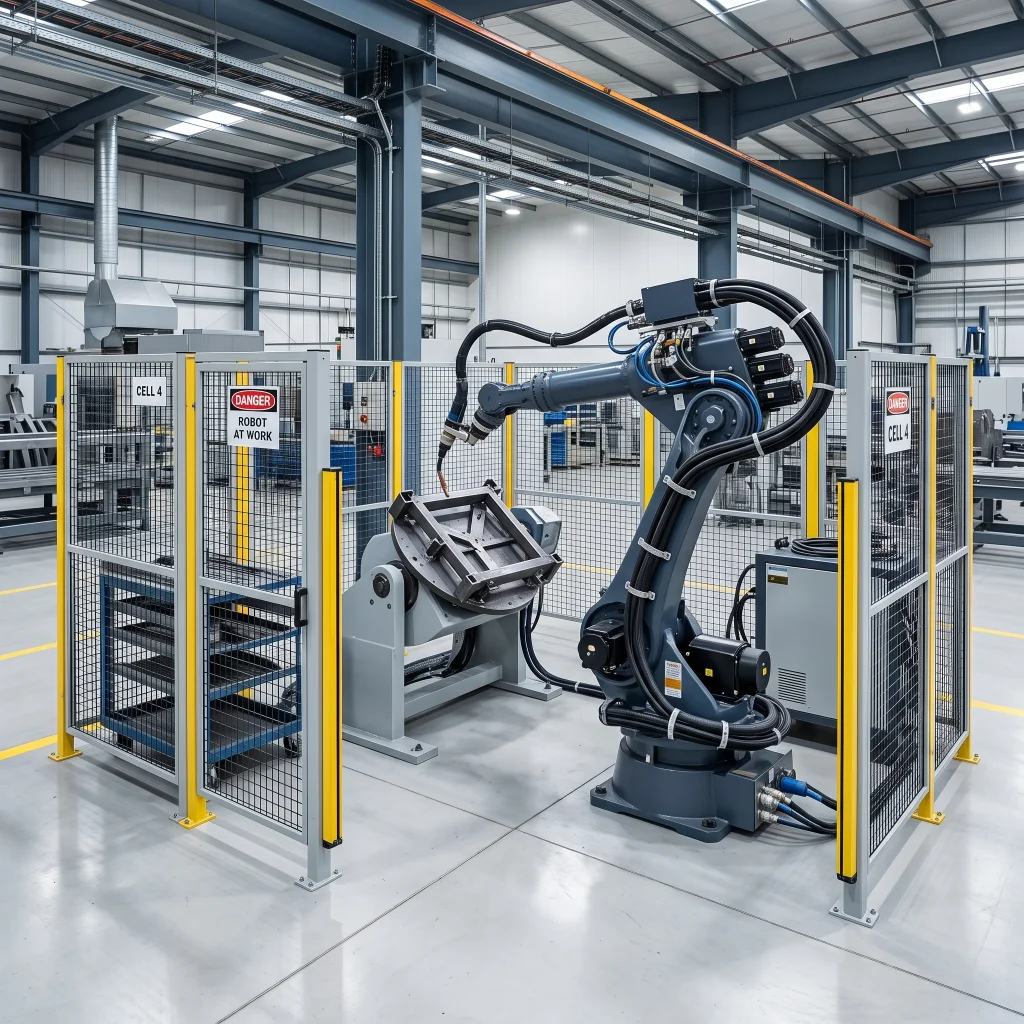
Automotive body-in-white work on front wing panels, doors, hoods, and luggage compartment covers generally favors servo-driven X-type or C-type robotic guns, chosen based on which joints need straight-line access versus offset reach. Hardware manufacturing, toolboxes, iron wire mesh products, and similar lower-volume or mixed-material work often runs efficiently on manual guns, especially where operators need to adjust position joint by joint. Home appliance and compressor shell assembly frequently mixes both, robotic guns on the high-repetition welds and manual guns for rework or lower-volume variants on the same line.
None of this is a one-size answer, which is exactly why spot welding gun specifications should be reviewed against your actual part geometry and production volume before ordering, not selected off a catalog page in isolation.
Where Heron Welder Fits Into Your Sourcing Decision
Heron has spent over 30 years building resistance welding equipment, and the welding gun lineup reflects that specialization rather than a bolt-on product line. The catalog runs to more than 300 models across robotic and manual configurations, covering the X-type and C-type structures with servo actuation for automotive-grade production, along with lightweight aluminum alloy manual guns for flexible or lower-volume work.
That range of spot welding gun types matters when the real question isn’t “which gun is best” in the abstract, but which spot welding gun types fit your specific joint access, force requirement, and duty cycle. Heron’s engineering team works from your part drawings and production targets to recommend a configuration, rather than pushing a standard model that happens to be in stock. Customers across automotive, motor manufacturing, compressor production, electrical and electronics, home appliances, and hardware manufacturing have sourced guns this way, matched to their line rather than adapted to a generic spec sheet.
If your team is finalizing a welding cell design or replacing aging tooling, get your part specs in front of Heron’s engineers before you commit to a gun model. Request a spot welding gun quote and include your material stack, force requirement, and cycle time targets, and you’ll get a configuration recommendation back rather than a generic price list.
FAQs About Spot Welding Gun Types
Q1.What’s the difference between X-type and C-type spot welding guns?
In spot welding gun types, X-type guns open like scissors, with both arms pivoting around a shared point, giving strong direct force on flat or moderately curved panels. C-type guns have one fixed and one moving electrode in a straight line, which gives better reach into recessed or offset joints that an X-type’s swing radius can’t access.
Q2. Are servo-driven welding guns worth the extra cost over pneumatic?
For high-volume or tight-tolerance work, generally yes. Servo actuation lets the control system adjust electrode force in real time and compensate for electrode wear, which reduces nugget variation over a production run. Pneumatic guns remain a reasonable choice for lower-volume or less tolerance-sensitive applications where the upfront cost difference matters more.
Q3. How do I know what electrode force my application needs?
Electrode force needs to match your material type and thickness. High-strength steel and aluminum alloy generally need higher force to achieve proper penetration, while thin gauge sheet requires lower force to avoid electrode indentation. This is a spec best confirmed with your equipment supplier against your actual material stack rather than estimated from a general chart.
Q4. Can one gun type handle multiple materials on the same line?
Sometimes, if the force range and current capacity are specified wide enough to cover the material mix. But a gun sized for hot-stamped steel isn’t automatically appropriate for aluminum alloy on the same station, so this should be confirmed during spec review, not assumed.
Q5. In Spot welding gun types: Does gun weight matter if I’m not using a robot?
Less, but not zero. On manual guns, weight affects operator fatigue across a shift, which is part of why aluminum alloy casting is common in manual gun construction. On robotic applications, weight is a hard constraint tied to robot payload capacity.
Q6. How long does it typically take to get a custom welding gun configuration quoted?
This depends on the complexity of the application and how complete the part specs are at submission. Sharing material stack, joint geometry, and cycle time targets upfront generally speeds up an accurate quote significantly.
Spot welding gun types aren’t a catalog decision; they’re a production decision. Get the structure, actuation, and specifications right before the tooling is built, and the rest of the welding cell has a much better chance of running the way it was designed to. Heron Welder’s engineering team is available to review your application and recommend a configuration built around your actual line, not a generic model number.