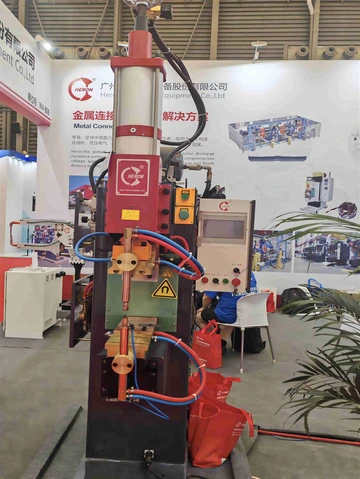
Silver contact spot welding is a critical process in the manufacturing of electrical switches, relays, and contactors. Since silver contacts directly affect conductivity, switching reliability, and service life, achieving consistent weld quality is essential for modern electrical components.
Among joining methods, resistance spot welding offers better control over heat input, weld consistency, and production efficiency for silver contact spot welding—making it the preferred solution for bonding silver contacts to substrates such as copper and Fe-Ni alloys.
1. What Is Silver Contact Spot Welding?
Silver contact spot welding is a resistance welding process where electrical current passes through the interface between the silver contact and the base material, generating localized heat under controlled pressure.
This process enables:
- Rapid weld nugget
- Minimal heat-affected zone.
- High repeatability in automated production.
Due to its short cycle time and precise energy control, it is widely used in high-volume electrical component manufacturing.
2. Key Challenges in Silver Contact Spot Welding
Despite its advantages, silver contact spot welding presents several technical challenges due to silver’s material properties:
- Extremely high electrical and thermal conductivity: Silver has the highest electrical conductivity among metals, about 1.05 times that of copper, causing rapid current dispersion. This requires higher current density and precise control during welding.
- Relatively low melting point: Pure silver melts at 78℃, significantly lower than copper or steel. Heat input must be strictly controlled to prevent excessive melting.
- Excellent plasticity and ductility: Silver’s high-temperature plastic deformation ability aids dense weld nugget formation under pressure but also makes it prone to deformation under excessive pressure.
- Strong arc erosion resistance: Silver contacts are widely used in switch contacts, but the welding thermal cycle directly impacts long-term performance.

3. Advantages of Silver Contact Spot Welding:
When properly controlled, silver contact spot welding offers significant quality and productivity benefits:
- Precise energy control and rapid response: Medium-frequency inverter spot welders enable closed-loop feedback control of current, time, and force. Millisecond-level adjustments accurately match the silver spot’s thermal response, avoiding overheating that could cause coarsening or cracking.
- Low heat input and minimal distortion: Short-time high-current welding, combined with high electrode force, enables rapid heating and cooling. This controls the heat-affected zone effectively, maintaining material micro-structural stability, ideal for miniaturized and high-density contact designs.
- High efficiency and process consistency: Silver contact spot welding integrates seamlessly into automated production lines, enabling stable multi-point welding with consistent batch quality, suitable for mass production of relays and contactors.
- No filler material or shielding gas required: This solid-state welding process fuses the base material itself, avoiding solder contamination or porosity defects that occur in brazing. It also eliminates the need for additional shielding gas, reducing process complexity and cost.
- High-Quality Metallurgical Bond: Pressure forms a metallurgical bond between silver dots and substrate, ensuring low and stable contact resistance. It is not prone to loosening or oxidation-induced contact failure during long-term use.

4. Best Practices for Optimizing Silver Contact Spot Welding
For optimal silver contact spot welding results, manufacturers should focus on:
- Precise parameter control: Current, weld time, and electrode force must be precisely tuned.
- Optimized electrode design: Proper geometry and material for better current concentration.
- Process monitoring: Real-time feedback ensures consistency and traceability.
- Application-specific setup: Parameters tailored to material combinations and part geometries.
Silver contact spot welding is the most efficient and reliable method for joining silver contacts in electrical components. Its precise energy control, consistent weld quality, and high production efficiency make it essential in modern manufacturing.
By integrating advanced welding equipment with data-driven process control, manufacturers can enhance product reliability, reduce variation, and meet the growing demands of high-performance electrical systems.