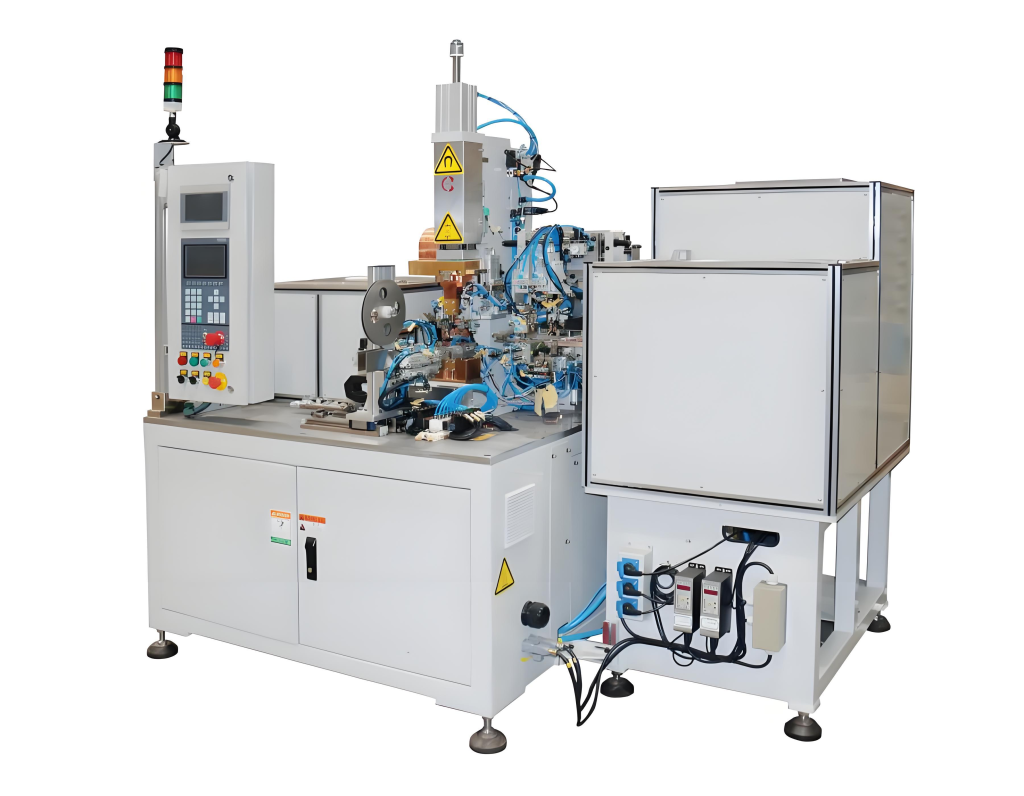
Robotic Projection Welder technology has become a cornerstone in modern industrial manufacturing, especially for high-precision applications such as battery pack and electrical component assembly. As manufacturers increasingly demand speed, accuracy, and repeatable quality, traditional welding methods are often insufficient to meet the rigorous standards of today’s automotive, electronics, and appliance industries.
Robotic projection welders combine advanced automation, precise control, and high-speed production capabilities to deliver consistent, high-quality welds on delicate and complex metal components. By integrating robotic arms, servo-controlled welding guns, and MFDC or capacitor discharge technology, these systems optimize every weld for strength, efficiency, and minimal material distortion.
In addition, automated welding solutions enhance workplace safety, reduce scrap, and enable manufacturers to scale production without compromising quality. For industries like electric vehicles and electrical equipment, where reliability and performance are paramount, adopting robotic projection welding can significantly improve assembly outcomes while reducing operational costs.
Robotic Projection Welders for Battery Pack and Electrical Component Assembly
In this guide, we will explain the features, applications, and benefits of robotic projection welders for battery pack and electrical component assembly.
1. Introduction
Robotic Projection Welder technology has become a cornerstone in modern industrial manufacturing, particularly for applications requiring precision and reliability such as battery pack and electrical component assembly.
With the increasing demand for electric vehicles (EVs), consumer electronics, and industrial electrical equipment, manufacturers face the challenge of producing high-quality welds consistently at high speed. Traditional projection welding methods often fall short in meeting the efficiency, repeatability, and quality standards required by modern production lines.
Robotic projection welders integrate automation with precise welding controls, enabling manufacturers to handle delicate and complex metal components efficiently. These systems use servo-controlled welding guns, MFDC (Medium-Frequency Direct Current) or capacitor discharge technology, and robotic arms to ensure accurate, repeatable welds.
Automated welding not only improves production throughput but also enhances operator safety, reduces scrap, and minimizes material distortion. Industries like EV battery manufacturing, electrical equipment production, and appliances benefit from this technology by achieving better performance and operational efficiency.
2. What is a Robotic Projection Welder?
A robotic projection welder is an automated machine designed to join metal components using controlled electrical current and pressure applied through projection welding points. Unlike manual or conventional projection welding, robotic systems allow manufacturers to automate the entire welding process, providing consistent quality and faster production.
Key components include:
-
Robotic Arms: Precisely position and move welding guns to exact locations on components.
-
Welding Guns: Equipped with servo-controlled systems to regulate pressure, current, and timing.
-
Power Supply: MFDC or capacitor discharge units to deliver accurate, repeatable energy for welding.
-
Control System: Programmable parameters to monitor and adjust weld quality in real time.
By combining these components, robotic projection welders can handle high-volume production while maintaining consistent weld integrity, which is critical for sensitive components like battery tabs and electrical terminals.

3. Why Use Robotic Projection Welding for Battery Pack and Electrical Components?
Robotic projection welding is particularly suitable for battery packs and electrical components due to several factors:
-
Precision Welding: Battery tabs and electrical contacts require extremely precise welds. Robotic systems ensure exact alignment and consistent weld depth.
-
Repeatable Quality: Automated control reduces variability caused by human operators, ensuring each weld meets strict industry standards.
-
High-Speed Production: Robotic projection welders operate at faster cycles than manual welding, supporting high-volume manufacturing demands.
-
Material Compatibility: Supports welding of aluminum, copper, and steel essential for battery packs, busbars, and electrical terminals.
-
Operational Safety: Robots reduce operator exposure to electrical hazards and hot surfaces.
Case studies in EV battery production show that adopting robotic projection welding reduces defective welds by up to 35%, while improving throughput by 20–25% compared to manual methods.
4. Key Features of Robotic Projection Welders
Modern robotic projection welders incorporate features designed to optimize production efficiency and weld quality:
-
Automated Welding Guns and Robotic Arms: Enable precise placement and controlled pressure for each weld.
-
Servo-Controlled Systems: Ensure consistent force and motion during welding cycles.
-
Programmable Welding Parameters: Voltage, current, and dwell time can be customized for different materials and thicknesses.
-
Welding Process Monitoring: Real-time sensors detect deviations, allowing immediate corrections.
-
Integration with Production Lines: Easily incorporated into automated assembly lines, including battery module assembly and electrical component manufacturing.
These features collectively reduce defects, increase operational efficiency, and enhance the reliability of welded assemblies.
5. Applications in Battery Pack Assembly
Battery pack assembly, particularly for EVs and energy storage systems, requires precise, durable welds for battery tabs, connectors, and busbars. Robotic projection welders are widely used for these applications because:
-
Uniform Tab Welding: Ensures consistent electrical conductivity and mechanical strength across all cells.
-
High-Volume Production: Robots can weld multiple battery cells in seconds, meeting fast production schedules.
-
Material Flexibility: Works with thin aluminum, copper, or hybrid battery materials without causing warping.
-
Reduced Scrap and Rework: Automated welding reduces mistakes that lead to defective packs.
A 2022 case study from a leading EV battery manufacturer demonstrated that robotic projection welding reduced welding defects from 4% to 1.2% while improving battery module throughput by 22%.
6. Applications in Electrical Component Assembly
Electrical components such as switches, relays, circuit breakers, and busbars also benefit from robotic projection welding:
-
Terminal Welding: Ensures strong and reliable connections for electrical circuits.
-
High-Volume Assembly: Supports mass production without compromising quality.
-
Lightweight Material Joining: Aluminum and copper components are welded efficiently without damaging material integrity.
-
Precision Control: Each weld is monitored for resistance, current, and pressure to maintain standards.
Industries using robotic projection welders for electrical assembly report a 40% reduction in manual labor requirements while maintaining or improving product quality.
7. Benefits of Robotic Projection Welding in Industrial Production
Robotic projection welding provides several advantages that make it ideal for modern industrial applications:
-
Improved Production Efficiency: Automated systems reduce cycle time and increase throughput.
-
Consistent Weld Quality: Real-time monitoring ensures every weld meets specifications.
-
Reduced Scrap and Rework: Accurate welds reduce the risk of defects and wasted materials.
-
Enhanced Safety: Operators are removed from high-voltage and high-temperature operations.
-
Energy Efficiency: MFDC and servo-controlled systems consume less power compared to traditional welding.
-
Scalability: Easily adapted to growing production needs in battery and electrical assembly lines.
Case studies from appliance and EV manufacturers show measurable ROI within the first year of implementation due to reduced labor costs, improved yield, and minimized defects.
8. Choosing the Right Robotic Projection Welder
When selecting a robotic projection welder, manufacturers should consider:
-
Production Volume Requirements: Machines should match the number of welds per hour needed.
-
Material Compatibility: Ensure the system can handle aluminum, copper, and steel of varying thickness.
-
Integration Capabilities: Compatibility with existing automated assembly lines and robotics.
-
Manufacturer Support: Access to technical assistance, spare parts, and customization options.
-
Future Scalability: Ability to upgrade for higher speed, additional welding points, or Industry 4.0 integration.
Heron Welder, for example, provides modular solutions that can be customized for EV battery packs, electrical component assembly, and appliance manufacturing.
9. Future Trends in Robotic Projection Welding
Robotic projection welding continues to evolve alongside smart manufacturing and Industry 4.0 technologies:
-
Digital Process Monitoring: AI-assisted quality control detects inconsistencies before they become defects.
-
Automated Line Integration: Systems connect with sensors, conveyors, and robots for fully automated production lines.
-
Lightweight Material Applications: Welding aluminum, copper, and hybrid materials for EVs and electronics.
-
Sustainable Production: Energy-efficient systems reduce power consumption and environmental impact.
The combination of robotics, precision welding, and digital monitoring positions robotic projection welding as a future-proof solution for industrial manufacturers.
FAQs: Robotic Projection Welder
1. What is a robotic projection welder?
A robotic projection welder is an automated welding system that uses robotic arms, servo-controlled welding guns, and MFDC or capacitor discharge technology to join metal components. It is designed for high-precision, repeatable welds in industrial manufacturing, including battery packs and electrical components.
2. How does robotic projection welding work?
Robotic projection welding works by applying controlled electrical current and pressure to projection points on metal parts. The robotic system ensures precise positioning, consistent weld quality, and high-speed production, reducing defects compared to manual methods.
3. Why is robotic projection welding important for battery pack assembly?
Battery packs require uniform welds on thin metal tabs and connectors to maintain electrical conductivity and mechanical integrity. Robotic projection welders provide precise, repeatable welds, improving efficiency and reducing scrap in EV and energy storage manufacturing.
4. Can robotic projection welders handle different metals?
Yes. These systems can weld aluminum, copper, and steel, which are commonly used in battery tabs, busbars, and electrical terminals. Adjustable parameters allow the welder to handle materials of varying thickness and conductivity.
5. What industries benefit most from robotic projection welding?
Key industries include electric vehicles, electronics, home appliances, electrical equipment manufacturing, and industrial metal assembly. Any high-volume production requiring precise, repeatable welds can benefit.
6. How does robotic projection welding improve production efficiency?
By automating welding tasks, these machines reduce cycle time, operator intervention, and rework, while increasing throughput. Integration with production lines allows multiple welds per cycle, improving overall efficiency.
7. What are the key features of a robotic projection welder?
Important features include servo-controlled welding guns, programmable welding parameters, real-time quality monitoring, robotic arms for precise positioning, and integration with automated assembly lines.
8. How do robotic projection welders ensure weld quality?
They use real-time sensors and feedback systems to monitor voltage, current, and weld pressure, ensuring each weld meets the required standards. Deviations are automatically corrected, reducing scrap and defects.
9. What should manufacturers consider when choosing a robotic projection welder?
Factors include production volume, material compatibility, integration with existing lines, manufacturer support, and future scalability. Systems should match the workflow and material requirements of battery pack or electrical component assembly.
10. Are robotic projection welders suitable for small-scale production?
While optimized for high-volume industrial applications, smaller robotic projection welders are available for limited production runs or R&D purposes. However, ROI is maximized in larger-scale, automated manufacturing environments.
Conclusion
Robotic projection welders are transforming battery pack and electrical component assembly by providing precision, repeatable quality, and high-speed production. These systems improve efficiency, reduce defects, and enhance operator safety while supporting modern manufacturing requirements for EVs, electronics, and appliances. By integrating servo-controlled welding guns, robotic arms, and advanced MFDC or capacitor discharge technology, manufacturers can achieve superior results and measurable ROI.
For companies looking to automate their welding processes, investing in robotic projection welding is no longer optional it is essential for maintaining competitive advantage, ensuring product reliability, and scaling production efficiently.