Projection Welding vs Resistance Spot Welding: A Complete Guide for Manufacturers
In this guide, we will explain the key differences, working principles, applications, and how to choose between projection welding and resistance spot welding for industrial manufacturing.
1. Introduction to Projection Welding vs Resistance Spot Welding
Manufacturers working with sheet metal, fasteners, and electrical components often evaluate Projection Welding vs Resistance Spot Welding to determine the most efficient joining process. Both methods belong to the resistance welding family, where heat is generated through electrical resistance and pressure is applied to form a weld.
The choice between these two processes directly impacts:
- Production speed
- Weld quality
- Automation capability
- Overall manufacturing cost
For engineers and procurement teams, understanding the difference between projection welding and resistance spot welding is essential for optimizing production lines and achieving consistent output.
2. What Is Projection Welding? (Process, Principle & Key Features)
Projection Welding Process Explained
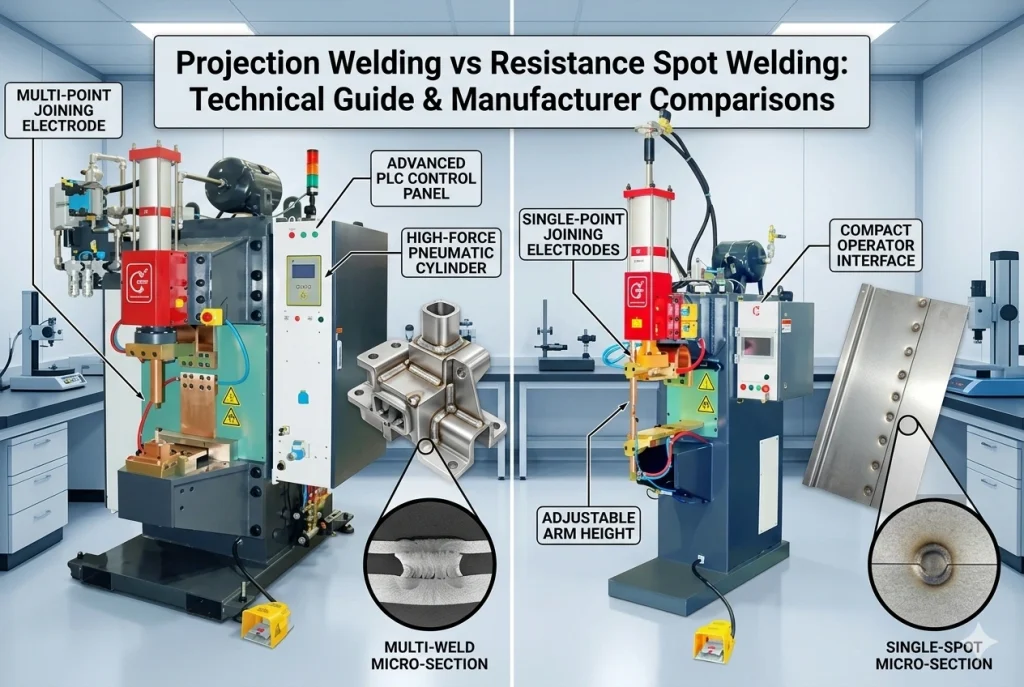
Projection welding is a resistance welding technique where localized projections (embossments) are formed on one of the workpieces. When current flows through these projections, heat is concentrated at specific point, creating multiple welds simultaneously.
Working Principle
- Projections focus electrical current
- Heat is generated at precise point
- Pressure collapses projections to form welds
Key Features
- Multi-point welding in a single cycle
- Controlled current concentration
- Reduced heat spread
- High repeatability
Advantages of Projection Welding
- Ideal for nut, bolt, and fastener welding
- Enables high-speed production
- Reduces electrode wear
- Supports automated welding systems
3. What Is Resistance Spot Welding? (Working Principle & Applications)
Resistance Spot Welding Process Explained
Resistance spot welding joins metal sheets by applying pressure and electrical current through electrodes at a specific point, forming a weld nugget.
Working Principle
- Two electrodes clamp the material
- Current flows through the contact area
- Heat forms a molten weld nugget
- Pressure solidifies the joint
Key Applications
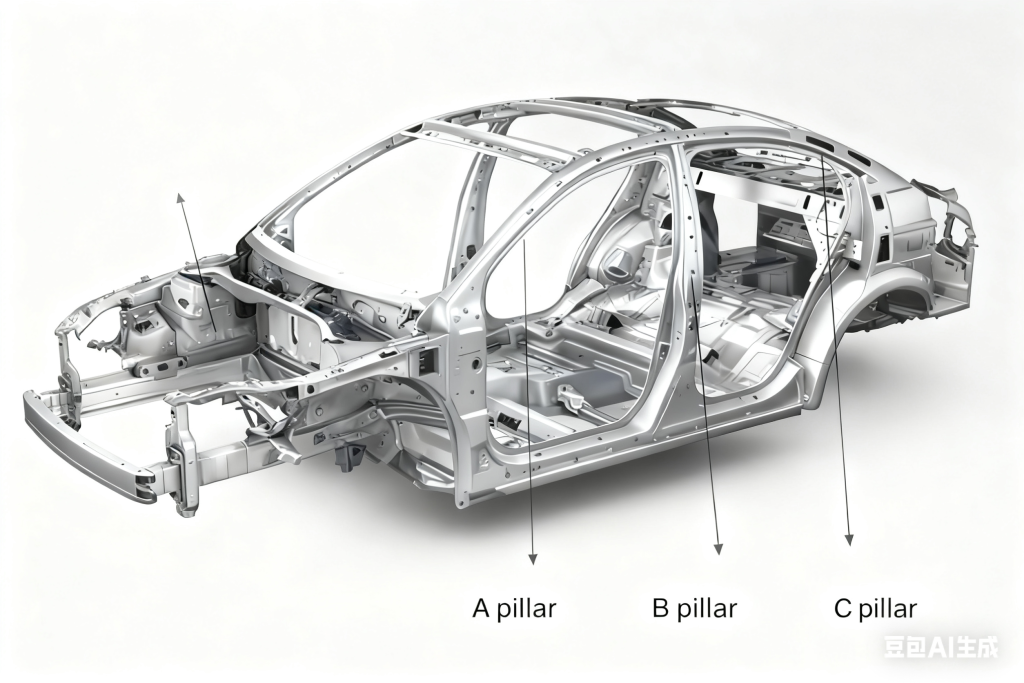
- Automotive body panels
- Electronics assembly
- Sheet metal fabrication
Advantages of Resistance Spot Welding
- Simple and flexible process
- Lower initial setup cost
- Suitable for thin sheet materials
- Widely used in mass production
4. Projection Welding vs Resistance Spot Welding: Key Differences Explained
Process Differences
- Projection welding uses pre-formed projections
- Spot welding uses direct electrode contact
Heat Generation
- Projection welding: Localized heat concentration
- Spot welding: Heat distributed at electrode contact
Electrode Design
- Projection welding: Flat electrodes
- Spot welding: Pointed electrodes
Pressure Application
- Projection welding: Uniform pressure across projections
- Spot welding: Focused pressure at a single point

5. Projection Welding vs Resistance Spot Welding Comparison Table
| Factor | Projection Welding | Resistance Spot Welding |
|---|---|---|
| Welding Points | Multiple | Single |
| Speed | High | Moderate |
| Automation | Excellent | Good |
| Electrode Wear | Low | Higher |
| Cost Efficiency | High in mass production | Lower for small runs |
| Applications | Fasteners, automotive | Sheet metal, electronics |
6. Industrial Applications: When to Use Projection Welding vs Spot Welding
Projection Welding Applications
- Automotive fasteners
- Compressor components
- Wire mesh welding
- Battery pack connections
Spot Welding Applications
- Car body panels
- Thin sheet assemblies
- Consumer electronics
Best Use Case Insight
- Use projection welding for repetitive, high-volume production
- Use spot welding for flexible, low-complexity operations
7. Advantages of Projection Welding in Manufacturing
Projection welding offers several benefits for industrial manufacturers:
- Multi-point welding capability improves productivity
- Reduced electrode wear lowers maintenance costs
- Consistent weld quality enhances product reliability
- Supports automated welding production lines
For large-scale factories, projection welding provides a balance of speed and precision that supports modern manufacturing demands.
8. Advantages of Resistance Spot Welding in Industrial Production
Resistance spot welding remains widely used due to:
- Simple equipment setup
- Lower investment cost
- Flexibility for different materials
- Proven reliability in automotive industries
It is particularly effective for operations where production flexibility is more important than speed.
9. Projection Welding vs Spot Welding for Automated Manufacturing Systems
Automation is a key factor in modern manufacturing. Both processes can be integrated into automated systems, but their capabilities differ.
Projection Welding in Automation
- Ideal for robotic welding systems
- Compatible with PLC-controlled machines
- Supports multi-point welding automation
Spot Welding in Automation
- Common in robotic lines production
- Suitable for single-point repetitive tasks
Industry Insight
Manufacturers adopting Industry 4.0 prefer projection welding due to its efficiency in automated environments.
10. Cost, Efficiency, and Performance Comparison
Cost Analysis
- Projection welding: Higher initial setup, lower long-term cost
- Spot welding: Lower setup cost, higher operational cost
Efficiency
- Projection welding increases throughput with multi-point welding
- Spot welding requires multiple cycles
Energy Consumption
- Projection welding is more energy-efficient in bulk production
Production Output
- Projection welding delivers higher output in less time
11. How to Choose Between Projection Welding and Resistance Spot Welding
Manufacturers should evaluate:
Key Factors
- Production volume
- Material type
- Required weld strength
- Automation level
Decision Guide
- Choose projection welding for mass production and automation
- Choose spot welding for flexibility and lower investment
12. Why Advanced Welding Solutions Matter for Modern Factories
Modern manufacturing requires:
- High precision
- Reduced downtime
- Consistent output
Advanced welding solutions, including automated systems, help factories meet these demands.
Companies like Heron Welder provide integrated welding solutions that combine:
- Automation
- Process optimization
- Custom system design
This approach improves efficiency and ensures long-term reliability in production environments.
Projection Welding vs Resistance Spot Welding – Which Is Best?
There is no single “best” welding process. The choice depends on production needs.
- Projection welding is best for high-volume, automated manufacturing
- Resistance spot welding is ideal for flexible and low-cost operations
For manufacturers aiming to scale production and improve efficiency, projection welding offers clear advantages.
FAQs: Projection Welding vs Resistance Spot Welding
1. What is the main difference between projection welding and resistance spot welding?
Projection welding uses raised projections to focus current and create multiple welds simultaneously, while resistance spot welding uses directly electrode contact to form a single weld point.
2. Which welding process is better for automotive manufacturing?
Both processes are widely used, but projection welding is preferred for fasteners and structural components, while spot welding is commonly used for body panels and sheet metal assemblies.
3. Is projection welding more efficient than resistance spot welding?
Yes, projection welding is more efficient in high-volume production because it can create multiple welds in a single cycle, reducing time and energy consumption.
4. When should manufacturers choose resistance spot welding?
Manufacturers should choose spot welding when flexibility, lower setup cost, and simple operations are required for thin sheet materials.
5. Can projection welding and spot welding be automated?
Yes, both processes can be integrated into automated systems, but projection welding is more suitable for robotic and high-speed automated production lines.
6. What materials are suitable for projection welding vs spot welding?
Both methods work well with conductive metals like steel and aluminum, but projection welding is ideal for thicker materials and components with defined weld points.
7. Which welding method offers better weld strength?
Projection welding often provides stronger and more consistent welds in multi-point applications, while spot welding is effective for single-point joints.
8. How does electrode wear differ between projection welding and spot welding?
Projection welding typically results in lower electrode wear because the current is concentrated at projections, while spot welding electrodes experience more direct heat and pressure.
9. What is the cost difference between projection welding and resistance spot welding?
Projection welding may have a higher initial setup cost but offers lower long-term operational costs, while spot welding has lower initial investment but may incur higher maintenance and energy costs.
10. Which welding process is better for mass production?
Projection welding is generally better for mass production due to its speed, efficiency, and ability to perform multiple welds in a single operation.
Final Thoughts
Understanding Projection Welding vs Resistance Spot Welding is essential for manufacturers aiming to improve production efficiency, control costs, and maintain consistent product quality. Each process offers distinct advantages depending on the application, material type, and production scale.
Projection welding stands out in high-volume environments where multi-point welding and automation deliver measurable gains in speed and efficiency. On the other hand, resistance spot welding remains a reliable option for flexible operations and simpler manufacturing setups.
The key is not choosing one process over the other blindly, but aligning the welding method with your specific production goals and operational requirements. Factors such as throughput, weld strength, maintenance, and integration with automated systems should guide the decision.
Manufacturers that invest in the right welding technology and optimize their processes can significantly enhance performance, reduce downtime, and achieve long-term scalability in competitive industrial markets.