A nut welder is a specialized resistance welding system designed to securely join threaded nuts to metal components with high strength and dimensional accuracy. In automotive manufacturing, nut welders are widely used for structural and safety-critical assemblies, where weld quality has a direct impact on vehicle durability and crash performance.
Projection welding, as the core process of nut welders, enables simultaneous multi-point welding with short cycle times and low energy consumption—making it a preferred alternative to arc welding, brazing, and mechanical fastening.
Why Automotive Manufacturers Require Dedicated Nut Welders
As vehicle structures evolve toward lightweight designs and high-strength materials, conventional welding methods struggle to meet the demands of high-strength steels, galvanized steels, and automated production lines.
A purpose-built automotive nut welder ensures:
-
Stable weld nugget formation
-
Full preservation of threads and coatings
-
High repeatability in mass production
-
Lower operating and rework costs
To meet these demands, Heron self-developed medium-voltage capacitor discharge nut welders, now widely adopted by leading OEMs and Tier 1 suppliers.
I. Innovative Nut Welder Technology Engineered for Industry Challenges
Since its invention in 2010, Heron has continuously optimized its medium-voltage capacitor discharge nut welders, specifically addressing the rigorous demands of nut projection welding in automotive applications.
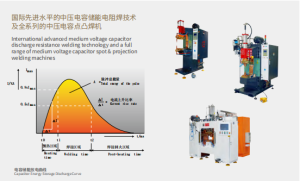
Key Technological Advantages of Heron Nut Welders
- Unique Discharge Logic
Heron’s nut welder converts three-phase AC power into DC to charge a custom-designed capacitor bank. During welding, the thyristor triggers an instantaneous discharge, delivering low-voltage, high-current output to the nut projections. The entire welding cycle completes in under 20 milliseconds, minimizing heat input and preventing thread damage.
- Current Ramping Characteristic
Unlike constant-current welding, Heron’s nut welder features a natural current ramping characteristic during capacitor discharge. This aligns with the need for reduced contact resistance and continuous molten pool expansion after projection melting, eliminating defects common in traditional constant current processes. The nut welder excels in high-strength and hot-formed steel applications.
- Energy-Efficient & Cost-Saving
Compared to traditional AC welders, Heron’s nut welder requires only 20% of grid power, and 50% less than MFDC welders. Cooling water consumption is reduced by up to 50%, significantly lowering total operating costs—a critical benefit for high-volume automotive production.
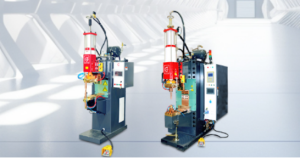
II. Addressing Four Core Challenges with Heron Proven Nut Welders
In automotive manufacturing, nuts are commonly welded onto A/B pillars, bumper beams, center consoles, subframes, and door anti-collision structures. These applications demand extreme consistency and reliability. Heron’s nut welder directly addresses the four most common challenges in nut projection welding:
| Challenges in Nut Projection Welding | Heron’s Proven Nut Welders |
| Unstable welding quality | The controlled current ramp ensures full nugget formation at every weld point, significantly improving weld-strength compliance and eliminating false welds. |
| Poor material compatibility | Heron nut welders reliably weld galvanized steel, hot-formed steel, and high-strength steel without burning off coatings or requiring post-weld processing. |
| Difficult positioning accuracy | When integrated with high-precision positioning fixtures, batch welding consistency improves by over 90%. |
| High operating costs | Annual energy consumption is reduced by approximately 40%. Elimination of tapping, re-threading, and repair welding cuts both labor and consumable costs. |
III. Industrial-Grade Nut Welder Design for Long-Term Reliability
Heron designs nut welders for to ensure durability, serviceability, and long-term stability for automotive production lines.
- Diamond-Guide Cylinder: Features a bearing-guided structure with adjustable clearance up to 0.1 mm, ensuring consistent pressure and welding stability.
- Modular Architecture: Standardized internal modules allow flexible configuration and fast maintenance, minimizing downtime and maximizing equipment uptime.
From technological principles to mechanical details, Heron’s nut welder sets a new benchmark for automotive nut projection welding—enhancing both process efficiency and the structural safety of automotive parts.
Nut Welder Technology Proven in Automotive Production
Heron nut welders are used in high-volume automotive production lines worldwide, enhancing quality, efficiency, and cost control.
If you’re evaluating nut welders for automotive or structural applications, Heron can offers case studies, technical data, and customized solutions tailored to your production needs.
Learn more about projection welding advantages: Projection Welding – Advantages & Applications