Nut Projection Welder is a critical component in modern automated manufacturing, especially for fastener attachment in automotive, hardware, and appliance production. Unlike conventional spot welding, nut projection welding focuses electrical current through the small projections on the nut, creating a localized, precise weld that ensures strong attachment without compromising thread integrity.
This process allows manufacturers to achieve repeatable weld quality, reduce scrap, and maintain high throughput, making it ideal for high-volume production lines where consistency and efficiency are crucial.
In today’s industrial environment, automated nut projection welder systems integrate servo nut feeders, robotic handling, and PLC-controlled operations, transforming a standalone machine into a smart solution capable of synchronizing with the entire production workflow.
These systems not only improve cycle time and labor efficiency but also provide real-time quality monitoring to track weld data, reduce defects, and support compliance for automotive OEM standards. Additionally, modern MFDC (Medium-Frequency Direct Current) technology enhances performance for various materials, including galvanized steel, stainless steel, and high-strength alloys.
In this guide, we will explain how nut projection welders work, their applications, technology features, and benefits for automated fastener and automotive parts manufacturing.
Nut Projection Welder for Automated Fastener & Automotive Parts Manufacturing
In modern sheet metal assembly, nut projection welder systems are no longer just welding machines. They are part of the larger manufacturing workflow that connects fastener placement, weld consistency, traceability, and production throughput.
For automotive parts manufacturers, hardware factories, and automated fastener production lines, the ability to weld threaded nuts with stable current, repeatable force, and integrated feeding directly affects cycle time, downstream assembly accuracy, and scrap rates.
This is where a Nut Projection Welder becomes a core production asset.
At scale, manufacturers need:
- stable nut positioning
- repeatable projection collapse
- strong thread integrity
- minimal spatter
- compatibility with robotic or PLC-driven lines
- weld data monitoring
- support for high-strength steel and galvanized sheet
Heron’s manufacturing ecosystem already supports this through its MFDC spot and projection welder platforms from 110KVA to 2500KVA, with strong use cases in automotive, home appliance, compressor, and hardware production.
What Is a Nut Projection Welder and How Does It Improve Fastener Welding?
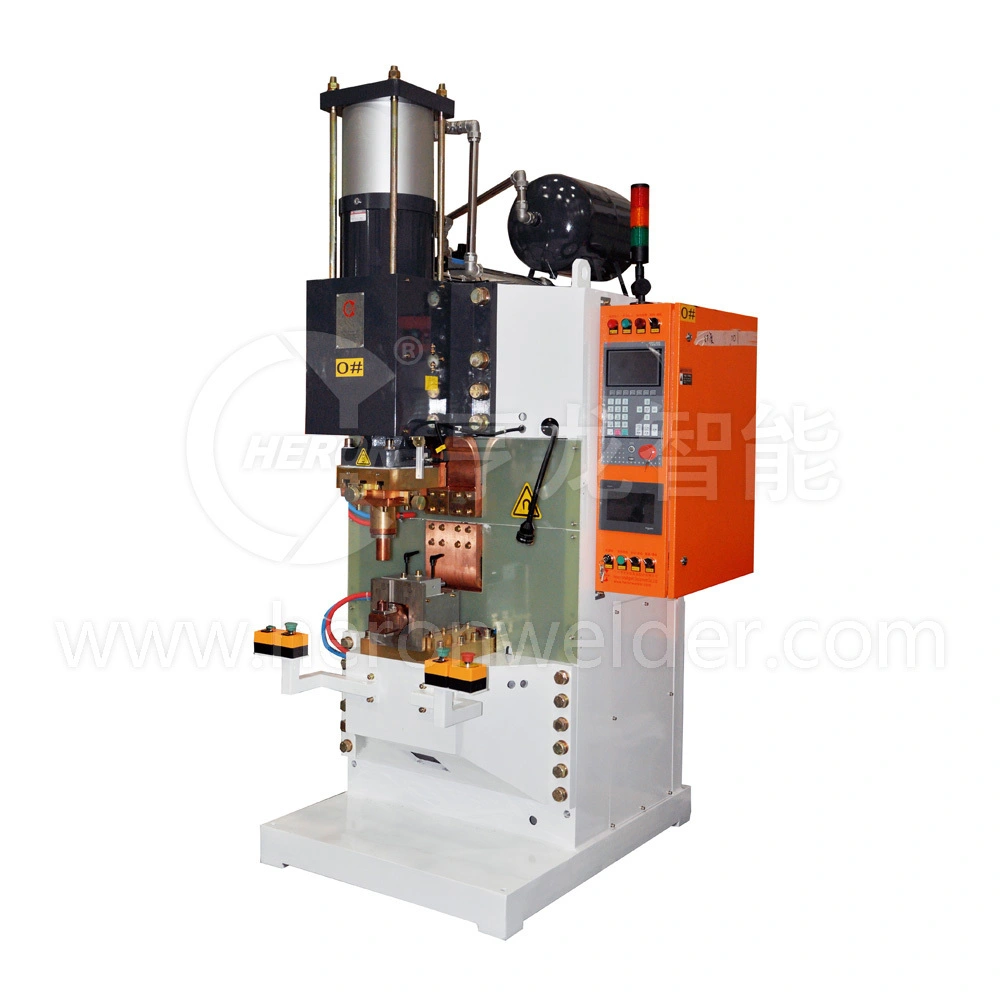
A nut projection welder is a resistance welding machine designed to attach weld nuts, threaded inserts, or specialty fasteners onto sheet metal using the nut’s pre-formed projections.
These projections focus current density into defined contact points, creating:
- localized heat
- controlled material fusion
- low distortion
- repeatable weld nugget formation
Compared with generic spot welding, projection welding offers better:
- nut alignment
- thread protection
- weld strength
- cosmetic finish
- automation compatibility
This makes it ideal for:
- seat rails
- body brackets
- chassis reinforcement plates
- battery tray assemblies
- HVAC brackets
- appliance panels
For manufacturers handling automotive stamping parts, this process reduces post-weld thread correction and improves downstream bolt assembly success rates.

Automatic Nut Projection Welder Systems for High-Volume Production Lines
The real value in modern production comes from the automatic nut projection welder, not a standalone bench machine.
High-volume plants need systems that combine:
Servo Nut Feeder Integration
Automatic feeders place nuts into exact positions before welding.
This reduces:
- manual loading labor
- nut orientation errors
- cycle variation
- line stoppages
PLC-Controlled Welding Automation
Heron’s HRC-802/HRC-803 controller architecture supports PLC logic and integration options, enabling synchronized welding sequences in semi-automatic and full automatic lines.
Robotic Nut Welding System Compatibility
For automotive body and bracket production, robotic handling systems can transfer stamped parts directly to the weld station.
Smart Production Line Synchronization
The best systems connect:
- feeder
- transfer arm
- weld head
- quality monitor
- unloading conveyor
- MES traceability layer
This transforms the welder into a smart fastener welding solution.
Heron’s broader automation capabilities in custom machines and production lines strongly support this business model for OEM factories.
Nut Projection Welder Applications in Automotive Stamping and Fastener Manufacturing
The strongest demand for nut projection welder machines comes from automotive stamping and hardware production.
Automotive Parts
Typical welded components include:
- car door frames
- seat slides
- bracket assemblies
- reinforcement plates
- EV battery trays
- structural body panels
Heron’s automotive solution pages already demonstrate strong fit in these workflows.
Hardware Manufacturing
In hardware production, nut welding is used for:
- elevator panels
- electrical enclosures
- water pumps
- tool cabinets
- fire bottle brackets
- industrial housings
Home Appliance Assemblies
Fastener welding is common in:
- dishwasher liners
- washing machine frames
- oven cavities
- refrigerator brackets
This wide industrial relevance improves the semantic ranking potential of the keyword cluster:
- automotive stamping nut welder
- fastener welding machine
- threaded nut welding system
- weld nut machine
Key Technologies Behind MFDC Nut Projection Welder Performance
The most effective systems today use MFDC nut projection welder technology.
Heron’s MFDC platforms provide measurable performance benefits including:
- 3ms welding current rise
- stable output
- reduced heat-affected zone
- improved weld consistency
- better energy efficiency
Why MFDC Matters
MFDC enables:
- faster current response
- better control over nugget formation
- improved performance on galvanized steel
- less thermal distortion
- reduced electrode wear
Existing Technical Data from Heron Machines
Heron’s production-ready models demonstrate real industrial capability:
| Model | Rated Capacity | Max Short Circuit Current |
|---|---|---|
| DB-220 | 220KVA | 40KA |
| DB-440 | 440KVA | 59.9KA |
| DB-660 | 660KVA | 85KA |
These figures are especially relevant in multi-projection nut welding where stable current delivery is essential.
Pressure and Force Control
Repeatable welding depends on:
- cylinder pressure stability
- electrode parallelism
- projection collapse timing
- hold time consistency
This is critical for thread-safe welds.
Smart Fastener Welding Solutions for Quality Assurance and Weld Consistency
Quality assurance is often what separates a good weld from a production-ready weld.
Modern smart fastener welding solutions use:
Real-Time Weld Monitoring
Track:
- current waveform
- weld time
- pressure curve
- displacement
- alarm conditions
Heron’s site already highlights advanced quality monitoring systems, making this highly aligned with your business positioning.
Low Spatter Fastener Welding
Controlled waveform output reduces:
- thread contamination
- weld splash
- electrode sticking
- post-cleaning time
Traceability and Process Data
For Tier-1 automotive suppliers, weld data can be linked to:
- part serial number
- station ID
- operator
- shift
- time stamp
This supports PPAP and customer audit requirements.

How Automated Nut Projection Welding Increases Throughput and ROI
For B2B buyers, the purchasing decision is rarely about the machine alone.
It is about ROI per shift.
Faster Cycle Times
Automatic feeding and MFDC current response can reduce weld cycles significantly compared with manual nut placement.
Heron’s 3ms rise-time architecture directly supports high-speed production.
Lower Labor Dependency
A single automated cell can replace multiple manual stations.
Reduced Rework and Scrap
Better alignment and stable projection collapse reduce:
- missing nuts
- weak welds
- thread damage
- assembly line bolt failures
Better Factory Productivity
Higher OEE comes from:
- fewer stoppages
- less manual handling
- lower consumable waste
- longer electrode life
These are the real metrics procurement teams evaluate.
Why Choose Heron Nut Projection Welder Solutions for Automotive and Hardware Manufacturing
When the requirement moves beyond a basic weld nut machine, supplier capability becomes the deciding factor.
Heron’s industrial strength lies in:
- 30+ years of resistance welding expertise
- custom welding automation
- automotive manufacturing solutions
- hardware production systems
- robotic work cells
- real-time monitoring
- Industry 4.0 production line design
The company’s 35+ Global Fortune 500 clients further strengthens buyer trust in large-scale OEM environments.
For manufacturers building:
- automotive seat structures
- chassis assemblies
- appliance frames
- electrical enclosures
- metal cabinets
Heron’s broader projection welding and automation infrastructure is a strong fit.
Featured Snippet: What Is the Best Nut Projection Welder for Automotive Manufacturing?
The best nut projection welder for automotive manufacturing combines:
- MFDC power supply
- servo nut feeding
- PLC control
- robotic compatibility
- real-time quality monitoring
- weld traceability
- stable cylinder force
- support for galvanized and high-strength steel
For high-volume production, systems in the 220KVA to 660KVA range are commonly selected depending on material thickness and nut size.
FAQs About Nut Projection Welder Machines
- What materials can a nut projection welder handle?
Low-carbon steel, galvanized steel, stainless steel, and selected aluminum assemblies depending on nut design and thickness. - Is MFDC technology better for automotive nut welding?
Yes. MFDC (Medium-Frequency Direct Current) provides faster current rise, stable heat input, and consistent welds, which is ideal for high-volume automotive stamping parts. - Can the machine support automatic nut feeding?
Yes. Modern nut projection welders integrate with servo feeders, bowl feeding systems, or robotic feeders for fully automated operation. - Which industries commonly use nut projection welders?
Automotive, hardware, home appliances, electrical cabinets, compressor brackets, and sheet metal fabrication industries. - How does projection welding protect threads?
The heat is concentrated on the nut projections, reducing direct thread contact and preserving fastening accuracy during assembly. - What types of nuts can be welded with this system?
Threaded weld nuts, hex nuts, flange nuts, and specialized fasteners designed for projection welding. - Can nut projection welders handle high-strength steel and galvanized parts?
Yes. MFDC-controlled welders ensure proper heat penetration without damaging coated surfaces or high-strength alloys. - How is weld quality monitored in automated systems?
Advanced systems use real-time monitoring for current, pressure, displacement, and cycle time, ensuring consistent welds and traceability. - What are the typical applications for automotive parts?
Seat rails, chassis brackets, battery trays, body panels, and reinforcement plates are commonly welded using nut projection systems. - Can the welder integrate into a full production line?
Yes. These machines can synchronize with conveyors, robotic arms, PLCs, and MES systems for fully automated, high-throughput manufacturing lines.
Final Takeaway
A Nut Projection Welder is now a critical automation asset for manufacturers focused on:
- fastener accuracy
- weld traceability
- production speed
- reduced labor
- automotive compliance
- hardware throughput