Portable spot welding equipment is becoming a core production tool for smart factories that demand flexibility, digital traceability, and stable welding quality across multiple manufacturing scenarios.
In modern automotive component, appliance, HVAC, and electrical equipment plants, traditional fixed resistance welding stations alone can no longer support frequent product changes, short production cycles, and line-side repair requirements.
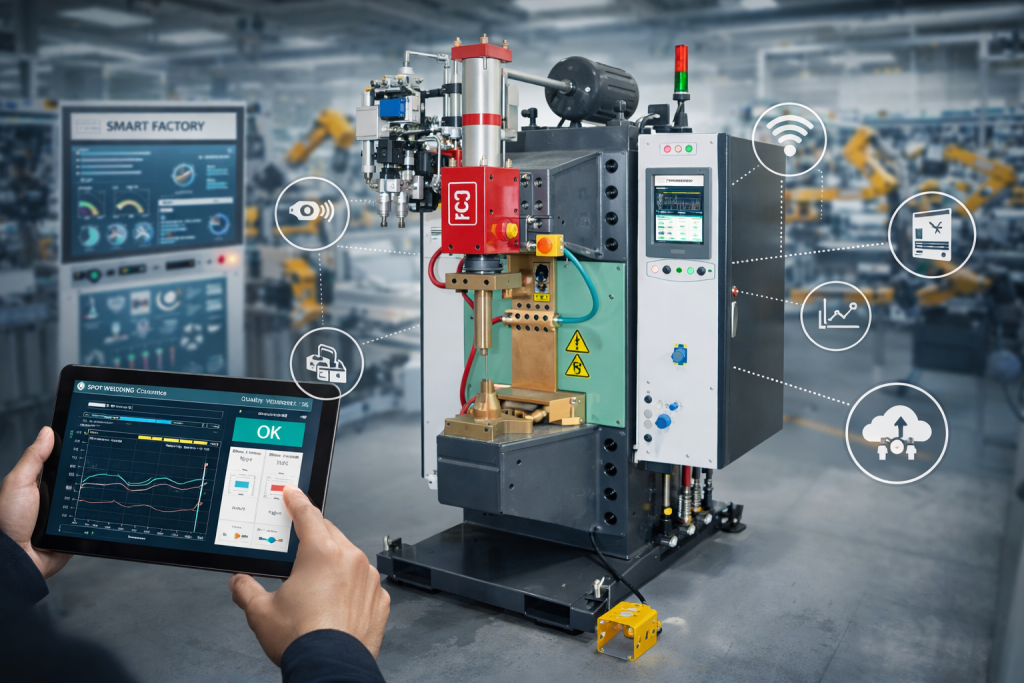
As a result, manufacturers are increasingly adopting portable resistance spot welder systems equipped with MFDC power supplies, intelligent welding controllers, and real-time quality monitoring functions.
Unlike conventional mobile welding tools, industrial portable spot welding equipment is designed to operate as part of the factory’s digital production infrastructure.
With stable MFDC current output, precise electrode force control, and integrated data acquisition, these mobile welding systems can deliver repeatable nugget quality while supporting production traceability and process optimization.
For solution-oriented manufacturers such as Heron Welder, portable welding systems are engineered to integrate seamlessly with automation lines, robotic cells, and MES platforms, enabling manufacturers to maintain consistent joining performance even in high-mix and variable production environments.
Portable Spot Welding Equipment for Smart Factories: MFDC Technology and Quality Monitoring
Modern manufacturing is moving away from fixed, single-purpose workstations and toward flexible, data-driven production environments. For automotive suppliers, appliance manufacturers, and electrical equipment factories, one joining challenge keeps appearing on the shop floor: how to perform reliable resistance spot welding at different locations on the line without sacrificing quality, traceability, or process stability.
This is where portable spot welding equipment becomes an important production tool for smart factories.
Instead of relocating parts to fixed welding stations, manufacturers can bring a portable resistance spot welder directly to the work position. When combined with MFDC technology and real-time weld quality monitoring, portable welding systems can now deliver the same level of process control expected from automated welding cells.
This article explains how portable spot welding equipment for smart factories works, how MFDC power supplies improve welding performance, and how intelligent monitoring systems support stable, traceable production based on industrial practices commonly implemented by solution providers such as Heron Welder.
1. The Role of Portable Spot Welding Equipment in Smart Factory Environments
Smart factories are defined by three key operational goals:
-
production flexibility
-
digital traceability
-
stable and repeatable process quality
In many factories, especially in automotive components, compressor manufacturing, and appliance assembly, not every welding operation can be automated using fixed robotic cells. Some operations are:
-
located in tight installation spaces
-
required only for small batch or mixed-model production
-
used for repair, reinforcement, or late-stage assembly
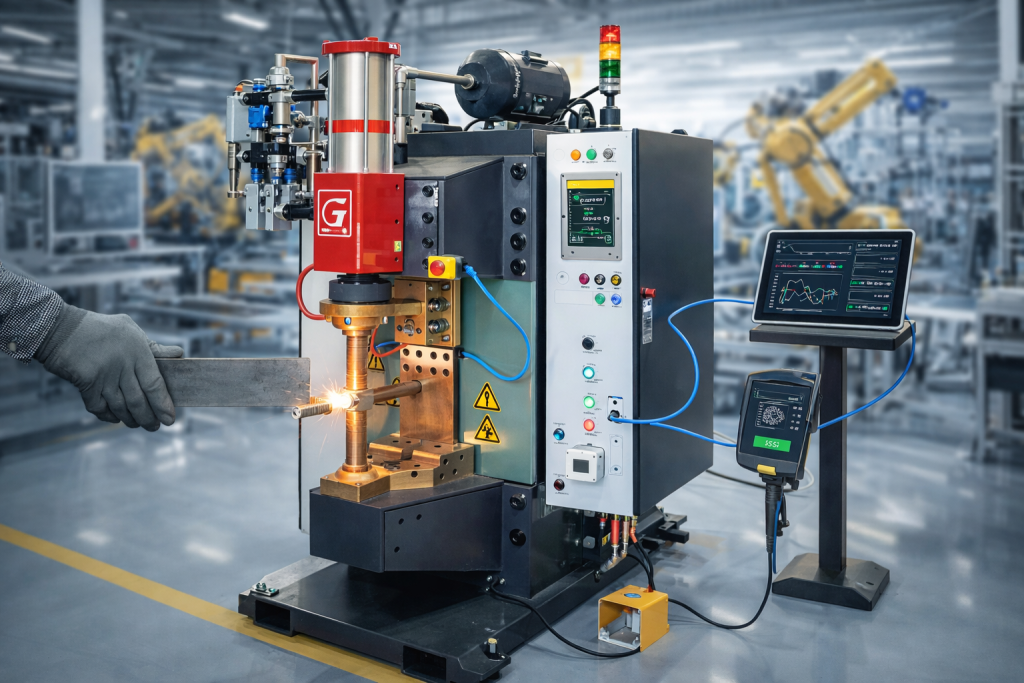
Portable spot welding equipment allows manufacturers to perform resistance spot welding directly at the assembly location while still using industrial-grade power supplies, controllers, and quality monitoring systems.
When integrated correctly, portable welding systems become part of the factory’s overall digital welding ecosystem rather than an isolated tool.
2. What Is Portable Spot Welding Equipment in Industrial Manufacturing?
In an industrial context, portable spot welding equipment refers to a mobile resistance welding system consisting of:
-
a portable welding gun system (manual or servo-assisted)
-
a portable MFDC or inverter power supply
-
an intelligent welding controller
-
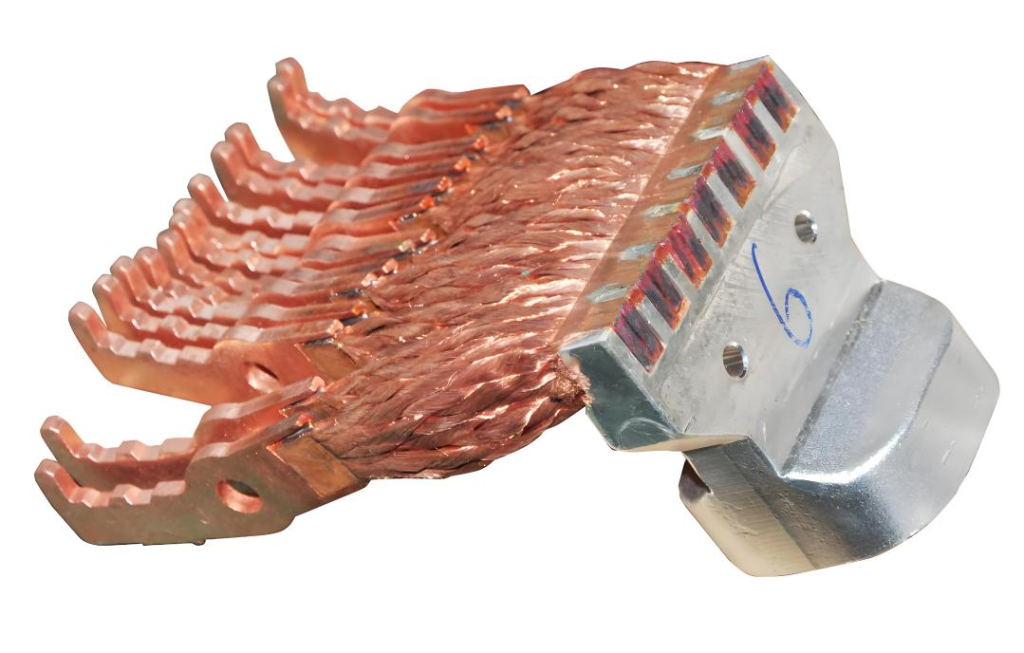
flexible cables, cooling, and mobility structure
Unlike light-duty handheld welders, an industrial portable resistance spot welder is designed to deliver:
-
controlled welding current
-
programmable squeeze and hold times
-
electrode force control
-
repeatable welding schedules
Portable vs. fixed spot welding stations
| Aspect | Portable spot welding equipment | Fixed spot welding station |
|---|---|---|
| Mobility | High – movable within the line | Fixed installation |
| Application | Line-side welding, repair, flexible cells | High-volume repetitive production |
| Integration | Can connect to MES and quality systems | Fully integrated |
| Investment | Lower than complete robotic cells | Higher system cost |
In smart factories, both systems coexist. Portable equipment fills the flexibility gap.
3. Key Industrial Applications of Portable Spot Welding Equipment
Automotive component manufacturing
Tier-1 and Tier-2 automotive suppliers use portable spot welding equipment for:
-
reinforcement welding after forming
-
bracket attachment
-
late-stage subassembly welding
-
repair of rejected parts before scrap
Because automotive production requires strict traceability, portable spot welding equipment with quality monitoring is increasingly demanded.
Home appliance and HVAC production
In appliance factories, portable welding systems are used for:
-
compressor shell components
-
washing machine frames
-
refrigerator cabinet structures
Production layouts change frequently, and mobile welding solutions reduce line modification costs.
Electrical cabinets and low-voltage assemblies
Manufacturers of:
-
switch cabinets
-
distribution boxes
-
electrical enclosures
use portable welding equipment to weld sheet metal parts after partial assembly, when parts are no longer easy to move to fixed welding stations.
Line-side repair and rework
A common smart factory use case is creating dedicated portable welding stations for:
-
defect repair
-
prototype welding
-
pilot production runs
4. Why MFDC Technology Is Ideal for Portable Spot Welding Equipment
What is MFDC in resistance welding?
MFDC stands for Medium Frequency Direct Current welding. In MFDC systems, the power supply converts input AC into a medium-frequency signal (typically around 1 kHz), then rectifies it to DC output.
Compared with traditional AC welding transformers, MFDC technology offers major benefits for portable spot welding equipment.
Stable welding current control
MFDC portable spot welding systems provide:
-
fast current rise time
-
high control resolution
-
minimal current fluctuation
This is especially important when welding:
-
coated steel
-
dissimilar thickness materials
-
high-strength steels
Stable current delivery directly improves nugget consistency.
Compact and lightweight power supply design
One practical advantage for mobile systems is size and weight.
MFDC power supplies are:
-
smaller
-
lighter
-
easier to integrate into mobile carts
This enables true mobile spot welding systems suitable for line-side operations.
Energy efficiency and power factor
MFDC systems typically achieve:
-
higher electrical efficiency
-
better power factor
-
reduced peak demand
For factories operating multiple portable welding units, MFDC helps reduce:
-
line loading
-
transformer oversizing
-
electrical infrastructure upgrades
Compatibility with advanced controllers
MFDC power supplies work seamlessly with modern industrial resistance welding controllers, which enables:
-
adaptive current control
-
process data acquisition
-
closed-loop quality monitoring
5. Core Components of an Industrial Portable Spot Welding System
A professional portable spot welding system is not only a welding gun.
Portable welding gun system
Industrial portable welding guns include:
-
C-type and X-type configurations
-
manual and servo-assisted models
-
water-cooled electrode holders
For advanced applications, servo-controlled portable welding guns allow precise electrode force control and repeatable squeezing behavior.
Portable MFDC spot welding power supply
The MFDC power unit provides:
-
programmable current output
-
high duty cycle
-
stable current regulation
Intelligent resistance welding controller
The controller manages:
-
current waveform
-
welding schedules
-
force synchronization
-
monitoring parameters
It also acts as the interface between the welding equipment and the factory network.
Mobility and cable management
Industrial portable spot welding equipment must include:
-
flexible, high-current cable assemblies
-
ergonomic support arms
-
safe cable routing
-
compact mobile frames
Poor cable management is one of the main causes of operator fatigue and unstable welding results in mobile applications.
6. Intelligent Welding Controllers for Portable Spot Welding Equipment
Modern smart factories require portable welding systems to use the same digital control architecture as robotic welding cells.
Real-time parameter control
Advanced controllers support:
-
current feedback control
-
dynamic compensation for electrode wear
-
precise squeeze and hold time control
This ensures consistent weld formation even when:
-
operator handling varies
-
welding positions change frequently
Welding program management
Portable systems often store:
-
multiple welding schedules
-
product-specific parameter sets
-
access-controlled recipe libraries
This prevents incorrect parameter selection and supports standardized production procedures.
Data acquisition and traceability
Controllers can record:
-
actual current curves
-
welding time
-
fault events
-
electrode force values
These datasets can be transferred to factory servers for:
-
quality audits
-
process analysis
-
traceability documentation
7. Quality Monitoring in Portable Spot Welding Equipment
Why quality monitoring is essential in mobile welding
One common concern in portable welding operations is operator dependency.
Without monitoring, variations in:
-
positioning
-
pressure application
-
electrode condition
can directly affect weld quality.
Real-time weld quality monitoring
Advanced portable spot welding equipment supports:
-
current and voltage monitoring
-
dynamic resistance evaluation
-
process window supervision
The system continuously compares actual welding behavior with predefined quality windows.
Nugget consistency control
Through resistance curve analysis, the system estimates:
-
heat input
-
melting behavior
-
nugget growth stability
If abnormal behavior is detected, the controller can:
-
generate alarms
-
block part release
-
request corrective action
Defect prevention and early warning
Monitoring systems can identify:
-
electrode sticking
-
spatter formation tendencies
-
surface contamination
-
poor contact resistance
This supports proactive maintenance and prevents large batches of defective parts.
8. Integration of Portable Spot Welding Equipment into Automation and Robotic Cells
Portable welding systems are increasingly used inside flexible automation environments.
Portable welding system integration with production lines
Modern portable spot welding equipment supports:
-
digital I/O for line communication
-
barcode or RFID triggers
-
recipe selection via MES commands
This allows portable systems to operate as controlled production stations.
Use in robotic workstations
In hybrid cells, portable welding guns may be:
-
mounted on collaborative robots
-
used as auxiliary welding tools
-
shared between workstations
MFDC portable spot welding equipment provides the necessary current stability for such robotic operations.
Connectivity with factory MES
Integration enables:
-
automatic job selection
-
welding record upload
-
quality reporting
-
equipment utilization analysis
This is an important requirement for Industry 4.0 deployment.
9. Performance Requirements for Industrial Portable Spot Welding Equipment
High current and short cycle times
Industrial portable systems must support:
-
high peak currents
-
short welding times
-
stable current ramps
This is essential for maintaining takt time on fast production lines.
Consistent quality in mixed production
Smart factories often run:
-
different materials
-
multiple product variants
-
frequent changeovers
Portable welding equipment must support fast recipe switching and stable performance across different setups.
Mechanical rigidity and ergonomics
A portable welding gun must provide:
-
balanced weight distribution
-
stable arm structures
-
smooth electrode alignment
This directly affects operator fatigue and welding repeatability.
Reliability in continuous operation
Unlike maintenance tools, production portable welding equipment operates continuously across multiple shifts. Components must be rated for:
-
high duty cycle
-
thermal stability
-
long-term electrode life
10. Safety and Compliance Considerations in Portable Spot Welding Systems
Industrial portable welding systems must comply with:
-
electrical insulation requirements
-
protective earth standards
-
emergency stop integration
Additional considerations include:
-
water cooling leak detection
-
cable protection
-
mechanical guarding for moving gun parts
In smart factory deployments, safety interlocks are often integrated with the line PLC.
11. How to Select the Right Portable Spot Welding Equipment for Smart Factories
Define application and material requirements
Start by analyzing:
-
sheet thickness range
-
material types
-
joint access conditions
This defines current capacity and gun geometry.
Select the appropriate MFDC power system
MFDC portable spot welding equipment should be selected based on:
-
required peak current
-
duty cycle
-
electrical infrastructure limits
Controller and monitoring capability
Choose controllers that support:
-
real-time monitoring
-
resistance curve evaluation
-
network connectivity
Without digital monitoring, portable welding equipment will not meet smart factory expectations.
Automation and future expansion
The system should support:
-
robot compatibility
-
MES connectivity
-
modular expansion
This protects future production flexibility.
12. Typical Use Cases of Portable Spot Welding Equipment in Modern Manufacturing
Line-side reinforcement stations
Portable spot welding systems are installed at dedicated stations to perform:
-
structural reinforcements
-
bracket additions
-
corrective welding
Prototype and pilot lines
R&D and process engineering departments use portable welding equipment to validate:
-
new materials
-
new joining layouts
-
new electrode designs
Flexible manufacturing cells
Portable welding equipment is shared between multiple workstations to support:
-
low-volume, high-mix production
-
custom assemblies
-
short product life cycles
13. Why Solution-Based Portable Spot Welding Systems Matter for Smart Manufacturing
Simple standalone portable welders lack:
-
quality monitoring
-
data connectivity
-
parameter traceability
In contrast, solution-based systems integrate:
-
MFDC power supplies
-
intelligent controllers
-
digital quality monitoring
-
automation connectivity
Companies such as Heron Welder design portable resistance welding systems as part of complete manufacturing solutions. This approach ensures that mobile welding equipment delivers the same process reliability and digital transparency as fixed welding cells.
For manufacturers pursuing smart factory implementation, portable welding equipment must not be treated as a temporary tool, but as a controlled production asset.
Conclusion: Building Flexible and Intelligent Joining Processes with Portable Spot Welding Equipment
Portable spot welding equipment plays a growing role in modern smart factories. When supported by MFDC technology, intelligent controllers, and real-time quality monitoring, mobile welding systems can achieve:
-
stable welding performance
-
traceable production data
-
flexible deployment across production lines
For automotive, appliance, HVAC, and electrical equipment manufacturers, this combination enables a more adaptive joining strategy without compromising quality control.
By integrating portable resistance welding systems into digital factory infrastructures following solution-oriented practices adopted by industrial providers such as Heron Welder –manufacturers can build flexible, reliable, and data-driven welding processes that fully support the next generation of smart manufacturing.